Lumber is sold under familiar nominal names, but measured width and thickness depend on product category and condition. A nominal size is a label, not a tape-measure reading. For framing and layout, use the dressed dimensions that match the product and standard.
Selected softwood sizes
These examples come from the 2026 NIST Handbook 130 table for softwood lumber. Dry and unseasoned sizes are separate. They are minimum dressed dimensions at manufacture under the cited product-standard context; they do not describe every rough, surfaced, remanufactured, or aged board.
| 1 x 4 | 3/4 x 3 1/2 | 25/32 x 3 9/16 |
|---|---|---|
| 1 x 6 | 3/4 x 5 1/2 | 25/32 x 5 5/8 |
| 2 x 4 | 1 1/2 x 3 1/2 | 1 9/16 x 3 9/16 |
| 2 x 6 | 1 1/2 x 5 1/2 | 1 9/16 x 5 5/8 |
| 2 x 8 | 1 1/2 x 7 1/4 | 1 9/16 x 7 1/2 |
| 2 x 10 | 1 1/2 x 9 1/4 | 1 9/16 x 9 1/2 |
6 rows
Scroll horizontally to view all columns.
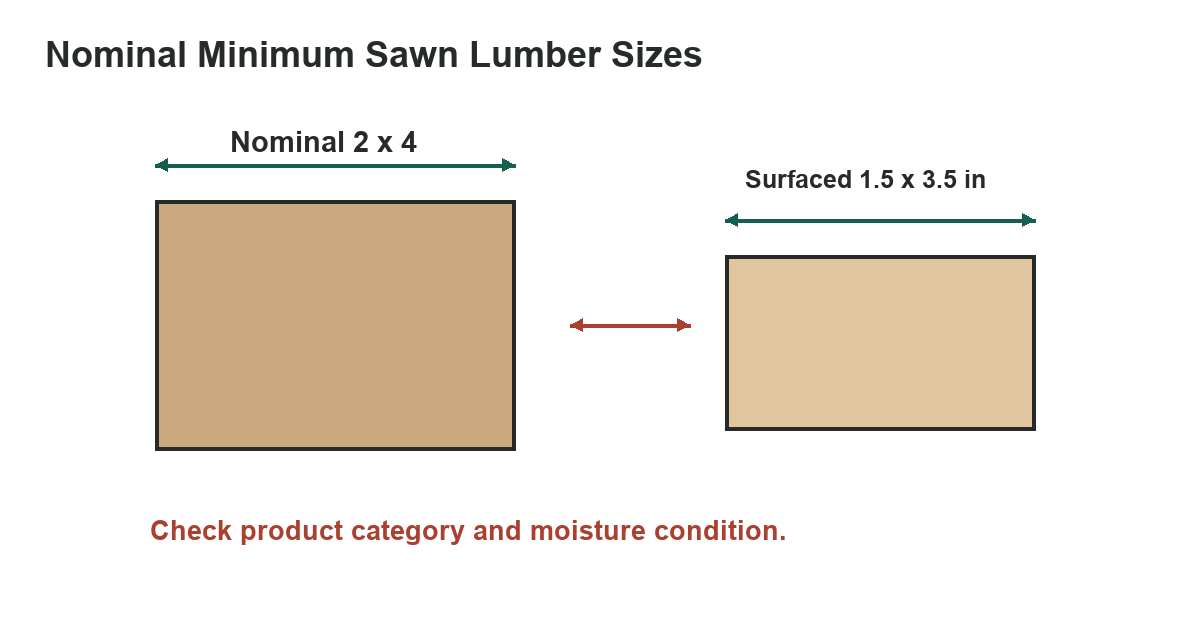
A nominal 2 x 4 dry board is listed at 1 1/2 x 3 1/2 inches. The unseasoned minimum is 1 9/16 x 3 9/16 inches. Measure the board you have when fitting a part or checking a tight clearance.
Why actual dimensions are smaller
Nominal dimensions came from rough lumber sizes before drying and surfacing. Drying removes moisture and surfacing removes material, so a dressed board is smaller than its nominal label. Moisture changes can also alter dimensions after manufacture.
NIST distinguishes softwood lumber from retail hardwood lumber, which has separate categories and minimum surfaced-size rules. Do not apply this softwood table to hardwood, rough stock, engineered panels, or a product with a different specification.
The unseasoned column is not permission to assume a board will stay at that size as it dries. Moisture movement can change width and thickness, with larger cross-grain movement than lengthwise movement. For close-fitting joinery, acclimate and measure the actual piece, and allow for movement where the design requires it.
Measure before cutting or ordering
For a replacement, record the nominal label and measure actual thickness and width. Note whether the board is rough or surfaced and whether its moisture condition affects the fit. The nominal name helps when shopping; the actual measurement matters for a joint, shelf opening, or machine fence.
When a size is near a tolerance limit, check the governing product standard and the lot you are buying. A reference minimum describes the standard’s boundary in its stated context, not the exact dimension of every retail piece. For a project with interchangeable parts, consistent measuring tools and a single reference surface help prevent small size differences from accumulating.
For layout, distinguish a board’s nominal label from its finished cross-section in drawings and cut lists. If a plan calls for a true 2-inch thickness, a nominal 2-inch board will not meet that dimension after surfacing; specify the actual size or choose stock that can be milled to it. Confirm available stock before designing a tight assembly around a standard name.
Dimensions in the table are widths and thicknesses, not lengths. Lumber lengths are sold in separate increments and can include trimming allowance, so verify both the length and any end condition needed for the project. A measurement chart cannot establish straightness, grade, moisture content, or suitability for a structural span.
Do not compare a rough-sawn dimension directly with a minimum dressed dimension: the surfaces have undergone different processing. If you need to remove material during milling, start with stock large enough to finish at the required measurement and account for defects and flattening. Ask the seller how the material was surfaced when its condition is unclear.
- Use measured width and thickness for clearances and joinery.
- Keep dry and unseasoned sizes separate.
- Check whether the product is softwood, hardwood, rough, or engineered.
- Verify specialty products against their own current specifications.
- Do not infer grade, strength, or span capacity from nominal dimensions.
Plan with workbench dimensions, compare top materials, and browse other size charts.
References
Review NIST Handbook 130 (2026), the American Wood Council explanation, and the USDA chapter on commercial lumber.