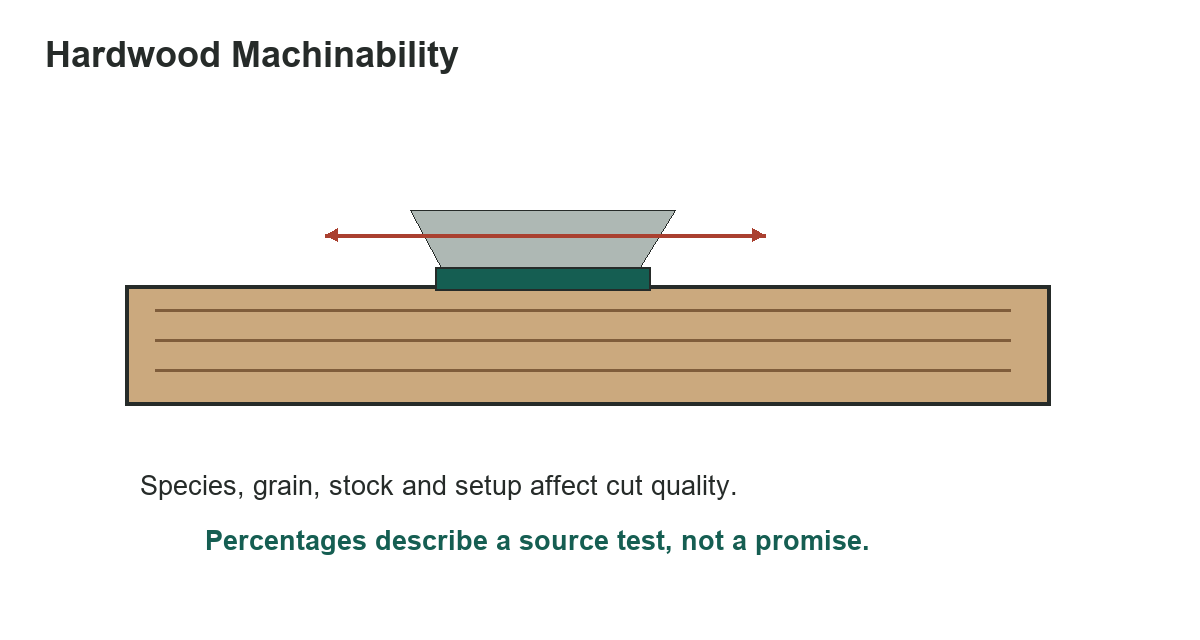
Machinability is not one universal score. A species may plane cleanly yet perform differently in turning, boring, or sanding. Results also depend on grain, moisture, defects, tool condition, feed, and the job’s quality target.
Selected historical test results
This table summarizes four operations for six hardwoods. Each column has its own result category: perfect planing, fair-to-excellent turning, or good-to-excellent boring and sanding. Read each column on its own; the percentages are not interchangeable across operations.
| Ash | 75 | 79 | 94 | 75 |
|---|---|---|---|---|
| Beech | 83 | 90 | 99 | 49 |
| Hickory | 76 | 84 | 100 | 80 |
| Maple, hard | 54 | 82 | 99 | 38 |
| Oak, red | 91 | 84 | 99 | 81 |
| Oak, white | 87 | 85 | 95 | 83 |
6 rows
Scroll horizontally to view all columns.
The source defines the figures as the percentage of pieces attempted that met the stated quality requirement. An ellipsis means the source does not report a value for that cell, not zero percent. A high percentage is not a guarantee for a particular board or machine.
Choose the operation, not a single winner
For a planed face, check the planing column and the surface threshold. For a turned part, use the turning result as historical context, then consider grain runout, blank balance, and lathe setup. Boring and sanding have separate outcomes. The table does not establish an overall ranking for every task.
These values come from Table 3-8 of the 1999 USDA Forest Products Laboratory Wood Handbook and are comparative historical results. The source reports the percentage of tested pieces meeting each operation’s own quality threshold. Current Forest Products Laboratory chapters provide updated context on wood properties and commercial lumber, but neither guarantees results for retail stock.
The labels matter when reading a percentage. For example, a high boring result means many tested pieces met the source’s boring-quality threshold; it does not mean the wood is easy to machine in every operation. A separate planing result uses its own acceptance standard, and should not be averaged with turning, boring, or sanding to create a new score.
The selected rows are examples, not an exhaustive list of domestic hardwoods. Common names and commercial groups should be checked against the stock supplier’s identification, particularly when appearance or strength is important. If a species is uncertain, do not assume that a familiar trade name maps cleanly to one row in this historical test table.
What changes the shop result
Confirm the actual species and cut; common names can cover different commercial groups. Inspect grain direction, knots, checks, and moisture. A dull or unsuitable cutter can tear fibers that a sharp tool would cut cleanly. Feed and support also affect chip-out, burning, and surface finish.
For a repeatable comparison, use similar stock dimensions and moisture, a sharp cutter, consistent machine settings, and the same acceptance rule. Record the setup and make a test cut. If a cut is unsafe or the work cannot be supported securely, change the setup instead of relying on a species percentage.
Tool geometry and grain orientation are especially important near reversing grain or figured areas. A light finishing pass, suitable feed direction, and adequate work support can improve the result, but follow the tool manufacturer’s safe operating instructions. The source percentages cannot account for a specific cutter profile, machine alignment, or operator technique.
When selecting stock for a finished surface, consider the entire process: rough milling, joinery, shaping, sanding, and the intended coating. A species that performs well in one operation may still need extra care at another stage. Make a representative test piece using the same cutter, feed, and finishing sequence before committing a large or valuable blank.
Use the chart to form a question for the next test, not to skip the test. If results differ from the reference, inspect moisture, grain, tool sharpness, and feed before concluding that the table is wrong. Keep the machine’s guards and workholding in place, and stop if the stock cannot be controlled safely.
- Match the table column to the operation.
- Do not treat a missing cell as zero.
- Inspect grain and defects on the actual blank.
- Use the machine maker’s instructions.
- Test on scrap before committing valuable stock.
Compare workbench-top species, see the table-saw guide, and review bandsaw options.
References
The machining percentages are from the USDA Forest Products Laboratory Wood Handbook (1999), Table 3-8. For current background, see the Forest Products Laboratory chapters on wood properties and commercial lumber.