A wood-weight chart is a planning reference, not a promise about an individual board. The same species can weigh differently as moisture changes, and density varies among trees and pieces. Check the condition and units before estimating a lift, shipment, or storage load.
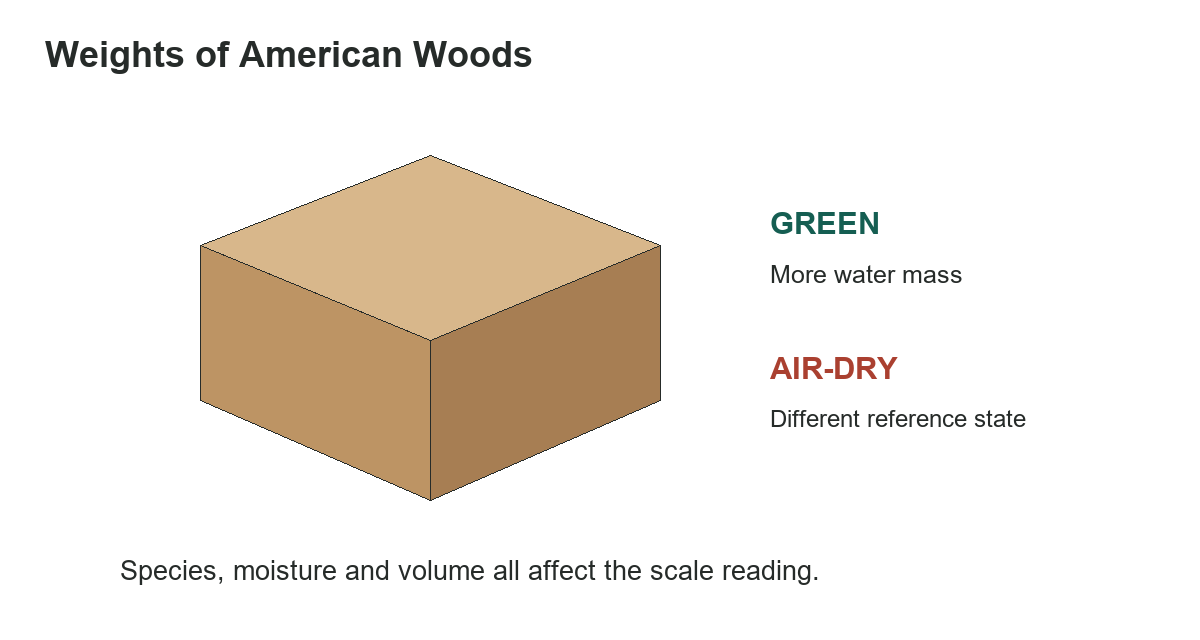
Green and air-dry are different
The table gives selected pounds-per-cubic-foot values under the source headings green and air-dry. Green wood contains water within the material. Air-dry is another reference condition; it is not oven-dry and does not identify one guaranteed moisture percentage for every species and board.
Density and weight are related but not identical concepts in everyday use. Density expresses mass per volume under a defined volume and moisture basis; a board’s scale weight also depends on its actual dimensions. The chart’s pounds-per-cubic-foot convention is useful for an estimate, but avoid substituting it for a supplier’s measured shipping weight when a handling limit is close.
| Alder, red | 46 | 28 |
|---|---|---|
| Ash, black | 52 | 34 |
| Basswood | 42 | 26 |
| Beech | 54 | 45 |
| Birch | 57 | 44 |
| Douglas fir, coast region | 38 | 34 |
| Maple, sugar | 56 | 44 |
| Oak, red | 64 | 44 |
| Pine, ponderosa | 45 | 28 |
| Walnut, black | 58 | 38 |
10 rows
Scroll horizontally to view all columns.
For a rough estimate, multiply a matching density by the board’s volume in cubic feet. Use measured dimensions: a nominal 2-by-4 is not a 2-by-4-inch rectangle. The answer is still approximate because the chart values are rounded and your board may be wetter or drier.
Moisture changes the scale reading
The USDA Forest Products Laboratory describes wood as hygroscopic: it exchanges moisture with surrounding air. Its moisture content is calculated relative to oven-dry wood mass, and density depends on the volume basis used. A chart should state whether the reference is green volume, 12-percent moisture volume, or another condition.
The Forest Products Laboratory source defines air-dry as 12% moisture content. That is a reference condition, not a guarantee for every board: species, growth, storage, and actual moisture affect weight. Use these rounded figures for comparisons, then measure actual stock when a load limit matters.
Volume basis matters too: wood shrinks as it dries, so a value calculated using green volume can differ from one using a smaller dry volume even for the same wood substance. That is why a density figure is meaningful only with its stated condition and basis. This chart preserves its original headings rather than silently converting them to another standard.
When estimating a stack, calculate each piece from actual width, thickness, and length, then multiply by a condition-matched value. Add pieces after estimating them individually if the stock has mixed sizes. Include packaging and hardware separately, and leave margin for variability; a species average should not be used to decide whether a hoist, shelf, trailer, or vehicle is within its rated limit. Weighing the finished load is better when capacity is tight.
For shop planning, weight can still help compare alternatives. A lighter species may reduce the effort of moving a panel, while a denser species can change the total load on a bench or storage rack. The chart supports a first-pass comparison only. Weigh the finished assembly or use reliable product data whenever a lifting or support limit is important.
Estimate a board carefully
Measure width, thickness, and length, then calculate cubic feet. Choose a density only when its reference condition reasonably matches the material. Wet, freshly sawn, treated, or unusually dense stock can differ from a generic species average. A scale gives the most direct reading for a piece that can be weighed safely.
- Keep lb/ft3 distinct from pounds per board foot.
- Use actual dimensions for volume.
- Record green, air-dry, or measured moisture condition.
- Allow for variation within a species.
- Use a scale or supplier data for critical lifting limits.
Compare species for a workbench top, plan around available workbench space, and browse the reference chart library.
References
Weight values are selected from the USDA Forest Products Laboratory Technical Note 218, Weights of Various Woods Grown in the United States, which defines air-dry at 12% moisture content. For current background, see USDA chapters on wood moisture and physical properties and commercial lumber.