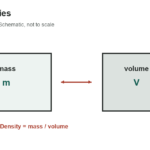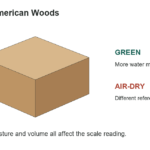
Wood density changes as moisture content changes because added water increases mass. The USDA Forest Products Laboratory (FPL) gives a direct relationship when basic specific gravity is known and moisture content is above approximately 30%, near the fiber-saturation point. The examples below apply that formula to two illustrative specific-gravity values; they are calculations, not lookup values for particular species. For related woodworking references, see our workbench wood guide, table-saw guide, and wood-screw chart.
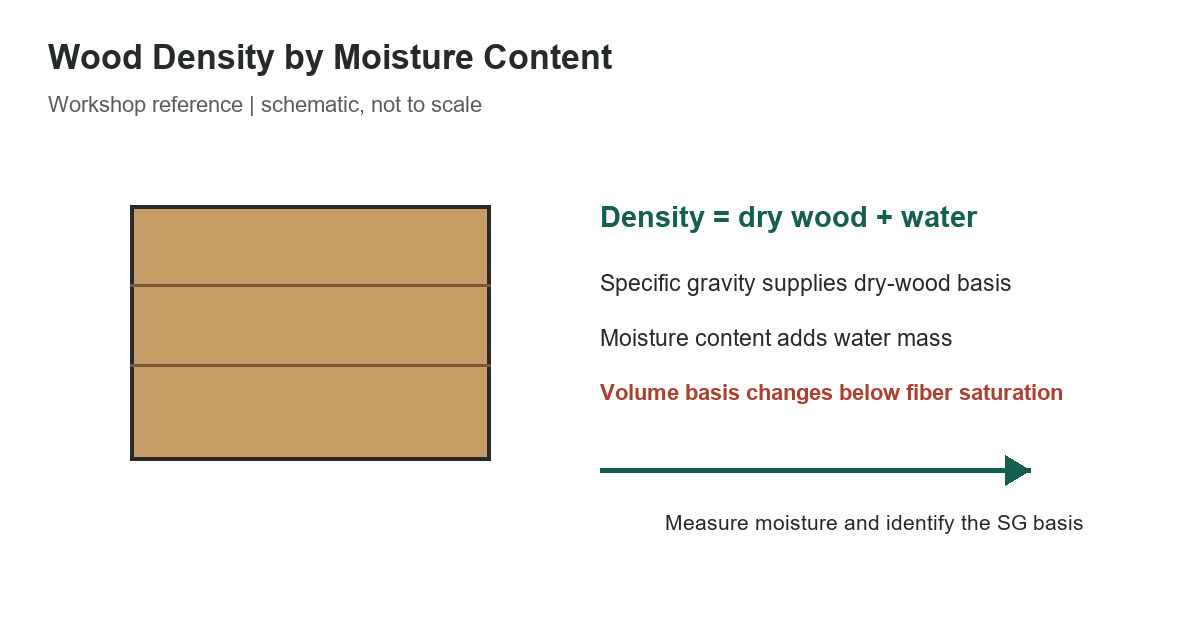
Formula and calculated examples
For moisture content M above approximately 30%, the FPL equations are density in kilograms per cubic metre = 1,000 x Gb x (1 + M/100), or density in pounds per cubic foot = 62.4 x Gb x (1 + M/100). Here, Gb is basic specific gravity based on oven-dry mass and green volume. M is a percentage, so a value of 50% is entered as 50/100, not as 0.50 in the percentage term.
[gs_table id=”10879″]
For example, with Gb = 0.50 and M = 50%, density is 62.4 x 0.50 x 1.50 = 46.8 lb/ft^3, or 750 kg/m^3. The metric form is calculated directly as 1,000 x 0.50 x 1.50. Differences in the last displayed digit can occur when converting a rounded customary-unit result; the metric column is calculated from the equation independently.
Know which specific gravity you have
The formula requires basic specific gravity, not an arbitrary specific-gravity figure copied from a table without checking its volume basis. FPL distinguishes basic specific gravity from specific gravity based on volume at the current moisture content. At or above the approximate fiber-saturation point, green volume can be used for this relationship. Below about 30% moisture, wood shrinks as it dries, so current volume changes and the simple above-fiber-saturation equation is not the complete calculation.
If the board is below 30% moisture, use the FPL’s shrinkage-aware method or a species-appropriate density table at the target moisture content. Do not extend the linear formula downward and assume it accounts for volume shrinkage. Moisture content is conventionally expressed relative to oven-dry wood mass, so values can exceed 100%; 100% means the water mass equals the oven-dry wood mass, not that the wood is half water by volume.
Use the result carefully
This calculation estimates density from a representative basic specific gravity and moisture content. A real piece may differ because of species, growth conditions, heartwood or sapwood, defects, extractives and measurement error. A single board can also have a moisture gradient from surface to core. For load, shipping or kiln decisions, measure representative samples with an appropriate method and use the applicable engineering or industry procedure.
To estimate a piece’s mass, multiply density by volume using consistent units. In customary units, pounds per cubic foot times cubic feet gives pounds. In SI, kilograms per cubic metre times cubic metres gives kilograms. Board-foot volume is not cubic-foot volume: one board foot is 1/12 cubic foot nominally, before accounting for actual finished dimensions. Convert the dimensions first and keep moisture and volume basis consistent.
The examples use Gb values of 0.50 and 0.60 to demonstrate the arithmetic. They do not identify a species, predict strength, or replace the wood’s measured moisture content. A density estimate alone cannot establish safe load capacity, fastener withdrawal resistance or drying schedule. Those require additional properties, dimensions and design conditions.
For a repeatable shop estimate, record the species identification if known, measurement method, sample location, moisture reading, specific-gravity source and volume basis. When moisture is near 30%, uncertainty about shrinkage basis matters more; use the FPL chapter’s method and do not imply that the transition is an exact universal threshold for every specimen.
Sources
The USDA Forest Products Laboratory’s Wood Handbook Chapter 3 supplies Equations 3-6a and 3-6b and explains the below-30% shrinkage adjustment and above-fiber-saturation volume basis. All displayed rows are new calculations from those equations.