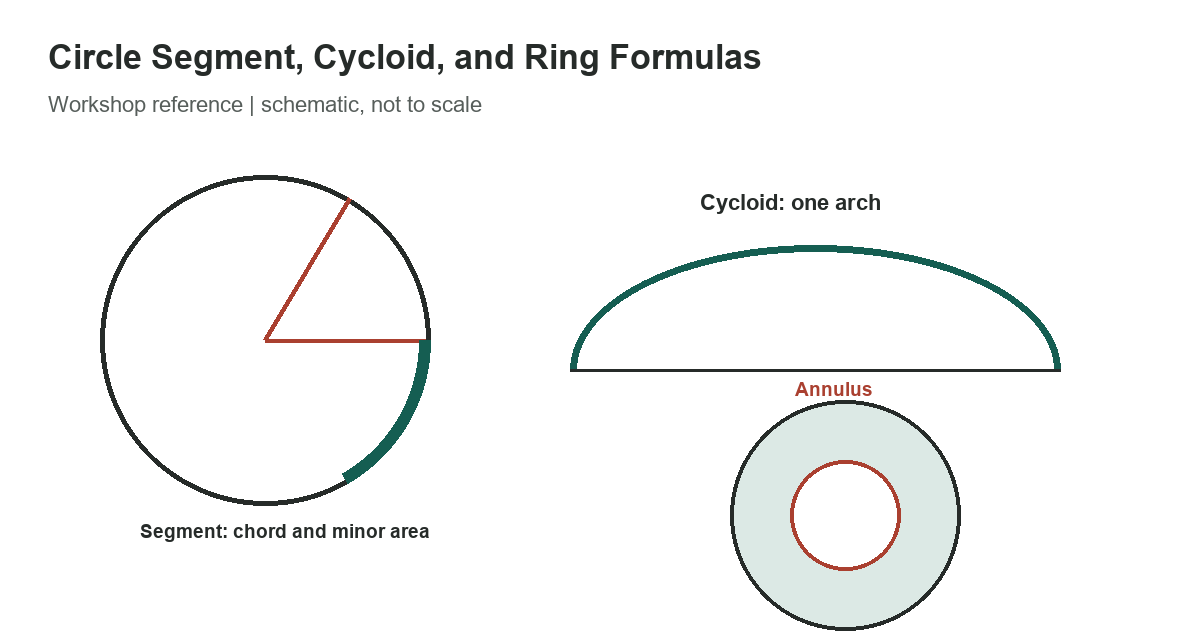
These formulas cover three useful geometry cases: a circular segment cut off by a chord, one arch of a cycloid, and the area of a full circular ring. They are intentionally separated from sector-area lookup. For adjacent formula references, see circle and sector formulas, polygon area formulas, and our garage workshop guide.
Selected formulas
In the table, all lengths use a consistent unit system. The angle theta is in radians. The circle-segment expressions use the minor central angle and describe the minor segment between a chord and its arc. The cycloid quantities refer to one complete arch generated by a circle of radius a rolling without slipping along a straight baseline.
[gs_table id=”10883″]
Circle segment: connect chord, radius and angle
For a circle of radius r and central angle theta, the chord length is 2r sin(theta/2). The area between that chord and the minor arc is the sector area minus the isosceles triangle area: one-half r squared times theta, less one-half r squared sin(theta). Combining those terms gives A = r^2(theta – sin theta)/2. If the angle is supplied in degrees, convert it to radians before using the formula: radians = degrees x pi/180.
As a check, at a right angle theta = pi/2, the chord is r times square root of 2 and the segment area is r^2(pi/4 – 1/2). As theta becomes small, the chord approaches r theta, while the segment area becomes small much faster. Do not use the minor-segment expression with a reflex angle unless you intentionally reformulate which region is being measured.
Cycloid: one arch only
A cycloid is traced by a point on the rim of a circle rolling without slipping. For one arch, the generating circle advances one circumference along the baseline. The enclosed area is three times the circle area, 3pi a^2, and the arc length is 8a. These compact results rely on the standard cycloid parameterization and refer to one arch, not an arbitrary segment or several repeated arches.
Use the generating-circle radius consistently. If a drawing gives the diameter, convert it to a = diameter/2 before evaluating either result. The length has the same units as a; area has squared units. If a curve is truncated before the arch ends, calculate the desired parametric interval rather than applying the complete-arch result.
Ring area: subtract the inner disk
A full circular ring is the larger disk minus the hole: pi R^2 – pi r^2. For example, radii of 10 mm and 6 mm give pi(100 – 36), or 64pi mm^2. If the dimensions are diameters, halve them first. If the drawing describes only part of the ring, this full-ring formula does not account for an angular sector; that is a separate geometry problem.
Check that outer radius R is at least as large as inner radius r. If both are equal, the ring area is zero; if the reported inner radius is larger, a dimension or label has likely been reversed. Keep a drawing’s radius, diameter, chord, arc and included angle labels distinct, and annotate whether the angle is measured in radians or degrees before substituting values.
These are ideal geometric relationships. They do not account for kerf, clearance, material thickness, corner radii or manufacturing tolerances. For a physical part, define the measured boundary and the required tolerance separately, then verify the final dimensions with appropriate inspection tools. The formulas provide the nominal geometry only.
Sources
The University of Texas at Austin and MIT calculus materials cover parametric curves and arc length. The displayed circle and ring formulas follow standard sector, triangle and disk-area relationships; the scope notes specify the angle and complete-arch assumptions.