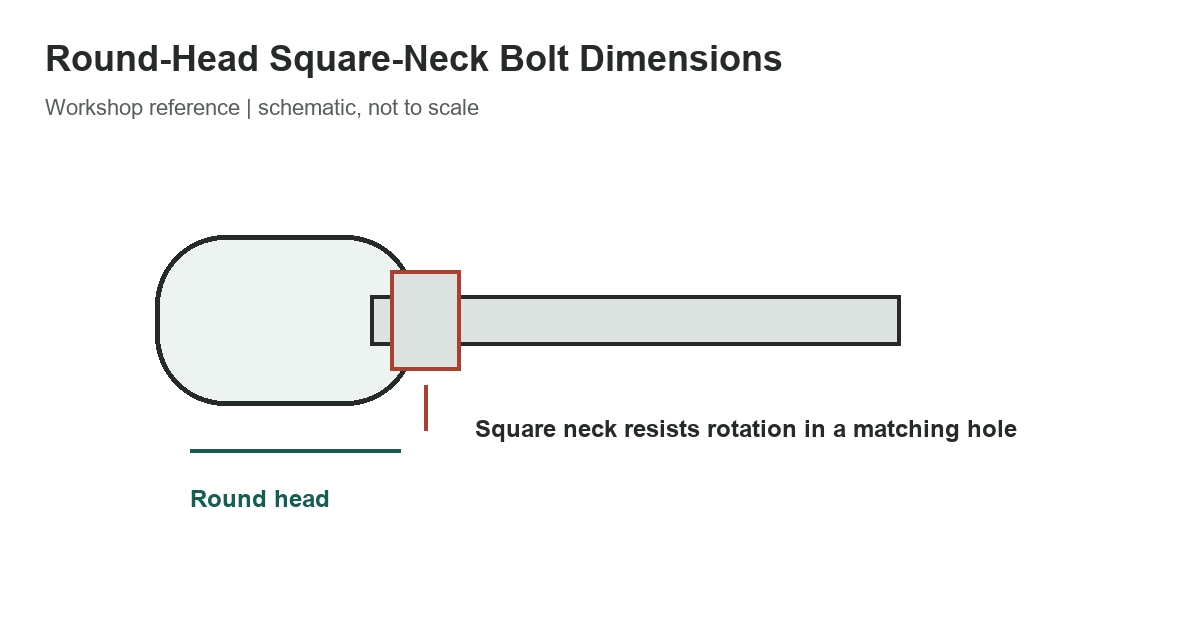
A round-head square-neck bolt, often called a carriage bolt, combines a domed head with a square section directly under the head. In a correctly sized square hole or formed seat, the neck helps resist rotation while the nut is tightened. The table gives a few inch-series dimensions for identification and fit checks; it is not a strength rating or a substitute for the complete standard.
Selected dimensions
ASME B18.5 covers inch-series round-head bolts, including square-neck forms. The listed body, head and square-neck dimensions are bounded ranges, not single target measurements. A real bolt can sit anywhere within the specified limits, and plating or coating allowances can affect the thread fit. Check the applicable standard edition and the manufacturer’s product data for the exact bolt type.
[gs_table id=”10821″]
How the square neck fits
The square neck is a retention feature, not a universal anti-rotation guarantee. It needs a matching opening, material thickness and seating geometry. In wood, the neck is drawn into a suitable prepared seat as the nut is tightened. In metal, a formed or punched square hole may be used when the design permits it. A round oversized hole will not capture the neck merely because the bolt head is round.
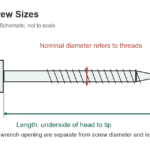
Before replacing a fastener, compare nominal diameter, thread series, length measured from under the head, head clearance and the square-neck width and depth. Do not identify a bolt by head diameter alone. Similar-looking elevator bolts, step bolts and other round-head products have different head shapes or dimensions. A matching nominal size does not establish that a replacement has the right grade, material, coating or mechanical properties.
Measurement and ordering checks
Use calipers for the head and neck, and a thread gauge for pitch or threads per inch. Measure the body on an unthreaded shank when available; do not measure across thread crests and call it the body diameter. Record fractional inch size and decimal measurement together. If a mating square opening is already present, measure its across-flat dimension and depth, then compare them with the bolt and its intended seating method.
Specify the product by standard, nominal size, thread, length, material or property class, and finish where known. Ask the supplier to confirm a nonstandard or partially identified fastener. Do not infer allowable load, torque or corrosion resistance from these dimensional examples. Those depend on the complete fastener specification, joint design, installation and environment.
When measuring a square neck, keep the caliper jaws parallel to its flats. A corner-to-corner measurement is larger and is not the width used to judge a square hole. Check the neck depth as well as width: if it cannot seat fully, the head may stand proud or the neck may fail to engage. If the bolt is already installed, inspect the mating surface for deformation before reusing it.
Length conventions matter. For a round head, measure nominal bolt length from the bearing surface under the head to the end of the shank. Do not include the domed head in that length. Compare the required grip length, washer stack, nut engagement and any unthreaded shoulder with the assembly drawing. A longer bolt is not automatically safer; excess protrusion can interfere with moving parts or leave too little thread engagement when the nut bottoms.
The standard also distinguishes related head styles. A step bolt has a larger head, while an elevator bolt is flatter. The square neck may look similar across these products, but head height, bearing area and intended application differ. Match the drawing or part identification before ordering substitutes. If the fastener carries a structural load, replace it only under the responsible engineer’s or equipment maker’s specification.
For related measurements, see the bolt and wrench-size chart, the metric socket-head cap-screw dimensions, and the wood-screw size reference.
Sources
ASME B18.5-2012 (R2023) defines the inch-series dimensional standard and its scope. Fastenal’s product listings help distinguish stocked round-head square-neck bolt forms. Always confirm the exact specification for the part being purchased.