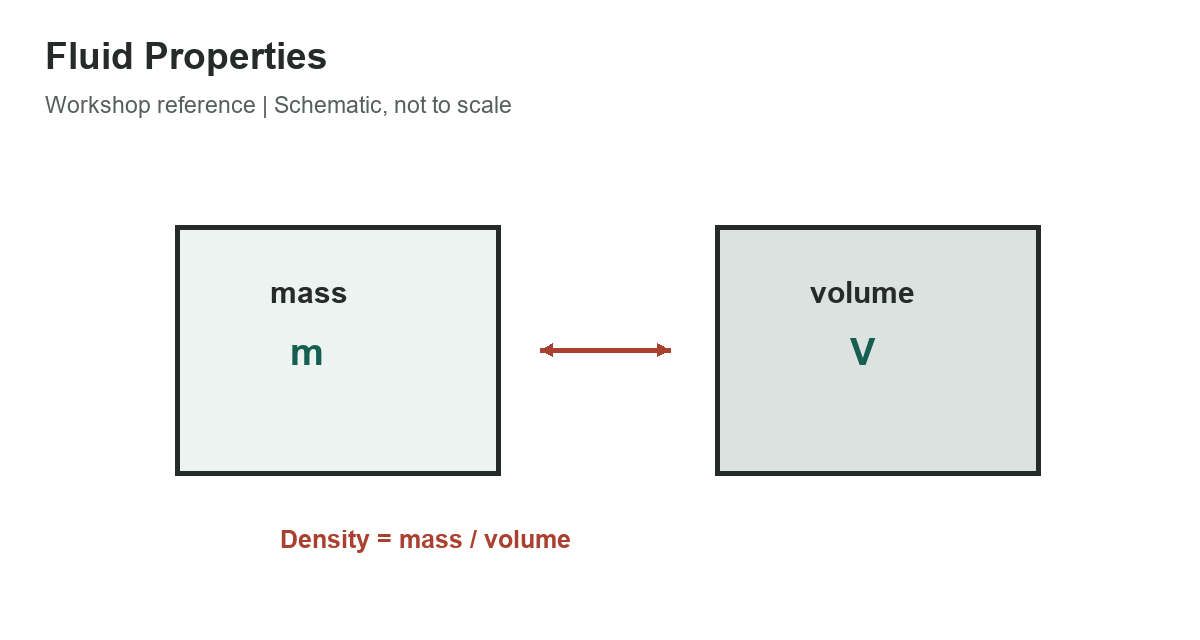
Fluid-property equations are simple, but their units and reference conditions matter. Mass density is mass per volume; specific weight is weight per volume; specific volume is the reciprocal of mass density; and specific gravity is a dimensionless ratio to a stated reference fluid. Confusing mass density with specific weight is a common source of unit errors in pressure and flow calculations.
Use the right quantity
The table collects the core relationships and common units. In SI, density is measured in kilograms per cubic metre and specific weight in newtons per cubic metre. The relation gamma = rho g converts between them using gravitational acceleration. In U.S. customary calculations, distinguish pound-mass from pound-force and use a consistent gravitational conversion constant when equations require it.
| Mass density | rho = m / V | kg/m^3; lbm/ft^3 |
|---|---|---|
| Specific weight | gamma = rho g | N/m^3; lbf/ft^3 |
| Specific volume | nu = V / m = 1/rho | m^3/kg; ft^3/slug |
| Specific gravity | SG = rho / rho_ref | Dimensionless |
| Dry-air estimate | rho = 1.325 B / T | lbm/ft^3; B in inHg, T in deg R |
5 rows
Scroll horizontally to view all columns.
Specific volume nu is volume divided by mass, so nu = 1/rho when both use consistent units. Specific gravity has no units. For liquids, the reference is commonly water at a stated temperature; for gases, the reference may be air at stated standard conditions. Always read the reference conditions because density changes with temperature and pressure.
Check an air-density estimate carefully
The dry-air relation in the table comes from the historical handbook and uses barometric pressure B in inches of mercury and absolute temperature T in degrees Rankine to estimate density in pounds-mass per cubic foot. It is an approximate relation for dry air, not a universal equation of state. Temperature must be absolute; using degrees Fahrenheit directly gives a meaningless result.
For an illustration, at 29.92 inHg and 491.67 degrees Rankine, the relation gives about 0.0806 lbm/ft3, close to the handbook’s rounded standard-condition reference of 0.08073 lbm/ft3. Humidity, nonstandard conditions, and gas compressibility can change the value. For compressed air or high-accuracy work, use property data at the actual pressure and temperature rather than this approximate line.
Keep mass and force separate
In SI, a kilogram is a mass unit and a newton is a force unit. In customary engineering, lbm and lbf are different quantities even though both are colloquially called “pounds.” A slug is a coherent mass unit in the foot-pound-second system. Write units alongside intermediate results and cancel them before accepting the number.
When a fluid property feeds a pipe-flow calculation, use a density appropriate to the operating temperature, absolute pressure, composition, and phase. A compressible gas may not be represented adequately by one constant density throughout a large pressure change. Liquids can also change density with temperature and pressure, although the change is often smaller in ordinary low-pressure water systems.
For a quick SI check, a fluid with mass 1.2 kg occupying 0.001 m3 has density 1200 kg/m3. With g = 9.80665 m/s2, its specific weight is about 11,768 N/m3. Dividing that weight density by a reference-water value near 9,807 N/m3 gives a specific gravity close to 1.20 under the chosen reference conditions.
In a measured system, include the temperature and pressure at which the fluid properties apply. For mixtures, dissolved gas, vapor near saturation, or refrigerants, a single textbook liquid value may be inappropriate. NIST’s property tools let you select the fluid, state, and units; retain the selected conditions with the result so another person can reproduce the calculation.
- Choose density, specific weight, or specific volume deliberately.
- State the reference fluid and temperature for specific gravity.
- Use absolute temperature in gas relations.
- Separate lbm from lbf and use consistent conversion constants.
- Use current property data for compressed or accuracy-critical systems.
For transition losses, see the pipe expansion and contraction formula guide. Compare the compressed-air pipe-size chart and browse the broader size-chart library.
References
Use the NIST SI Guide for density and specific volume definitions, NIST’s specific-gravity definition, and the NIST Chemistry WebBook for selected fluid property data.