Thermal expansion estimates how much a dimension changes when temperature changes. Plastics can move substantially more than metals, but a polymer name alone does not give a reliable coefficient. Grade, reinforcement, processing direction, temperature interval, moisture and restraint all matter. The examples below are specific Ensinger stock-shape grades, not universal values for every material sold under a similar polymer name.
Selected grade data
Ensinger reports coefficients of linear thermal expansion (CLTE) for named grades over a stated temperature interval. The values below are shown as multiples of 10^-5 per kelvin. They are useful for first-pass dimensional estimates within the supplier’s data context; confirm the exact product and current datasheet before designing a close fit.
[gs_table id=”10833″]
Estimate a dimensional change
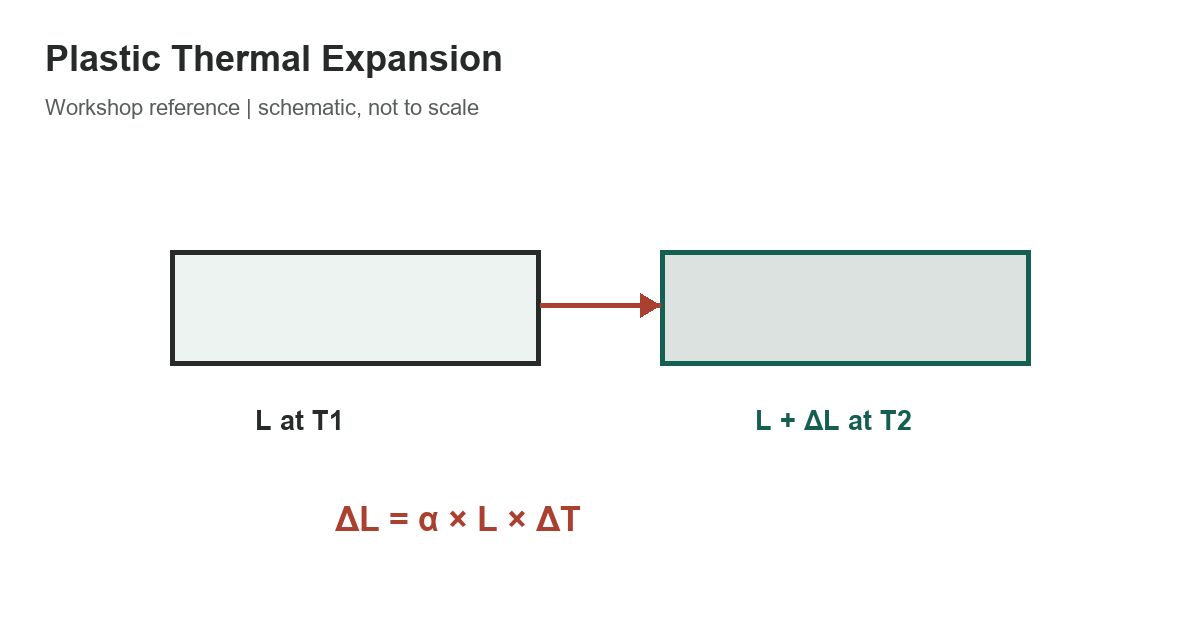
For a simple, unconstrained estimate, use ΔL = α × L × ΔT. Here ΔL is the change in length, α is the linear expansion coefficient, L is the original length and ΔT is the temperature change. Keep units consistent. If α is in per kelvin and L is in millimetres, the calculated change is in millimetres.
For a one-metre TECAFORM AH natural bar heated by 30 °C, use the current grade-sheet value α = 12.36 × 10^-5 K^-1 for the manufacturer’s 23-60 °C interval. The free-expansion estimate is 12.36 × 10^-5 × 1000 mm × 30 K = 3.708 mm. This is an idealized calculation, not a predicted finished-part tolerance. A constrained part can develop stress or move differently, and temperature may not be uniform through the component.
Why grade and direction matter
Glass reinforcement can reduce expansion and make it directional. A coefficient measured along the extrusion direction may not describe the transverse direction. Moisture absorption and conditioning also change dimensions in some polymers. Temperature-dependent behavior may not remain linear across a broad range, especially near transitions or service limits. Do not extend one catalog coefficient to a different grade, color, reinforcement level, manufacturer or temperature interval without evidence.
For a close-running clearance, press fit, bearing seat or long panel, obtain the exact grade’s current technical data and ask the supplier which test direction and interval apply. Check moisture conditioning, machining stress relief, service temperature, installation restraint and adjoining material expansion. When tolerances are critical, use a validated calculation or test with the actual geometry and environment.
Use the coefficient responsibly
CLTE describes length change per unit length per unit temperature; it is not the same as volumetric expansion. For isotropic material under a small temperature change, volume change is approximately three times the linear change, but that shortcut may not hold for anisotropic or constrained components. Use the material supplier’s definition and method. The values here are typical material data, not certification or a design allowable.
The coefficient has inverse-temperature units. For example, the TECAFORM AH value of 12.36 means 12.36 × 10^-5 K^-1, or 0.0001236 per kelvin. A temperature difference of one degree Celsius has the same numerical size as a difference of one kelvin, so the difference can be used directly in this equation. Temperature itself and temperature change are not interchangeable: use the change from the part’s reference condition.
For long stock, the estimated movement can be large enough to affect end clearance, alignment or support spacing. For a short insert, the change may be smaller than machining tolerance, but a tight fit can still be sensitive to differential expansion between the plastic and mating metal. Estimate both materials over the relevant service range, then consider restraint, contact pressure and humidity. A single free-expansion calculation does not predict a press-fit force or guarantee a functioning assembly.
Related material and workshop references include the size-chart library, the garage equipment and workshop guides, and the garage-floor epoxy guide.
Sources
Ensinger’s engineering-plastics manual lists CLTE for specific stock-shape grades and identifies its 23-60 °C test interval. The TECAFORM AH product page provides a grade-specific data point. Supplier datasheets for the exact grade should be checked before making a fit or tolerance decision.