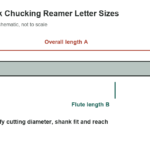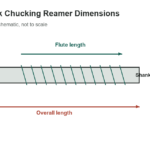
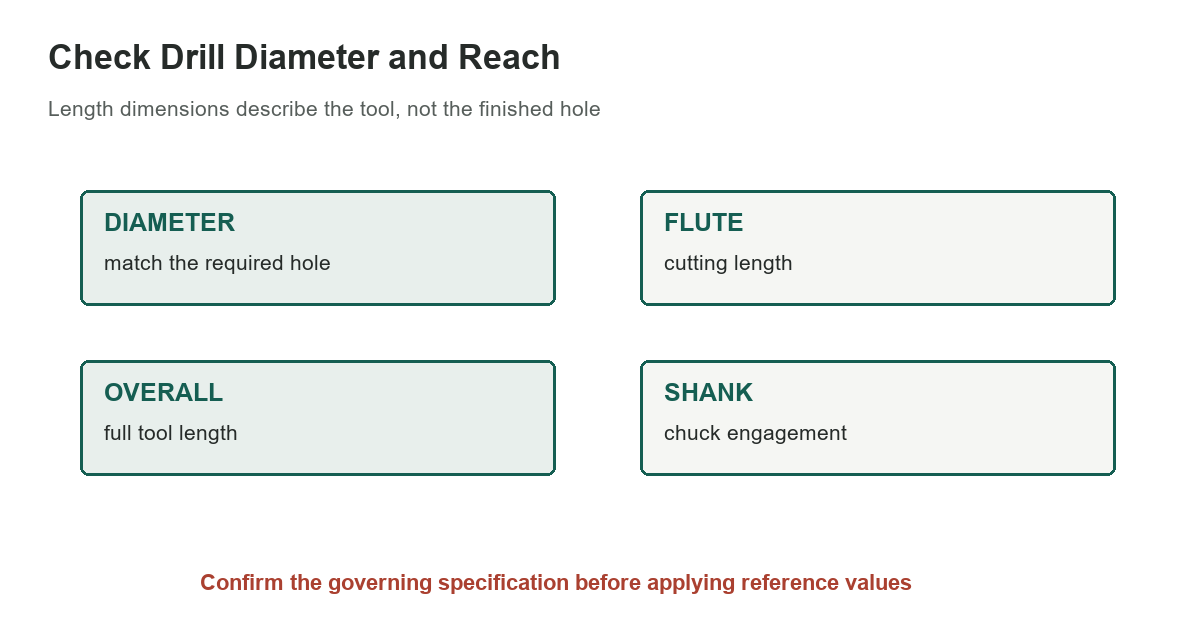
Large twist drills need more than a diameter check. Flute length, body length, overall length, shank engagement, and neck clearance all affect whether the tool can reach the work and fit the machine. This chart shows selected examples from the source table for drills larger than one-half inch.
[gs_table id=”11284″]
Read each length dimension
Flute length describes the fluted cutting portion; overall length is the full tool length. Body length and the listed shank and neck dimensions describe additional geometry that may affect reach and chuck engagement. These dimensions do not specify the hole depth that can be drilled in a particular setup.
Use the drawing or current toolmaker catalog for the complete geometry, tolerance, point style, and material. The source table separates inch fractional sizes from metric entries while also listing decimal equivalents. The selected rows here pair the inch examples with their source metric equivalents; they do not establish that all nominally similar products share identical geometry.
Choose a size from the work requirement
The source table begins above one-half inch. It includes fractional inch sizes and metric diameters in close succession, so do not assume every row is a direct conversion of the previous one. For example, 33/64 inch is 0.5156 inch, or 13.096 mm in the table; it is not a nominal 13 mm drill.
Specify the required finished-hole diameter and tolerance, then select a tool and process that can achieve it. Drill-bit size identification is a separate question from tool length; the site’s drill-point length chart provides a related geometry reference.
Check machine capacity and workholding
Before selecting a large drill, verify spindle capacity, chuck or holder range, quill travel, machine power, workpiece thickness, and fixture clearance. A drill that reaches the work in free air may not clear a vise, clamp, guard, or fixture once installed. Confirm that the shank is held securely with adequate engagement and that the tool is compatible with the holder.
Secure the workpiece mechanically; never attempt to restrain a large workpiece by hand. Plan chip evacuation and use the toolmaker’s recommendations for feed, speed, and coolant. The site’s benchtop drill-press guide discusses machine selection, but it does not certify a specific drill press for every diameter or material.
Understand the standard reference
ASME lists B94.11M-1993 for twist drills and describes coverage of nomenclature, definitions, sizes, and tolerances for high-speed-steel straight- and taper-shank drills; it covers inch and metric sizes and is on stabilized maintenance. A reference to the standard does not replace access to its full requirements or prove that an individual commercial drill conforms.
The article title in the historical handbook refers to taper-length straight-shank drills, but the selected rows present dimensional fields only. Review the standard, purchase specification, and manufacturer’s catalog to determine the exact type and tolerance class. Do not infer a shank fit or drill-point angle from this subset.
Plan the hole-making operation
Large holes may require a pilot hole, staged drilling, annular cutting, or another process depending on material, machine rigidity, and required finish. Follow the cutter maker’s procedure rather than choosing a pilot diameter by rule of thumb. Consider burr control, breakthrough, chip shape, and the risk of grabbing as the tool exits the work.
Keep hands away from the rotating spindle and chips. Use guards and eye protection appropriate to the operation, remove chips with a brush or tool after the spindle stops, and secure loose clothing and hair. OSHA’s machine-guarding guidance covers general hazard controls; the machine manual and workplace procedures govern the actual setup.
Verify the finished result
Measure the hole with suitable calibrated equipment and inspect its location, diameter, roundness, and finish against the drawing. Tool diameter alone does not guarantee final hole size because runout, material behavior, wear, feed, and machine alignment can change the result. For precision fits, use the specified inspection method and tolerance system.
For complementary setup guidance, see the site’s benchtop drill-press guide and its bolt and wrench size chart when planning general shop tooling. Those pages do not specify drill length or hole tolerance; use the actual drawing and tool supplier documentation.
Sources: ASME B94.11M-1993 Twist Drills, OSHA machine guarding overview, Original handbook extraction