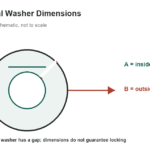
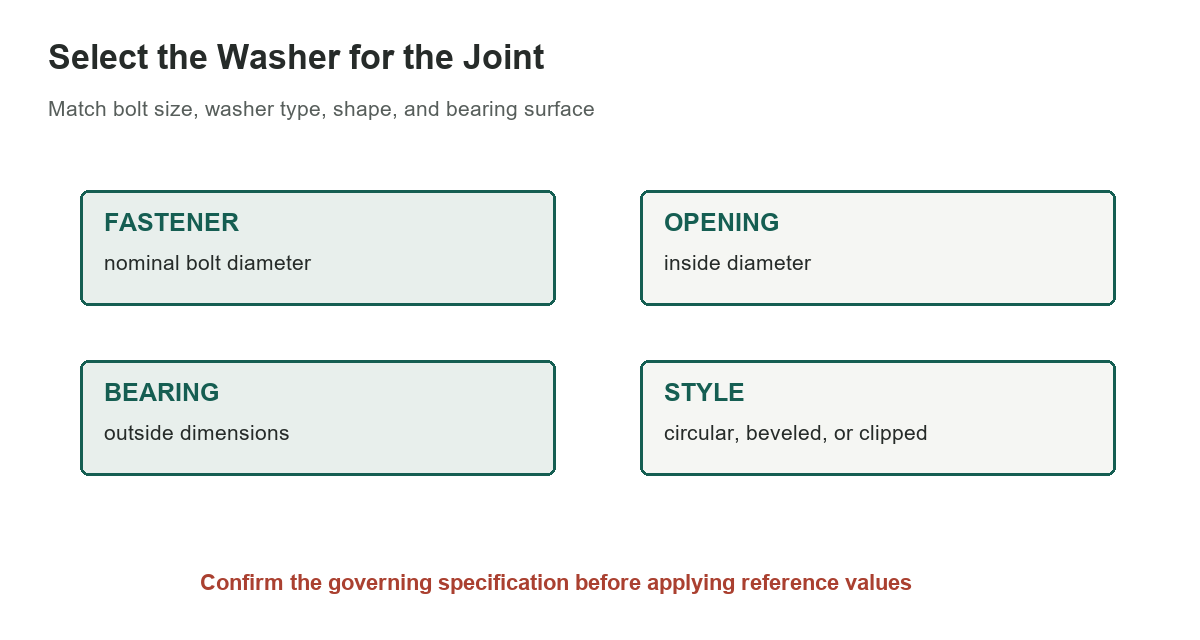
Hardened steel washers used with structural fasteners are specified by more than their inside diameter. Bolt size, washer type, style, hardness, thickness, outside dimensions, and bearing surface all matter. The selected inch-series examples below are a quick dimensional reference, not a substitute for the governing drawing or current specification.
[gs_table id=”11288″]
Read the dimensions and tolerances
The table shows basic inside and outside diameters, thickness limits, and the minimum edge distance noted for clipped washers. Basic dimensions are not necessarily inspection limits; the original table also gives tolerances that are not repeated in this compact selection. Use the full applicable specification and drawing for acceptance criteria.
The thickness column is a range rather than a single nominal value. Do not compare its minimum or maximum to a different washer class without checking definitions and test requirements. A washer that appears to fit over a bolt may still be incorrect for the joint because bearing area, hardness, shape, or coating differs.
Match the washer to the fastener assembly
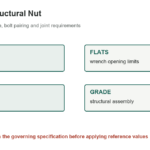
ASTM F436/F436M covers hardened steel washers for fasteners in both inch and metric dimensions, with type and style distinctions. The specification includes circular, beveled, clipped, and extra-thick forms for stated applications. Select the washer required by the bolt or assembly specification rather than choosing solely by the nominal bolt diameter.
Metric and inch values are treated as separate systems in the ASTM specification and should not be mixed as if each row were an exact conversion. Confirm the bolt standard, grade, washer type, installation instructions, and project documents as one assembly. A washer is not a general substitute for a plate washer where the design calls for one.
Choose the shape for the bearing surface
Circular washers suit applications with adequate space and appropriate angularity. Beveled washers are used to accommodate sloped flanges on certain beams and channels. Clipped washers address space constraints where a circular outline interferes with a nearby feature. The edge-distance column applies to the clipped condition and should not be treated as a universal clearance dimension.
Inspect the contact surfaces and hole geometry. A washer may not sit flat if the supporting surface is sloped, damaged, obstructed, or incompatible with its shape. For structural connections, use the specified washer style and orientation, and do not stack washers to correct an unapproved gap or misalignment.
Verify current specification status
ASTM lists F436/F436M-24 as active and describes chemical, mechanical, and dimensional requirements for hardened steel washers. The ASME B18.2.6 reference concerns fasteners for structural applications; the exact contract, code, and connection design determine which document governs. A historical handbook table is not itself a current approval or certification.
Request material and compliance documentation when required, and verify markings, coating, dimensions, and traceability against the applicable project specification. For a structural connection, an engineer or responsible authority should resolve conflicts among drawings, standards, and supplier catalog data before installation.
Do not confuse washer families
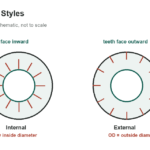
Hardened structural washers differ from plain unhardened washers, helical spring-lock washers, tooth-lock washers, and other specialty forms. Their load path and intended function are not interchangeable. Search results and hardware bins often group these items broadly as washers, so check the exact designation rather than relying on a product title or outer appearance.
The site’s bolt and wrench size chart, SAE wrench size chart, and inch and metric spanner guide cover related fastener identification. None defines structural washer requirements.
Inspect the installation
Before assembly, check that the washer is the specified type and size, sits correctly, and has no visible cracks, severe corrosion, deformation, or damaged coating. Follow the fastener assembly’s installation and tightening procedure. The washer dimensions alone do not establish the required preload, torque, joint slip resistance, or inspection method.
If a washer does not sit flat or the hole is oversized, stop and compare the condition with the approved detail rather than forcing the parts together. Keep inch and metric parts segregated, preserve required certifications, and obtain technical review when the joint is structural or safety-related.
Sources: ASTM F436/F436M-24 Hardened Steel Washers, ASME B18.2.6 Fasteners for Structural Applications, Original handbook extraction