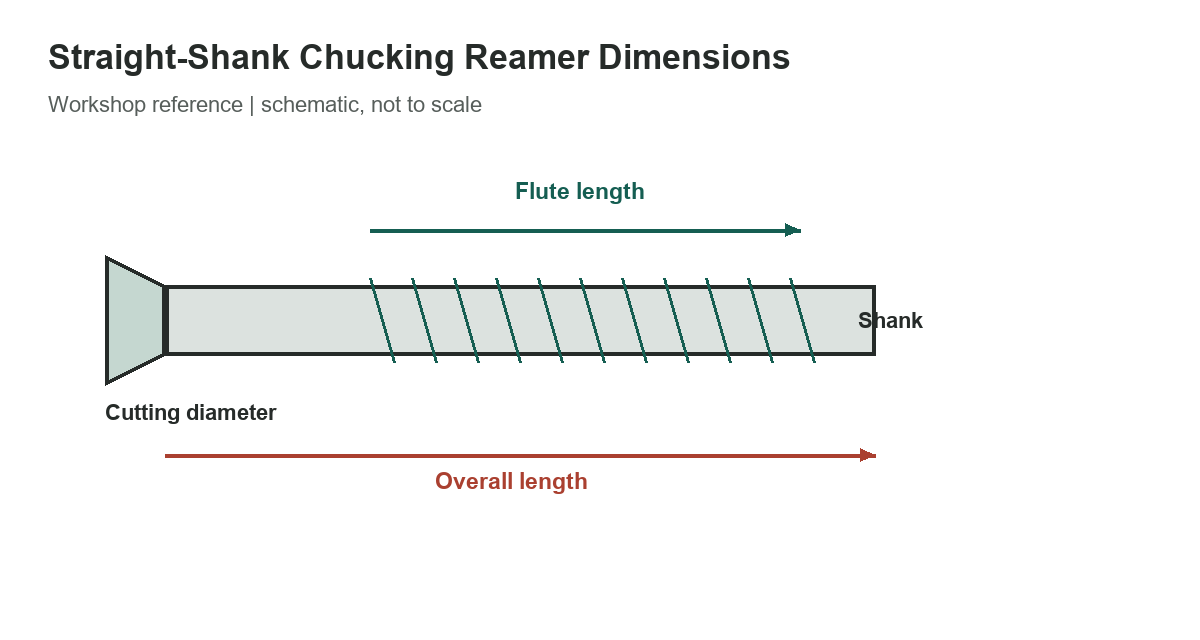
A chucking reamer finishes a drilled or bored hole to a more consistent diameter and surface than drilling alone. A straight shank is held by a compatible chuck or toolholder; the cutting diameter, shank, flute length and overall length all affect fit. The examples below are from one current manufacturer’s Series 607 coolant-fed chucking reamer line, not a universal dimensional standard.
Selected Series 607 sizes
CFT lists this series in M42 cobalt high-speed steel with straight flutes, right-hand cut and one coolant hole per flute. The selected fractional sizes are paired with the manufacturer’s decimal equivalents, shank diameters, flute lengths and overall lengths.
[gs_table id=”10858″]
Series 607 has three stated cutting-diameter tolerance bands: +0.0002/-0.0000 inch from 5/16 through 1/2 inch; +0.0003/-0.0000 inch from 17/32 through 5/8 inch; and +0.0005/-0.0000 inch from 21/32 through 1 inch. Check the exact part listing and current catalog before ordering, especially at band boundaries or when a finished-hole tolerance is critical.
Match the tool to the hole and holder
The reamer’s nominal cutting diameter is not the drill size. A reamer removes a small, controlled amount of material, so select the pilot hole from the toolmaker’s recommendation for the work material, hole depth and desired finish. A hole drilled too small can overload or break the tool; a hole already too large may leave insufficient stock for a clean finish.
Check the holder against the listed shank diameter. A nominal 1/2-inch cutting diameter in this series uses a 0.4355-inch shank, not a 1/2-inch shank. Verify chuck capacity and gripping length, and avoid holding the cutting flutes. The overall length and flute length also determine whether the tool can reach the full hole depth while leaving clearance for the holder and workpiece.
Coolant entry is model-specific. CFT publishes different end-entry details for diameter ranges, including cupped entries at smaller sizes and tapped entries at larger sizes. Confirm that the machine, holder, coolant path and pressure are compatible with the exact series. Do not assume every straight-shank chucking reamer is coolant-fed or can be used in the same way.
What the standard does and does not provide
ASME B94.2 covers reamer nomenclature, definitions, types, sizes and tolerances. ASME lists B94.2-1995 (S2025), the 1995 edition reaffirmed in 2025. That standard’s scope does not make the selected CFT product dimensions universal; the table above remains a manufacturer-specific catalog selection. Use the standard and the actual tool drawing for the job at hand.
Before cutting, confirm workpiece material, tool material, coating, flute style, rotation, feed, speed and coolant requirements from the toolmaker. A general reamer chart cannot replace the product’s application data. Secure the work, use the correct guard and eye protection, and stop the spindle before measuring or clearing chips.
Reamers are intended to remove a modest, controlled allowance, not to correct a badly misplaced or crooked hole. Check the drill or boring operation for position and alignment first. A straight-flute tool may be suitable for many through holes, while blind-hole chip evacuation and bottom clearance need special attention. Follow the manufacturer’s recommendation for cutting direction and feed; do not reverse a rotating tool to pull it from the work unless the tooling instructions permit that procedure.
Where the finished diameter is close-tolerance, measure with a calibrated bore gauge or appropriate internal micrometer after the part and tool have stabilized at the measurement temperature. A go/no-go plug gauge can answer a limit question but will not tell how far a hole is from nominal. Record the actual result and inspect for taper, bell-mouth or chatter if the part fails its size or finish requirement.
Flute count and length are not just catalog details. They influence chip space, rigidity and reach, while the coolant route affects chip removal and heat. A longer tool may reach a deeper feature but can be less rigid. Select only the length needed for the hole and setup, and ensure the holder does not bottom against the work before the cutting section reaches its intended depth.
For adjacent tooling references, see the drill-point length chart, tap-drill size chart, and our drill-press guide.
Sources
CFT Systems provides the Series 607 specifications and size-band tolerances. ASME’s B94.2 listing gives the reamer standard’s scope and current reaffirmation status. Always confirm the current series catalog and selected part number.