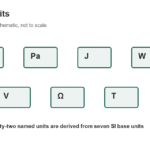
Compound SI units combine named derived units with other units to describe quantities such as viscosity, torque, heat transfer and material properties. Writing the quantity name alongside its symbol helps prevent mistakes: newton meter (N m) is the unit for moment of force, while joule (J) is used for energy, even though both reduce to the same SI base-unit expression.
Common compound expressions
These six common examples show how compound-unit expressions reduce to SI base units. A centered dot between unit symbols can show multiplication; spaces are also used in some standard forms, provided the expression remains unambiguous.
[gs_table id=”10854″]
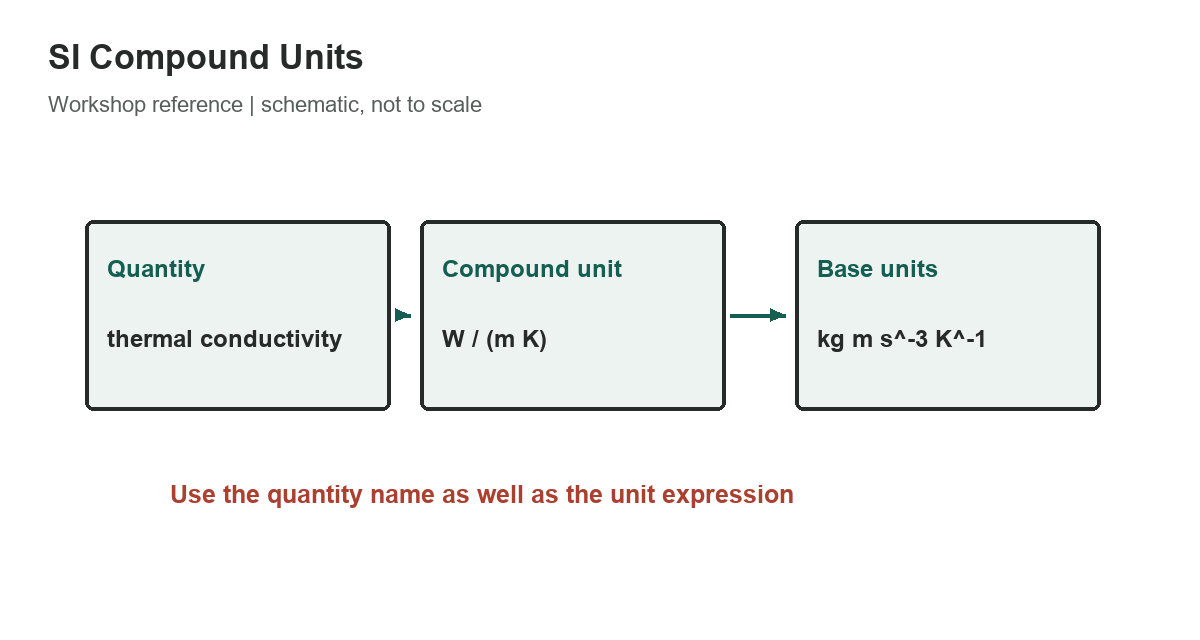
The base-unit expression is useful for checking dimensional consistency in equations. For example, dynamic viscosity is pascal second (Pa s), equivalent to kg m^-1 s^-1. Thermal conductivity is watt per meter kelvin, W/(m K), with base units kg m s^-3 K^-1. The symbols are case-sensitive: Pa is pascal, while pA would mean picoampere in a different context.
Do not identify a quantity from units alone
Different quantities can share the same base-unit expression. NIST notes that heat capacity and entropy both use joule per kelvin (J/K). Likewise, energy density and pressure both reduce to kg m^-1 s^-2, although the quantities and their engineering meanings are different. Context, quantity symbol and measurement method matter; a unit-only label can be ambiguous.
Moment of force is conventionally expressed as newton meter (N m), not joule, even though the dimensions match. Keeping the quantity-specific unit form preserves meaning in a drawing, calculation or test report. Angular units need care too: radian is dimensionless in SI base-unit terms, but the symbol rad is often retained in rad/s to communicate that the rate describes angular motion rather than ordinary frequency.
Write symbols consistently
Unit symbols are not abbreviations to be pluralized or punctuated. Use s for second, m for meter and K for kelvin; leave a space between a numerical value and its unit symbol. Use a slash or parentheses to make compound denominators unambiguous. For example, W/(m K) clearly places both meter and kelvin in the denominator. Avoid strings such as W/m K when a reader could parse the kelvin term as multiplication instead.
For powers, keep the exponent attached to its unit: W/m^2 means watts per square meter. Parentheses help when several factors are grouped, as in J/(kg K). In printed technical work, NIST’s typographic conventions use a centered multiplication dot between unit symbols where needed. Preserve the official capitalization of every symbol, and do not use a quantity’s unit as if it were its name.
These examples are coherent SI expressions, not a conversion table between SI and customary units. They do not replace a product specification, a material test method or a dimensional analysis of the complete equation. When a result is safety-critical, show the quantity, value, unit and calculation assumptions together.
Dimensional analysis can also expose a missing factor. If a formula for thermal conduction is written as power divided by area and temperature difference, the corresponding unit is W/(m^2 K), which is heat-flux density per temperature interval; conductivity itself is W/(m K). The extra length in the denominator comes from the temperature gradient through a material. The physical equation and quantity definition decide which expression is correct.
Angular velocity illustrates why symbols carry useful information. Its SI base expression is s^-1 because the radian is dimensionless, but rad/s is commonly retained to distinguish rotation rate from frequency in cycles per second. Frequency is expressed in hertz (Hz). Treating those labels as interchangeable can introduce a factor of 2 pi when converting between one revolution per second and radians per second.
Use the same convention throughout a calculation sheet. Define every quantity, keep unit symbols attached to the correct factors, and convert prefixes before combining numbers if that makes the arithmetic easier to audit. When software expects a particular unit, check the input documentation rather than relying on a familiar-looking abbreviation.
For other practical measurement references, see the bolt and wrench-size chart, pipe-size chart, and tire-pressure gauge guide.
Sources
NIST SP 811 Table 4 supplies the selected quantity, compound-unit symbol and base-unit forms. NIST Chapter 6 covers symbol typography, spacing and compound-unit writing conventions.