Rotational speed is often listed in revolutions per minute, while motion equations and many engineering calculations use angular speed in radians per second. The conversion is direct, but mixing the two quantities without converting can distort torque, acceleration, or surface-speed calculations. The selected examples provide quick checks; the formula is preferable when precision matters.
[gs_table id=”11272″]
Use the conversion formula
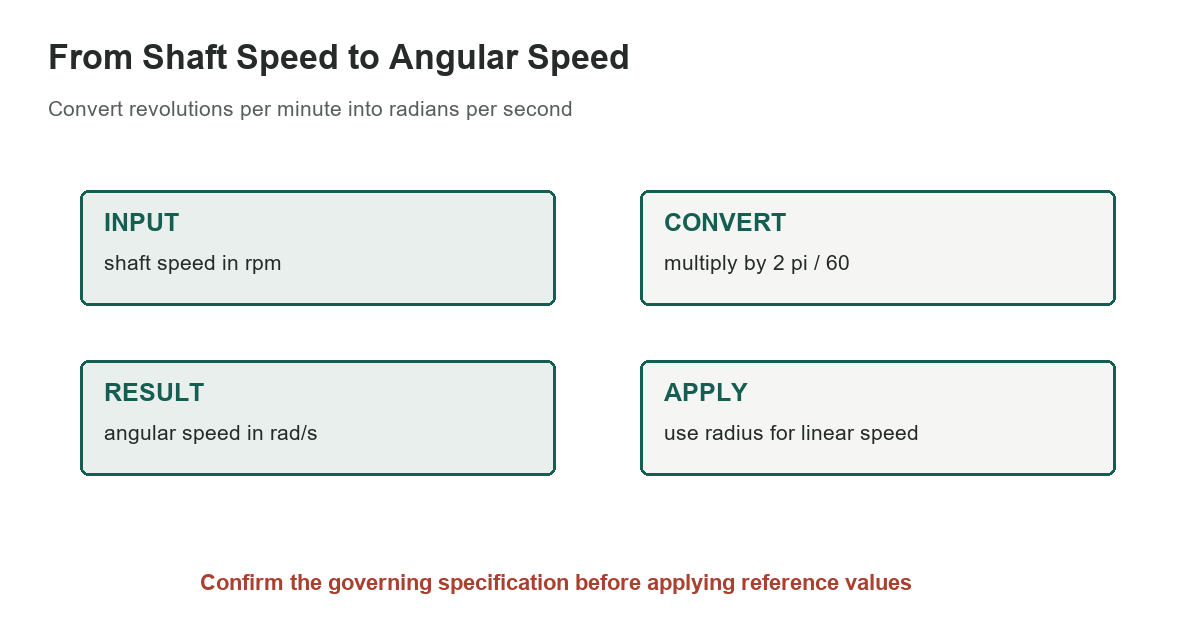
One revolution is 2 pi radians and one minute is 60 seconds. Therefore, angular speed omega in rad/s equals rotational speed n in rpm multiplied by 2 pi/60. The multiplier is approximately 0.104719755 rad/s per rpm. For the reverse conversion, multiply angular speed by 60/(2 pi), approximately 9.5493 rpm per rad/s.
For example, a shaft turning at 1,800 rpm has omega = 1,800 x 2 pi/60, or about 188.50 rad/s. Keep the units in the equation while substituting so the minute and revolution cancel. Do not treat rpm and rad/s as interchangeable just because both describe rotation.
Interpret the selected values
The managed lookup shows a small set of checkpoints from the larger source conversion table. At 60 rpm, one revolution per second corresponds to approximately 6.28 rad/s. At 120 rpm, the value doubles to 12.57 rad/s. The entries are rounded to hundredths; this display rounding is not part of the exact conversion.
The source grid covers integer speeds from 0 through 239 rpm. This article deliberately reproduces only five values. For a speed between listed rows, calculate from the factor rather than interpolating a rounded chart. A calculator that retains more digits avoids cumulative error in a multistep model.
Distinguish angular and linear speed
Angular speed describes how quickly an angle changes. Linear speed depends on both angular speed and the radius of the point being measured: v = omega r, when omega is in rad/s and r is in meters, the resulting speed is in meters per second. A point twice as far from the axis has twice the tangential speed at the same shaft rpm.
This relationship is useful for a wheel rim, pulley, or rotating tool, but it does not account for belt slip, changing effective radius, or contact deformation. The site’s grinding-wheel speed guide treats surface-speed conversions separately; use the measured working diameter and the wheel maker’s limits.
Know what a speed reading represents
A tachometer usually reports rotational rate, not angular velocity in SI form. Confirm whether the instrument reads shaft rpm, motor rpm, or a value inferred from a driven component. Gear reductions, belt ratios, variable-frequency drives, and slip can make the speed at the workpiece differ from the motor nameplate speed.
Record the measurement location and operating condition. A no-load value may not match loaded operation, and a speed controller display may show a commanded value rather than an independently measured speed. For machine setup, compare the reading with the equipment manufacturer’s operating range and the tool’s maximum rated speed.
Apply the conversion carefully
Angular speed is not angular acceleration. Acceleration describes the rate of change of angular speed and has units rad/s squared. Likewise, rpm is not automatically hertz: rotational frequency in revolutions per second is rpm divided by 60, while angular speed also includes the factor 2 pi. The site’s drill-point length reference concerns tool geometry, which should not be confused with rotational speed.
Use consistent units across torque, inertia, radius, and time. If converting a result back to rpm for a controller or tachometer comparison, retain enough precision internally and round only for the final display. State the conversion convention in calculation notes when multiple teams or software tools exchange the data.
Check equipment limits before operation
This conversion is a unit aid, not a recommendation to increase machine speed. Verify the tool, wheel, bearing, belt, coupling, and guarded equipment ratings independently. A correctly converted number cannot establish that an assembly is balanced, properly mounted, or safe at that speed.
For drilling, match the speed to the material, tool diameter, and manufacturer guidance; the site’s benchtop drill-press guide discusses equipment selection but does not specify a safe spindle speed. The scooter drive-belt chart is another rotational-drive reference, not a machine-speed recommendation. Isolate power before changing tooling and secure the work.
Sources: NIST Guide to the SI, Appendix B.9, NIST Guide to the SI, Chapter 8, Original handbook extraction