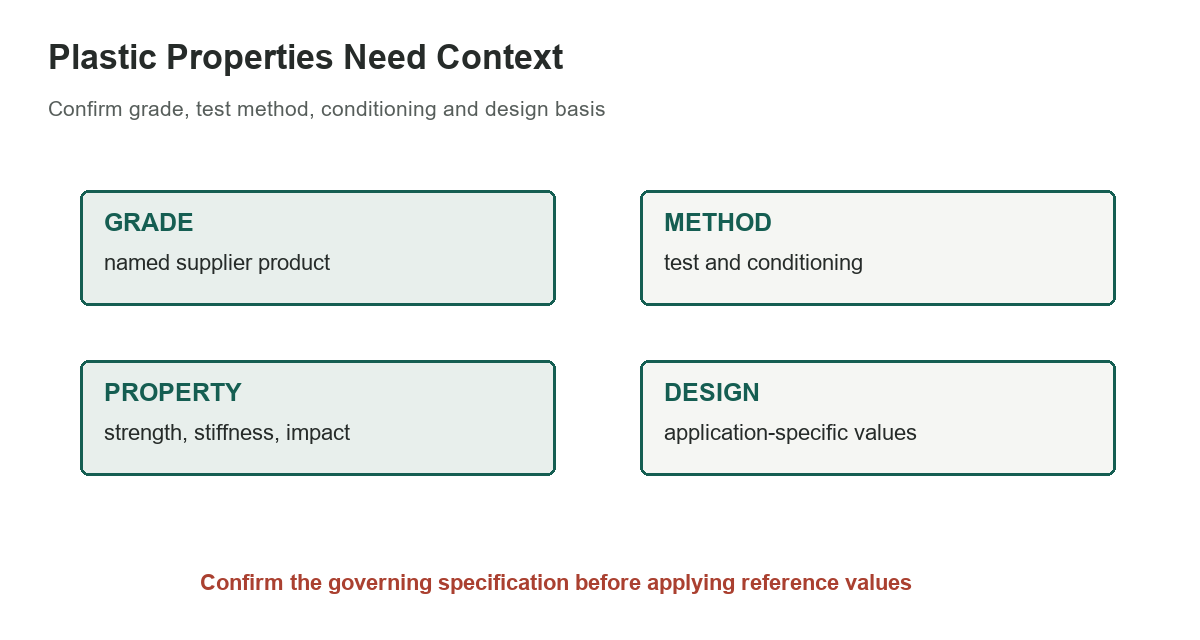
Plastic properties vary substantially by grade, formulation, reinforcement, processing and test condition. The selected values below are medians from a historical summary of supplier-submitted grades printed in the 31st edition of Machinery’s Handbook, with data credited to MatWeb. They are useful for learning how properties are organized, not for choosing a structural material or approving a design.
[gs_table id=”11263″]
Understand what each column measures
Yield stress in ksi describes the stress associated with the reported yield criterion. Elastic modulus in ksi describes stiffness in the measured range; it is not strength. Heat-deflection temperature is a test response under a specified load and method, not a recommended continuous-use temperature. Izod impact strength is an impact-test result tied to specimen geometry, notch and test procedure.
These properties answer different questions. A high median yield stress does not by itself indicate impact toughness, dimensional stability, chemical resistance or fatigue life. A high heat-deflection result does not certify a component for long-term use at that temperature. Compare like test methods and material conditions rather than ranking the families from one number.
Why a median can mislead
The source chart summarizes values across grades submitted by suppliers. A median is the middle of that reported set; it is not necessarily a currently available grade, a typical value for every product sold under that family name, or a statistical lower-bound design value. The historical spread between minima and maxima is wide for some properties, which underscores the difference between a polymer abbreviation and a controlled material specification.
MatWeb’s current help pages explain that property availability varies across material entries and that a search can return only the materials for which the chosen property is available. A family-level overview is a screening aid. For an actual design, identify a named grade and consult its current supplier datasheet with the exact test methods, specimen conditioning and orientation.
Use English units consistently
The chart reports stress and modulus in ksi, temperature in degrees Fahrenheit, and impact strength in foot-pounds per inch. One ksi equals 1,000 psi. Convert units with a consistent method and keep precision aligned with the original data. Do not mix a value in GPa with one in ksi without documenting the conversion, and do not compare impact values from different test standards as if they were interchangeable.
If a calculation uses stress, define the load case and effective area; if it uses stiffness, define geometry, support and temperature. These median values do not supply creep, fatigue, wear, thermal expansion, moisture conditioning, electrical performance or chemical compatibility. Each may control the part’s behavior.
Choose a grade for the environment
Check continuous and peak temperature, chemical contact, moisture, UV exposure, load duration, impact, surface finish, tolerance and regulatory constraints. Reinforced and unfilled grades can differ greatly. Mold flow, fiber orientation, cooling and residual stress may cause properties to vary with direction and wall thickness. Machined stock shapes can have a different material history from injection-molded specimens.
For a separate comparison of selected POM-C, PA 6 and PEEK properties, see the engineering plastics comparison, injection-molded wall-thickness guide, and reinforced laminate comparison. That page covers a limited grade-focused comparison; this article explains why broad historical medians cannot replace exact product data. The injection-molding guide also helps connect material choice to part geometry.
Set a defensible design basis
Before analysis or procurement, record the full manufacturer designation, lot or certification needs, specimen test methods, conditioning, temperature, orientation and applicable safety factors. Use design values accepted by the governing code or engineering organization. Where a failure could injure someone or damage equipment, obtain review from a qualified materials or design engineer and test the actual component when required.
The table includes only four material examples and four properties. It omits the full source list, low/high ranges and other property families to keep the summary focused. An absent value does not mean a material lacks that property. It means the chosen source excerpt does not supply it here.
Use the chart as a question prompt
These values can help a reader recognize units, compare kinds of measurements and identify where more precise data is needed. They cannot establish that ABS, polycarbonate, PEEK or polypropylene is suitable for a particular component. Confirm a named grade with its supplier and use conditions before release.
Source: Machinery’s Handbook, 31st edition, Table 2a, “Typical Mechanical Properties of Common Plastics (Inch),” printed page 573; data courtesy of MatWeb. The selected median values below reflect the publisher’s 2023 errata for Table 2a. Supplier datasheets should be used for a named grade and its test conditions.