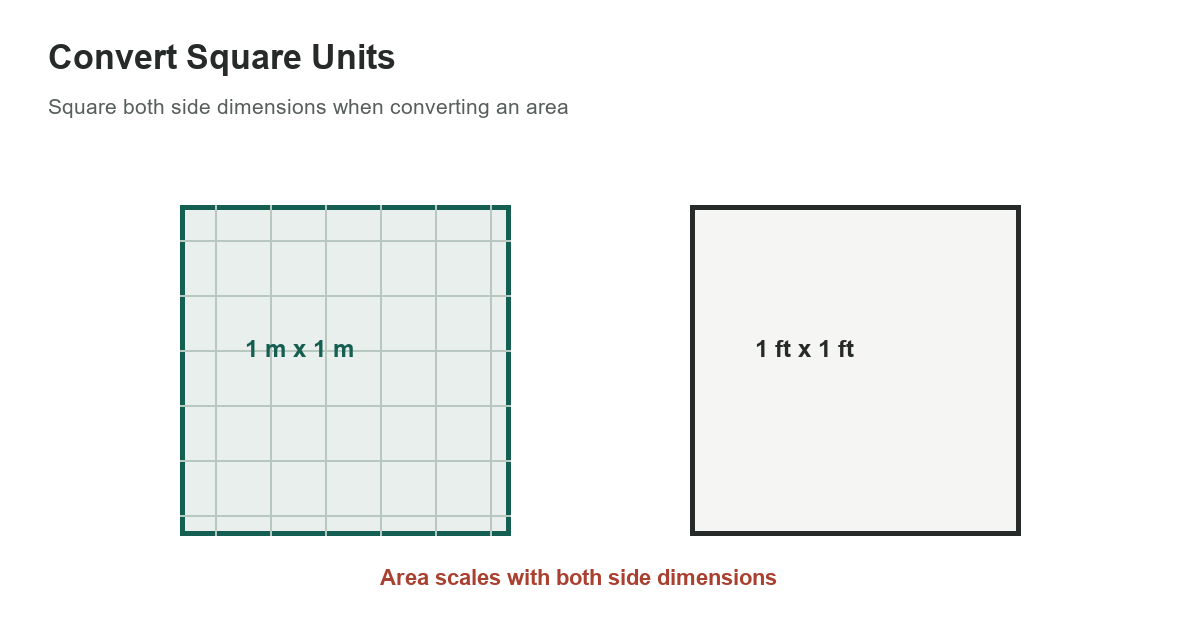
Area conversions use squared units. If a length conversion multiplies a side by a factor, converting an area requires applying the corresponding factor to both sides, so the area factor is squared. The values below convert selected international/U.S. area units to square metres. They are based on NIST conversion data and keep the underlying unit definitions explicit.
[gs_table id=”11238″]
Apply the factor to the full area
Multiply the number of starting units by the listed square-metre factor. For example, an area of 250 ft² multiplied by 0.09290304 m²/ft² is 23.22576 m². Keep the unit in the calculation until it cancels; this helps catch the common mistake of using a linear factor such as metres per foot directly on an area.
The table shows factors per one square unit. The equivalent definitions provide quick checks: a square foot contains 144 square inches, a square yard contains 9 square feet, and an acre contains 43,560 square feet. These identities are exact for the international foot and yard definitions used here.
Why squared conversions differ from linear ones
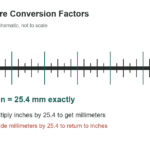
One international foot is exactly 0.3048 m. A square foot is therefore (0.3048 m) × (0.3048 m), or 0.09290304 m². Likewise, one international inch is exactly 0.0254 m, so one square inch is 0.00064516 m². The squared factor follows from the two dimensions of an area.
When converting hectares, square kilometres, square centimetres or square millimetres, use the metric relationships: 100 m² equal one are, 10,000 m² equal one hectare, and one square kilometre contains one million square metres. Prefixes apply to both dimensions, so a square centimetre is 10^-4 m², not 10^-2 m².
Keep international and survey units distinct
The square-mile factor shown uses the international mile based on the international foot. A U.S. survey-mile area is slightly different because the historic survey foot is longer. NIST provides a separate conversion for the survey-foot-based square mile. Avoid mixing survey units into ordinary area calculations unless the source data or legal survey explicitly uses them.
The acre does not depend on a square plot shape. It is an area equal to 43,560 square feet, regardless of whether the land boundary is square, rectangular or irregular. A square mile contains 640 acres. For a rough estimate, rounded values can be convenient; for surveying, contracts or engineering tolerances, use the precision and unit basis required by the governing document.
Conversions do not calculate the shape
This table converts a known area from one unit to another. It does not find the area from a length, radius, angle or set of coordinates. For shape calculations, use the trapezoid, hexagon and octagon formulas or the circle and sector area guide. Those articles address geometry; this page is about unit conversion.
For regular polygon dimensions, the square and hexagon across-corners chart supplies a separate measurement reference. Calculate the area with the appropriate geometry first, then convert the result here.
If an area comes from a drawing, confirm whether dimensions are nominal, inside, outside or centerline measurements before applying a formula. If it comes from a map or parcel record, confirm the stated survey unit system and coordinate reference. A correct conversion cannot fix a wrong source measurement.
Choose useful precision
Retain enough digits during intermediate calculations and round only the final result to match the accuracy of the input and the decision. A long decimal factor does not make an approximate measurement exact. For everyday estimates, 1 ft² is about 0.0929 m² and 1 m² is about 10.764 ft²; use the full NIST factor when more precision is needed.
Sources: NIST SP 811 Appendix B, NIST SI area units and NIST survey-foot conversions.