A barometer reports atmospheric pressure, often in inches of mercury (inHg). Converting that reading to kilopascals or pounds per square inch is a unit conversion, not a prediction of the weather or a compressor setting. The values below use NIST conversion factors; they are calculated examples, not a universal “normal” range for every location.
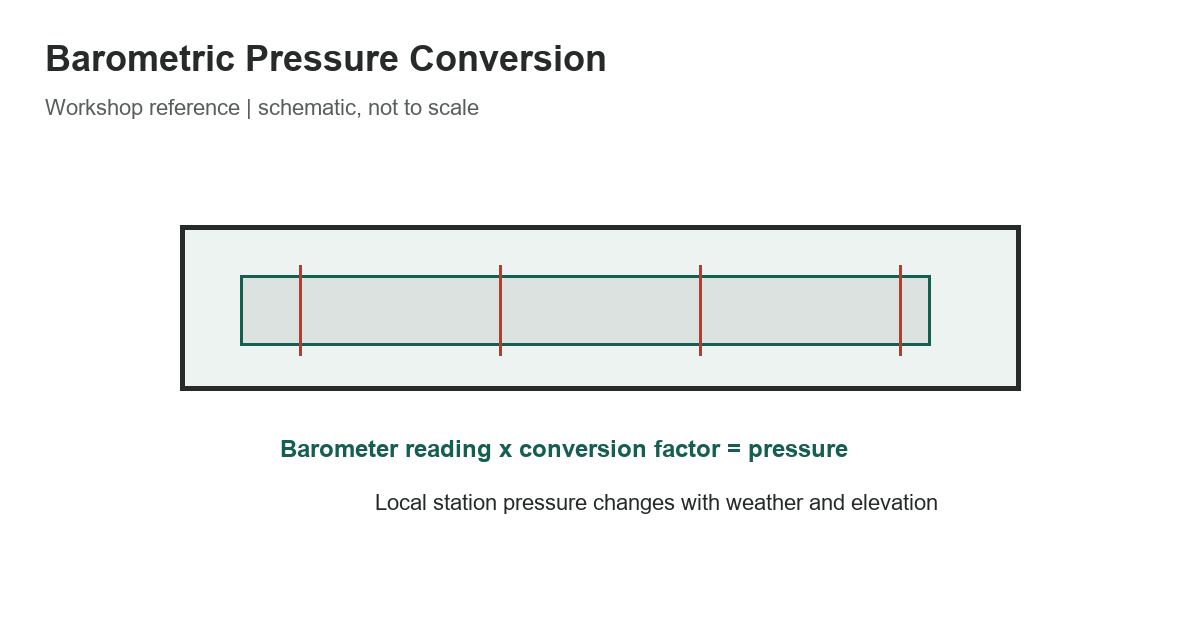
inHg conversion reference
Multiply an inHg reading by 3.386389 to obtain kilopascals, or by 0.4911541 to obtain psi. Keep the pressure reference clear: a barometer reading referenced to vacuum corresponds to absolute atmospheric pressure. Gauge pressure is measured relative to the local atmosphere, so the same physical condition can be written as about zero gauge pressure and a positive absolute pressure.
[gs_table id=”10789″]
How to use the conversion
For a reading of 29.9213 inHg, the conversions are approximately 101.325 kPa and 14.6960 psi. This is the standard-atmosphere reference often used in engineering calculations; it is not the pressure at every workshop. A reading of 28 inHg converts to about 94.819 kPa or 13.75231 psi. The arithmetic does not turn that observation into a sea-level-corrected value.
Some instruments display inches of mercury as a pressure unit, while others provide a weather-report setting adjusted to mean sea level. Read the instrument’s manual and label carefully. Do not mix station pressure with altimeter setting or a sea-level-reduced weather value. The National Weather Service defines station pressure as the absolute air pressure at the reporting station and notes that elevation causes substantial location-to-location differences in mountainous terrain.
Pressure is not the same as fluid head
A mercury-column barometer relates pressure to the force of a fluid column under specified reference conditions. Converting inHg into psi or kPa gives pressure units. Converting pressure to water head requires a water density and gravitational acceleration, and the result changes with temperature and the selected reference. Do not treat an inHg value as the same numerical height of a water column.
For a gauge instrument, distinguish absolute, gauge, and differential pressure before selecting a conversion. Absolute pressure is referenced to a vacuum; gauge pressure is referenced to ambient pressure; differential pressure compares two measured points. A pressure switch, vacuum gauge, refrigerant gauge, and barometer can therefore display different numbers for related states without contradicting one another.
As a practical check, record the raw barometer reading before converting it, then write the equation and units beside the result. Confirm that the pressure instrument is reporting local station pressure and whether its display has been corrected for sea-level weather reporting. If a reading seems inconsistent with another gauge, compare reference points and calibration before assuming that a component has failed.
Measurement and safety notes
Use a calibrated instrument with a suitable range and resolution. Note the units, pressure reference, calibration date, measurement location, and ambient conditions when recording results. A barometric conversion is not a substitute for the equipment manufacturer’s pressure limit, and it should not be used to infer safe operating pressure for a vessel, tire, gas line, or compressor receiver.
Round only to the precision justified by the instrument. The extra digits in a conversion factor do not make a coarse or uncalibrated reading more accurate. If a process requires traceable pressure measurement, use the prescribed instrument and calibration procedure and record the uncertainty.
- Confirm that the input is actually inHg.
- State whether the result is absolute, gauge, or differential pressure.
- Use local station pressure for local conditions, not a sea-level weather setting.
- Follow the equipment’s own pressure rating and procedure.
See the size-chart library, compare compressed-air pipe sizing, and review gas-pipe pressure references for related system topics.
Sources
NIST lists pressure-unit conversion factors, including inches of mercury, psi, and pascals. The National Weather Service glossary explains station pressure. Converted values in the table are calculations from those factors.