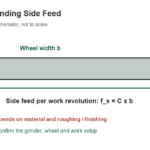
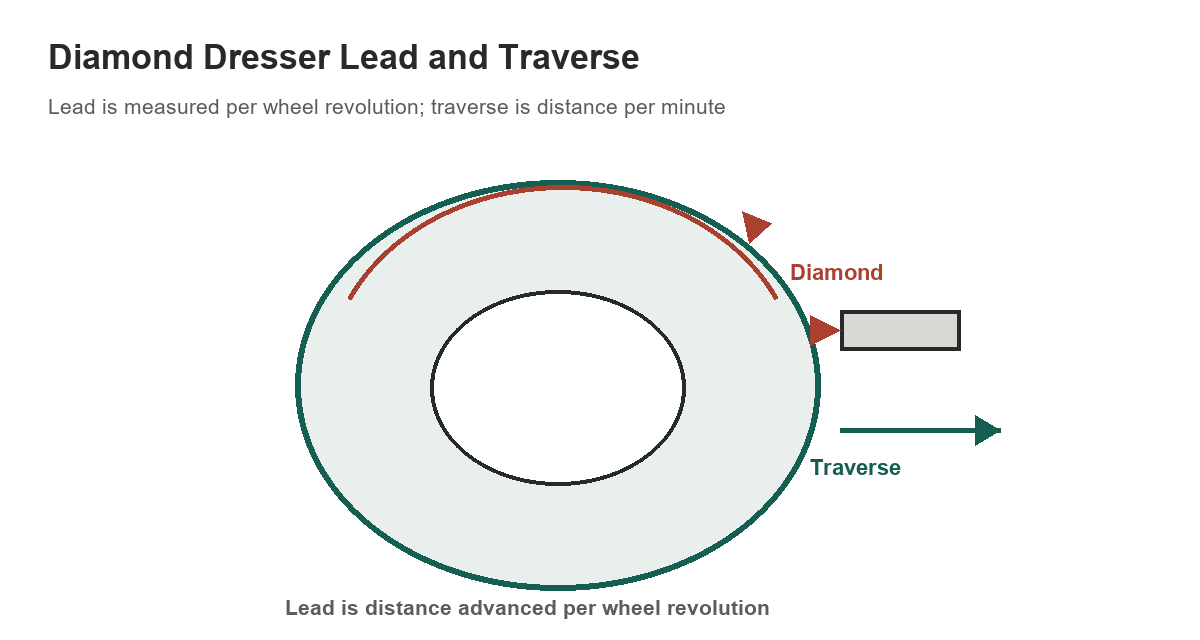
Diamond-dresser crossfeed is often expressed as lead: the distance the dresser advances across the wheel for each wheel revolution. That is different from traverse rate, which is a distance per unit time. Keeping those quantities separate prevents a lead value from being mistaken for inches per minute or entered into a machine control with the wrong units.
[gs_table id=”11209″]
Interpret the selected lead ranges
The table gives selected historical examples associated with abrasive grain size. They are not a universal recipe. Wheel bond, abrasive, width, dressing purpose, diamond shape, machine condition and finish target all affect the choice. Current wheel and dresser manufacturer instructions take precedence over an older reference table.
A smaller lead generally creates more overlap across the wheel face and can produce a finer dressed surface, while a larger lead can increase dressing aggressiveness and remove material faster. These are tendencies, not guaranteed outcomes. The dresser geometry and wheel condition also matter, so verify the result on the actual machine and work requirement.
Record whether a stated value is per wheel revolution, per table traverse or per dressing pass. A control may require a feed rate even when a reference provides lead, so the conversion requires the correct wheel RPM at the time of dressing. If speed changes, the same lead corresponds to a different traverse rate. Check the control manual for how it handles acceleration, reciprocation and reversal at the wheel edges.
Also confirm whether the feed applies in one direction only or on both strokes. Machine cycle conventions affect the time and coverage even when the nominal lead value is unchanged. Keep the dresser’s path clear of shoulders and wheel edges unless the procedure explicitly accounts for them.
Convert lead to traverse rate
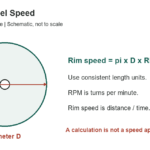
When the lead is specified per wheel revolution, the basic relationship is: traverse rate = lead × wheel revolutions per minute. Keep units explicit. If lead is in inches per revolution and wheel speed is in revolutions per minute, the product is inches per minute. For metric lead in millimeters per revolution, the result is millimeters per minute.
As a calculation example only, a 20-inch wheel turning at 1,200 rpm with a No. 46 grain lead range of 0.008-0.014 in./rev gives 9.6-16.8 in./min. The lower end is close to the historical example’s approximately 10 in./min. This arithmetic does not make either value suitable for a particular grinder. Confirm how the machine defines wheel speed, traverse, overlap and dressing cycle before entering settings.
Do not confuse lead with overlap ratio
Overlap ratio relates wheel face width to the dresser’s advance per wheel revolution and is used in many grinding references to discuss surface finish. Traverse, lead and overlap are connected but describe different quantities. A machine control may display crossfeed per pass, per revolution or as a rate; verify the control’s exact meaning instead of assuming its label matches the table.
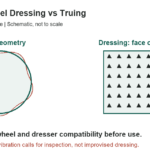
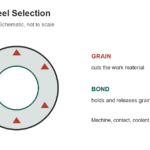
The grinding wheel speed reference explains surface speed units, while the dressing versus truing guide distinguishes the operations. The wheel selection guide covers wheel characteristics that can affect the result. These are related concepts, not replacements for the dresser manufacturer’s instructions.
Set up and verify conservatively
Inspect the wheel, mounting, guard and dresser before contact. Follow the machine and wheel instructions for speed limits, coolant and dressing sequence. Where required by the process, establish coolant flow before the diamond contacts the wheel and maintain it through the operation. Approach carefully and avoid impact loading the diamond.
Use the formula to check units and understand a setting, then choose the actual process from current equipment guidance. Record wheel specification, dresser type, lead or traverse definition, speed, coolant and observed finish so that a successful setup can be reproduced safely. Stop if the wheel, dresser or machine behaves unexpectedly.
Historical crossfeed ranges: Machinery’s Handbook, 31st edition, Table 2, “Typical Diamond Truing and Crossfeeds,” printed page 1458. For current process guidance, see Norton Abrasives’ grinding and surface-finish guidance and its diamond and cBN catalog.