A V-belt design factor is meaningful only within the method that defines it. The selected constants below are from a historical narrow-belt cross-section table. They are not standalone multipliers for arbitrary power, speed, or belt calculations, and their labels should not be detached from the original formula context.
[gs_table id=”11276″]
Identify the table correctly
The source page contains two adjacent tables. Table 4 lists speed-ratio correction factors, while Table 5 lists cross-section constants K1 through K4. This chart is limited to Table 5. Its values are selected by the belt profile, not by speed ratio. The site’s separate narrow V-belt speed-ratio guide covers the neighboring Table 4 topic.
The extracted grid file associated with this page does not match the Table 5 layout, so the displayed values were checked directly against the rendered page. That distinction matters: a plausible-looking factor from the neighboring table can still be the wrong input for a calculation.
Match the exact belt designation
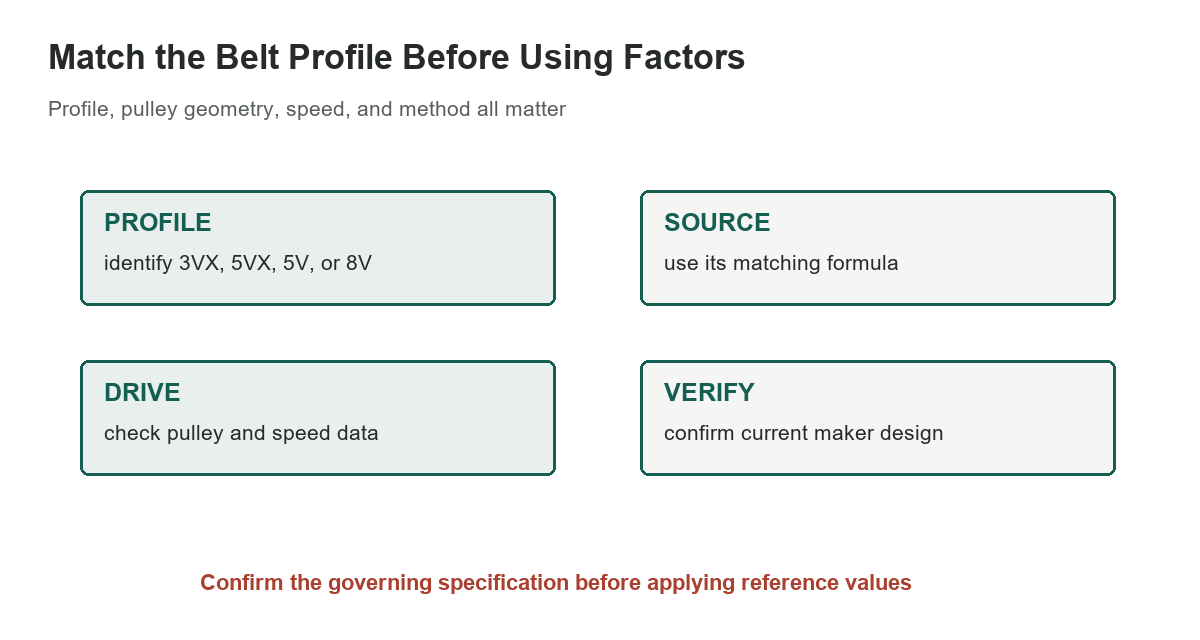
Profiles 3VX, 5VX, 5V, and 8V are not interchangeable labels. Confirm the manufacturer’s designation from the belt marking, equipment bill of materials, or a measured cross-section and the relevant belt standard. A nominally similar belt from another family may have different dimensions, construction, rating, and operating limits.
Check the pulley groove profile and condition as well as the belt. A belt should seat as intended on the sidewalls rather than bottoming in a worn or mismatched groove. The site’s narrow V-belt sheave dimensions reference is a dimensional companion, not a substitute for a compatibility check.
Do not infer a formula from constants
The four constants are reproduced without reconstructing the equation that uses them. The source section’s definitions, unit system, correction sequence, and assumptions determine how each value is applied. Multiplying a horsepower rating by K1 or adding K4 to a speed correction without the source equation can create a result with no engineering meaning.
Obtain the controlled edition of the design method and confirm that the variables and factors align. Manufacturer design manuals often use their own rated-power tables, service factors, wrap corrections, length corrections, and profile-specific limits. Do not combine values from one method with equations from another.
Build the rest of the drive model
A belt-drive selection also depends on transmitted power, driver and driven speeds, pulley pitch diameters, center distance, wrap angle, belt length, starting torque, duty cycle, environment, and the number of belts. Shaft alignment, tension, guarding, and installation procedure affect service life. A profile constant alone does not size the complete drive.
Use a current manufacturer calculator or approved design procedure for a new installation. Gates’ manual is a manufacturer reference, but its edition, profile coverage, and recommendations should be checked for the exact product and application. The light-duty V-belt sheave guide concerns another family and should not be applied to these narrow profiles.
Inspect before replacing a belt
Before removing a belt, isolate and lock out the drive according to the equipment’s procedure. Record the belt identification, pulley arrangement, center distance, and any evidence of oil, heat, cracking, glazing, or unusual wear. Check that the replacement belt and sheaves are compatible, then install and tension them according to the component manufacturer’s instructions.
Never pry a belt onto a rotating or powered sheave. Keep hands and clothing clear, reinstall the guard before operation, and investigate repeated failures rather than simply increasing tension. Excess tension can overload bearings and shafts; inadequate tension can permit slip and heat.
Use the chart as a cross-check
These values can help identify the source’s profile-specific constants, but they cannot establish a drive rating, belt life, or safe operating speed. Confirm the governing formula and the exact factor definitions in the original method before calculation. If the drive is safety-critical or failure could cause injury, have the selection reviewed by a qualified engineer or the equipment manufacturer.
Keep the chosen profile and method in the calculation record. Record whether the drive is a replacement or a redesign, the source edition, the input units, and any assumptions. This makes later inspection and maintenance decisions traceable instead of leaving a bare numerical factor without context.
Sources: Gates industrial V-belt design manual (manufacturer reference), Continental V-belts and components overview, Original handbook extraction