Narrow V-belts use section-specific sheave grooves. The numbers below compare selected minimum recommended sheave outside diameters for standard and deep grooves; they are not a universal pulley-sizing rule. Confirm belt section, groove profile, speed, ratio, wrap, load, and the manufacturer’s drive-design guidance before choosing a sheave.
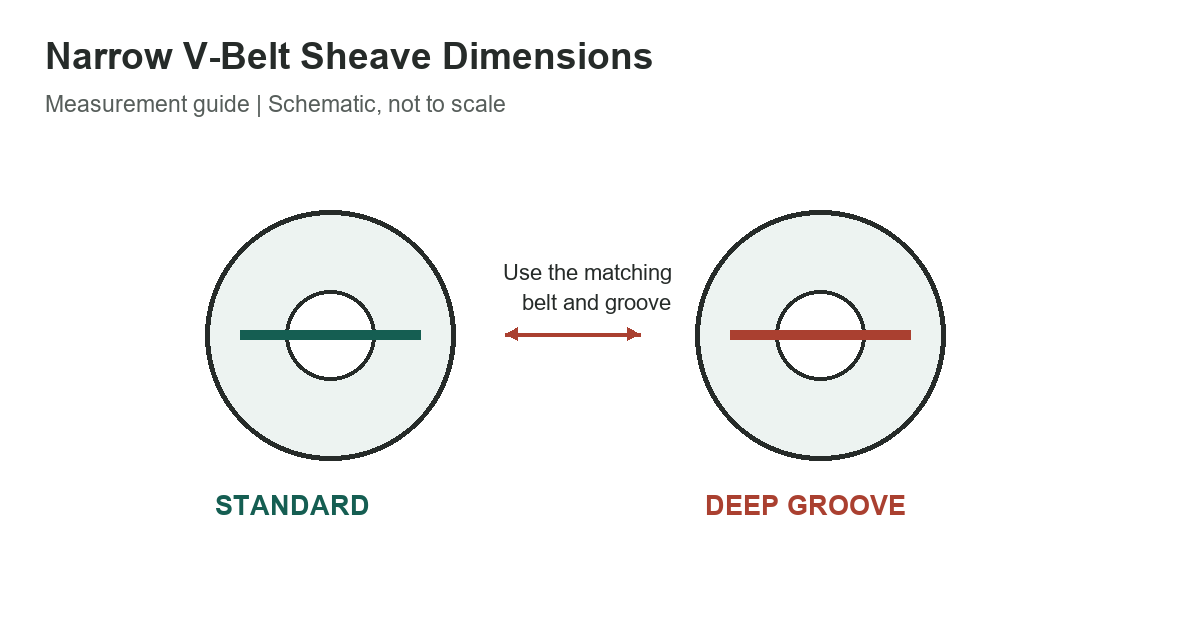
Read the belt section before the diameter
3V, 5V, and 8V identify different narrow belt sections. A sheave that is large enough for one section is not automatically compatible with another. Groove width, angle, depth, and belt construction must match. The table is deliberately limited to three selected section examples rather than a complete design standard.
Selected minimum outside diameters
Values are inches. The standard-groove figures in this selection align with current Gates heavy-duty drive guidance; deep-groove figures are separate source values and should not be substituted for the standard series.
| 3V | 2.65 | 2.87 |
|---|---|---|
| 5V | 7.10 | 7.42 |
| 8V | 12.50 | 13.02 |
3 rows
Scroll horizontally to view all columns.
For example, a selected 3V standard-groove minimum is 2.65 inches, while the corresponding deep-groove example is 2.87 inches. These are lower design bounds in the cited reference, not a promise that every sheave at that diameter is suitable for every speed or power.
When deep grooves are used
The handbook describes deep grooves for particular drive arrangements, including vertical or quarter-turn drives and drives with oscillating center distance. It also warns against running joined belts in deep-groove sheaves. That application note matters: deeper is not simply a stronger or universally safer replacement groove.
Use the exact belt maker’s section and sheave specification. Check whether the belt is a single belt, banded set, or joined construction, and verify that the pulley profile is intended for it. If the drive has a nonstandard orientation, changing center distance, shock load, or high speed, use the manufacturer’s selection method rather than relying on this small comparison.
Outside diameter is not pitch diameter
Outside diameter is measured across the sheave’s outer rim. Effective or pitch diameter refers to the belt’s working line in the groove. They are related but not interchangeable. Drive ratio and belt speed calculations should use the diameter convention specified by the belt or sheave manufacturer.
Minimum diameter also affects flexing and belt life. A smaller pulley may fit the available space but can increase bending severity and may fall below a belt’s permitted limit. Confirm the belt series, speed, horsepower, service factor, and operating temperature with a current catalog before ordering.
Do not compare a bare diameter without checking the drive’s operating speed. Centrifugal effects, belt temperature, and transmitted load all influence the allowable operating range. A design that meets a diameter minimum can still be unsuitable if the speed or power exceeds the belt maker’s limits. Check the full drive selection, including the driven-machine service factor and expected start-stop duty.
Also verify whether the sheave is a single-groove or multi-groove component and whether the selected belt is intended to run alone or as a matched set. Pulley runout, shaft alignment, and groove wear can undermine an otherwise correct size choice. For replacement work, compare the old and new components by profile and drawing, not appearance alone.
When a design uses several grooves, confirm that every groove has the same specified profile and that the sheave is rated for the combined belt load. Check the mounting and guarding details at the same time. These checks help distinguish a dimensional match from a complete, serviceable drive selection.
Before ordering a sheave
- Read the belt’s full section marking, not only its nominal length.
- Match groove profile and construction to the belt manufacturer.
- Confirm the listed minimum diameter and the actual diameter convention.
- Check speed, ratio, wrap angle, load, and center-distance limits.
- Inspect alignment and tension using the product instructions.
For related shop equipment, see the air-compressor types guide, compare the benchtop drill-press guide, and browse the reference chart library.
References
Consult the current Gates Heavy Duty V-Belt Drive Design Manual and verify the exact belt and sheave combination in the manufacturer’s current technical documents.