Variable-speed V-belts are identified by a profile code and a length designation. The designation is not always the same number as the effective length printed in a reference chart or on a current product listing. Use the complete belt code and the manufacturer’s specified length convention when identifying a replacement.
Designation and effective length
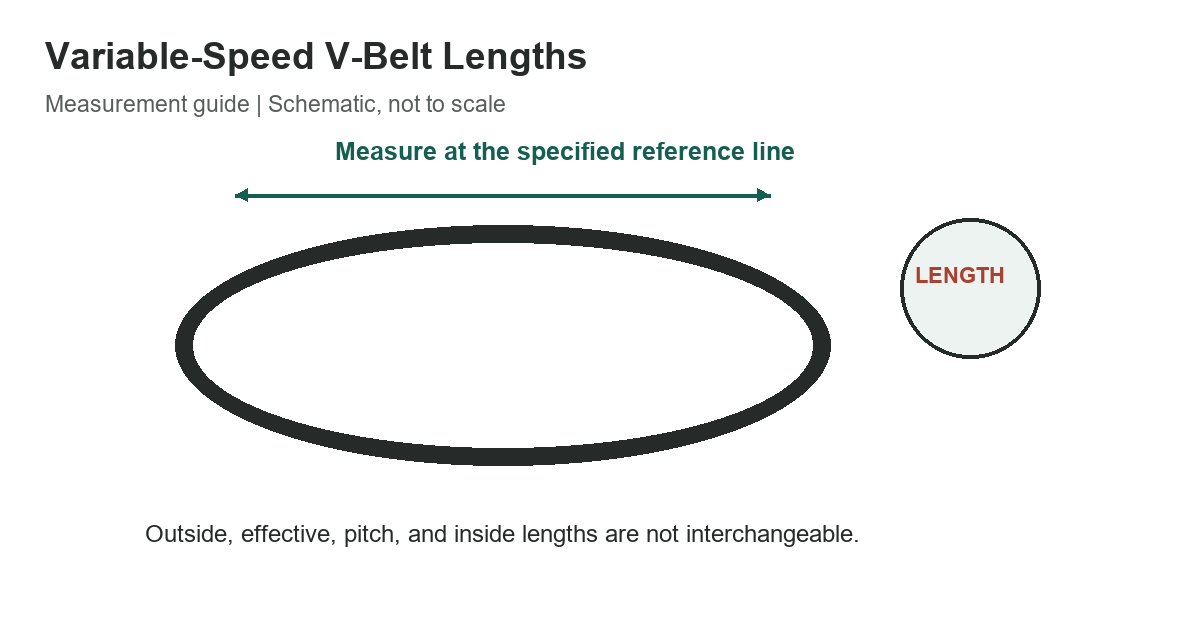
The historic table lists standard designations alongside effective lengths for several variable-speed profiles. Effective length describes the belt measured at its specified working reference line; outside circumference and other length measures can differ. The numeric designation is a catalog identifier, not a safe substitute for measuring the installed belt or checking a current part number.
Selected values for designation 600
The following are selected rows from one designation column in the source. Lengths and tolerance are in inches. Other profile families and designations are omitted, so do not infer their values from these examples.
| 1422V | 60.6 | +/- 0.9 |
|---|---|---|
| 2322V | 60.8 | +/- 0.9 |
| 3226V | 60.9 | +/- 0.9 |
| 4436 | 61.3 | +/- 0.9 |
| 4836 | 61.4 | +/- 0.9 |
5 rows
Scroll horizontally to view all columns.
For this historical selection, profile 2322V has an effective length of 60.8 inches at designation 600. The listed tolerance is plus or minus 0.9 inch. A current catalog may identify the same family using a fuller code and a different named measurement field; match the exact code before treating the figures as equivalent.
Why profile code matters
Variable-speed drives change their operating ratio by moving the belt across adjustable sheave faces. Belt width, angle, construction, and flexibility determine how it tracks and transmits load. Similar-looking belts can belong to different profile families and are not necessarily interchangeable.
Gates product listings, for example, publish complete codes such as 2322V347 and identify product characteristics separately from length. The example demonstrates why a short designation alone is not enough to order a replacement. Check the equipment manufacturer’s parts list, then confirm the belt maker’s profile and measurement definition.
Measure the existing drive carefully
If the original belt marking is readable, record every character. If it is not, document the driven equipment model, sheave geometry, center distance, and adjustment range. Measure the belt using a method intended for its profile; a flexible tape around the outside can produce a value that does not match effective or pitch length.
Inspect the sheaves for wear, polished sidewalls, debris, and damage. A belt that rides at the wrong depth may indicate a worn groove or incorrect section rather than a length problem. Follow the equipment maker’s tensioning procedure and do not use extra tension to compensate for poor fit.
Length tolerance is not a substitute for the drive’s adjustment range. A nominal belt can fall within its permitted manufacturing variation yet still be a poor fit if the equipment cannot move the sheaves or centers far enough to tension it. Confirm the usable adjustment window and the belt’s required operating range with the drive documentation.
Variable-speed mechanisms may also use matched belt and sheave profiles designed for a particular speed range. A small length difference can shift the belt’s running position and change the ratio or tracking behavior. Where the manufacturer’s model-specific parts list is available, it is the strongest starting point for replacement identification.
Check availability before redesigning
The source cautions that sizes may not be available from every manufacturer and recommends confirming stock before committing a design. Treat that as a practical warning, especially when changing the drive rather than replacing a known belt. A substitute must meet the required profile, speed, power, wrap, and adjustment range.
- Record the full belt profile and part number.
- Distinguish designation from effective, pitch, and outside length.
- Confirm the current maker’s tolerance and measurement method.
- Check sheave wear and drive adjustment range.
- Verify availability and equipment compatibility before ordering.
Review air-compressor types, compare table-saw options, and visit the size-chart library for more workshop references.
References
See the current Gates variable-speed belt listing and Gates belt identification chart. Confirm dimensions and stock with the belt manufacturer before specifying a drive.