A replacement circular-saw blade must match the saw’s specified blade diameter, center-hole size and shape, speed rating, and intended cutting application. A 7-1/4-inch blade is not automatically compatible with every 7-1/4-inch saw. Some use a 5/8-inch round arbor; some worm-drive models use a diamond interface. Other saws use metric bores. Read the exact model’s manual and the blade marking before buying or fitting a replacement.
The chart below compares a few documented examples. It is an identification aid, not an approval to adapt a blade to a different saw. Disconnect the power source before inspecting the arbor, flanges, or blade.
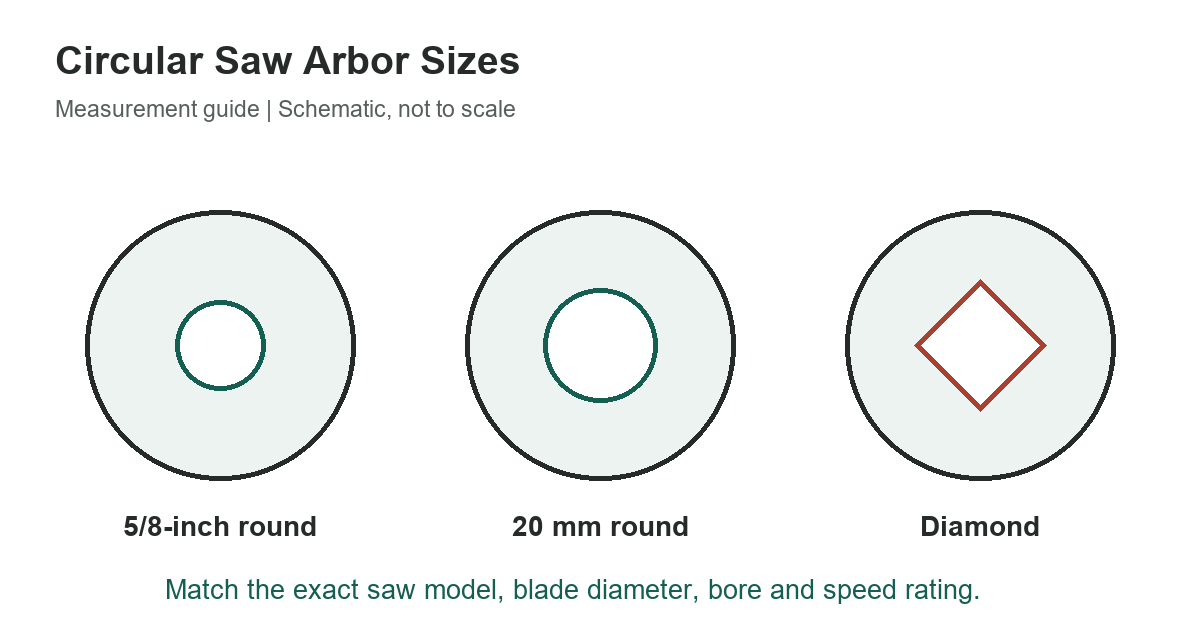
Documented circular-saw arbor examples
Blade diameter and arbor are separate columns because both must match. A blade’s material designation, kerf, maximum speed, and approved application still need checking even when its center hole fits. Regional variants and later model revisions may differ from the examples shown.
| Makita 5007F | 7-1/4 in | 5/8 in round | Confirm exact US model manual |
|---|---|---|---|
| Bosch GKM18V-20N | 5-3/8 in | 20 mm round | Metal-cutting model; match blade application |
| SKIL SPT77W | 7-1/4 in | Diamond | Use approved diamond-compatible blade |
3 rows
Scroll horizontally to view all columns.
The metric equivalent of 5/8 inch is 15.875 mm. That is not a 20 mm bore: the nominal diameter difference is 4.125 mm. Treating those labels as near equivalents would leave a substantial mismatch. A blade must locate and clamp in the exact manner intended by the saw and blade manufacturers.
What the arbor dimension describes
The arbor is the saw’s blade-mounting spindle or mounting interface. The blade’s center hole must suit it, together with the specified flanges, washers, and fastener. Measure a round interface across its diameter. A diamond drive is a shape as well as a size; do not try to identify it by measuring one diagonal and comparing that number with a round-hole chart.
Keep the manufacturer’s original mounting parts in the specified order and orientation. A washer that looks similar may differ in its locating shoulder, relief, thickness, or contact surface. If a component is missing or damaged, obtain the correct replacement using the tool’s model and parts documentation.
Round holes and diamond knockouts
Some blades are manufactured with a removable diamond knockout around a smaller round center hole. SKIL describes this feature on its 75724W framing blade. That feature is intentional only on blades that identify and support it. It is not permission to cut, file, or drill a diamond opening into any blade.
Follow the blade maker’s instructions if a specified knockout must be removed for a compatible saw. Once modified in the approved manner, the blade may no longer suit the original round-arbor application. If the required fitting procedure or resulting compatibility is unclear, stop and check the manufacturer’s documentation.
Why blade diameter alone is insufficient
Different saw designs can use similar-looking blades for different materials or mounting systems. The Bosch metal-cutting example in the chart uses a 20 mm arbor and a 5-3/8-inch blade, while the Makita wood-cutting example uses a 5/8-inch arbor and a 7-1/4-inch blade. These are model-specific observations, not a universal rule connecting blade diameter with arbor size.
Also check the blade’s maximum rotational speed against the saw’s requirements. Do not fit a blade whose marked speed capability is inadequate for the saw. Match the cutting application: a center hole that fits does not make a woodworking blade appropriate for metal, masonry, or another material.
Be cautious with reducing rings and adapters
Some saw-and-blade systems allow particular reducing rings; others do not. Use one only when the relevant manufacturers expressly approve the combination and its installation. Do not improvise a bushing from scrap, stack washers to compensate for a wrong bore, or rely on the bolt alone to center an oversize hole.
A ring must not interfere with the intended flange contact or leave the blade inadequately clamped. If the manual requires a specific arbor shape or mounting arrangement, select a blade that meets it. When correct parts are unavailable, waiting for the right blade is preferable to changing the mounting system by guesswork.
Checks before the first cut
- Read the full saw model number and obtain its current manual.
- Match blade diameter, bore size, bore shape, material application, and speed rating.
- Inspect the blade and all mounting components for damage, debris, and incorrect parts.
- Fit and tighten the assembly exactly as directed; check guard operation according to the manual.
- Secure the work and arrange support so the offcut and main piece will not trap the blade.
If a blade will not seat correctly, remove it and find the cause with the saw disconnected. Do not run the tool to see whether a poorly fitting blade will center itself. Unexpected vibration, rubbing, or an abnormal sound calls for stopping and investigating the assembly.
For workshop planning, compare folding work tables and garage workbenches. The reference-chart library contains other tool measurement guides.
Model and blade references
Confirm specifications against Makita’s 5007F product information, Bosch’s GKM18V-20N specifications, and SKIL’s SPT77W model information. SKIL’s 75724W blade description explains its particular diamond-knockout feature.