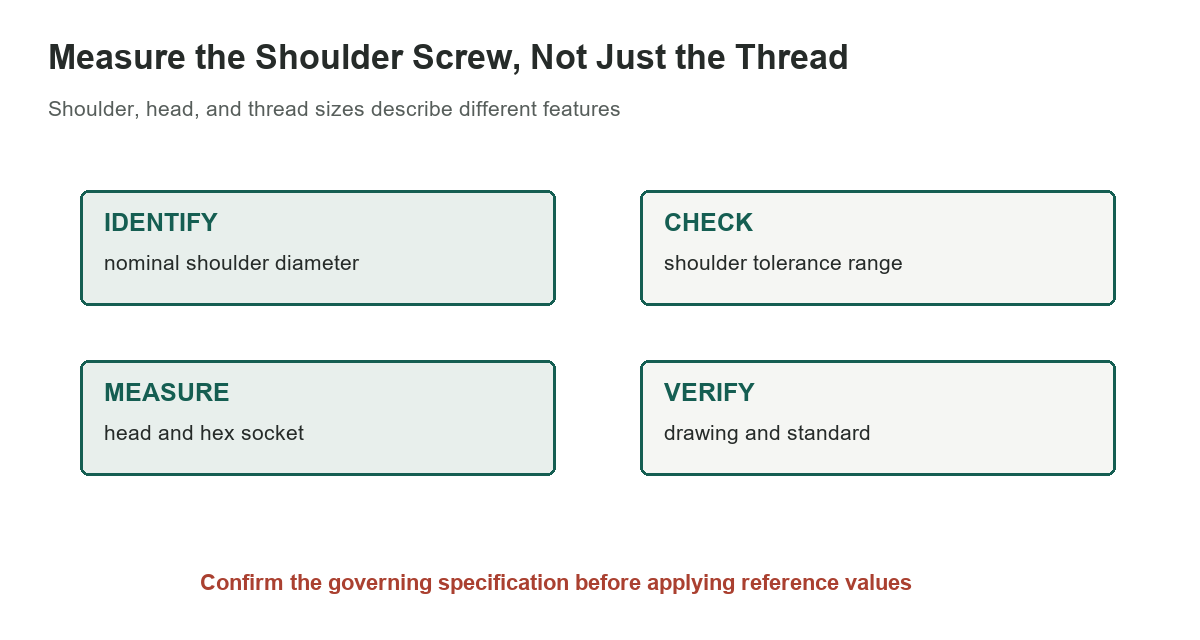
A shoulder screw is identified by more than its thread. The smooth shoulder controls the locating or bearing diameter, while the head and threaded end have their own dimensions. This selected metric table summarizes seven nominal shoulder diameters from the historical ANSI/ASME B18.3.3M reference. It is an identification aid; use the current drawing and approved specification for purchase or engineered replacement.
[gs_table id=”11430″]
Read the dimensions by feature
The table lists nominal shoulder diameter, shoulder diameter limits, head diameter limits, head-height limits, nominal thread size, and hex-socket size. Range cells are written minimum-to-maximum so they scan naturally. The source table presents maximum and minimum in separate columns, so always confirm which boundary applies before checking a part. All listed dimensions are millimetres.
The shoulder is not the thread diameter, and the socket size is not the head diameter. A screw with the correct thread can still have the wrong shoulder fit, head clearance, or socket-drive size. The source page’s lower table contains additional neck, fillet, and head-extension dimensions that are not included in this compact selection. Shoulder fit is particularly important where the smooth section locates a rotating or moving component. Check the mating bore, shoulder length, and load-bearing contact independently; the diameter range alone does not establish adequate engagement or prevent binding.
Do not confuse shoulder screws with cap screws
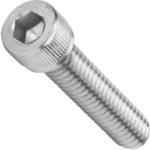
A metric socket-head cap screw has a threaded shank rather than the unthreaded precision shoulder that defines this fastener family. The site’s hex lag screw dimensions and metric heavy hex screw reference cover different thread and head families. Its bolt and wrench-size chart also covers other head styles. Similar nominal threads or wrench sizes do not make these parts interchangeable.
Treat the cited edition as historical
The source identifies ANSI/ASME B18.3.3M-1986, reaffirmed in 2008. ASME describes the metric shoulder-screw document as available for historical reference and says it is no longer an American National Standard or an ASME-approved standard. That status means the table can help interpret an older part or drawing, but it should not silently replace a current customer or engineering requirement.
The selected values do not reproduce the complete standard, its inspection provisions, material or mechanical requirements, part-number system, or every dimensional feature. The ASME standard page states that the full document includes dimensional, mechanical, and performance requirements. Use the exact standard edition required by the drawing and confirm any proposed substitution with the responsible design authority.
Measure and order with a complete record
For an existing fastener, record the nominal shoulder diameter, measured shoulder, shoulder length, thread size and pitch, head diameter, head height, socket size, material or property marking, coating, and manufacturer part number. Use suitable measuring tools and consider wear, plating, burrs, and damage. A caliper reading alone cannot confirm conformance or strength.
When replacing a shoulder screw, verify mating-hole fit, bearing surface, shoulder engagement, clearance, thread engagement, and the specified assembly method. Do not infer torque from the socket size or choose a replacement from the nominal shoulder diameter alone. Keep the drawing revision and supplier documentation with the part record. If a measured dimension falls outside the cited range, do not modify the screw or bore to force a fit; determine the cause and approved corrective action first.
Before procurement
Confirm whether the design calls for a shoulder screw, socket-head cap screw, or another fastener. Then check the approved standard and edition, all required shoulder and head dimensions, thread engagement, material, finish, and traceability. If the historical table is the only reference available, escalate the specification question rather than treating a close dimensional match as approval.
Sources: Machinery’s Handbook, 31st edition, metric socket-head shoulder-screw Table 6a, printed page 1719, ASME B18.3.3M: Metric Socket-Head Shoulder Screws