A plastics family can help narrow a material search, but it cannot tell you whether a specific part will survive its actual load, temperature, fluid and manufacturing process. Use family descriptions as screening clues, then compare the exact grade data sheet with the part’s service conditions. Reinforcement, additives, molding history and stock-shape processing can change behavior substantially.
[gs_table id=”11222″]
Start with the job the part must do
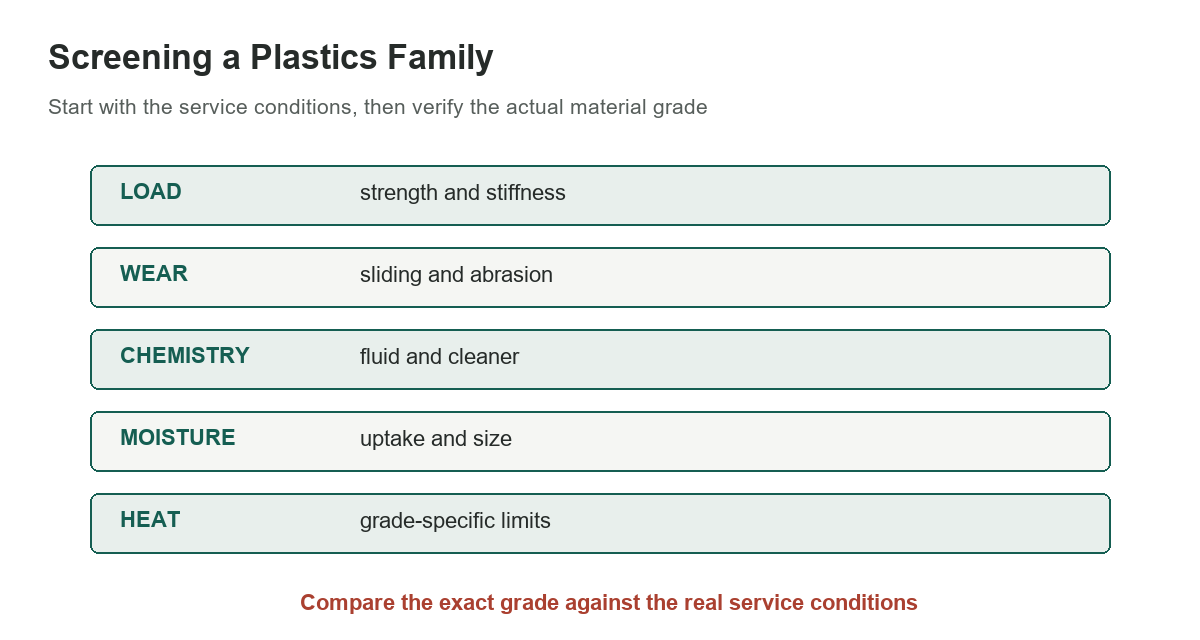
Write down the key requirements before selecting a polymer: static and impact loads, sliding or rubbing contact, temperature range, moisture, chemicals, sunlight, electrical needs, dimensional tolerance, fire requirements and expected life. Rank these constraints. A material that excels in one property may be a poor choice when another requirement controls, so avoid choosing by a single headline such as strength, heat resistance or chemical compatibility.
The table is intentionally qualitative. It does not assign universal temperature limits, strengths or wear rates. Those values depend on grade and test method. A supplier’s material page can describe a family, while the technical data sheet for a named product gives the values and conditions needed for an engineering comparison.
Distinguish a polymer name from a grade
Names such as nylon, acetal and polycarbonate identify broad chemistry families. A specific grade may be unfilled, lubricated, glass-reinforced, impact-modified, UV-stabilized, conductive or made for a regulated application. A filled grade may machine or wear differently from an unfilled material. Confirm the commercial designation, color, manufacturing route and any compliance certificate rather than assuming two products with the same polymer abbreviation are equivalent.
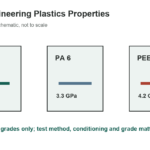
For example, POM homopolymer and copolymer have different property tradeoffs, while nylon moisture absorption can affect dimensions and mechanical response. Those are selection prompts, not a substitute for the supplier’s grade-level data. The engineering-plastics property comparison covers selected POM-C, PA 6 and PEEK properties; this page instead helps decide which family to investigate.
Match the environment and manufacturing method
Chemical resistance depends on the chemical, concentration, temperature, exposure time and mechanical stress. A generic compatibility chart can be a starting point, but mixtures and real operating cycles may behave differently. Check the exact supplier’s chemical-resistance information and test the material under representative conditions when failure would be costly or hazardous.
Moisture and temperature can change dimensions. Nylon is known for moisture uptake, while polypropylene can have relatively high thermal expansion. Machined stock, molded parts and reinforced compounds may respond differently because orientation, residual stress and wall thickness vary. Ask the manufacturer which properties apply to the process and product form you plan to use.
Manufacturing also affects what is practical. Injection molding can support complex geometry at volume, while machining stock shapes is useful for prototypes and low-volume parts. Thin walls, ribs, snap features, shrinkage, weld lines and fiber orientation all affect part performance. A resin data sheet alone does not validate the finished geometry or production process.
Compare properties on matching terms
When comparing data sheets, check units, specimen orientation, conditioning, test method and temperature. Tensile strength, flexural modulus, impact strength and heat-deflection temperature answer different questions. A value measured dry at room conditions may not represent a wet component in a warm enclosure. Design values should include appropriate safety factors and follow the governing application requirements.
For molded-part planning, see the injection-molded wall-thickness guide. For fiber-reinforced sheet materials, the G-10, G-11 and GPO-3 comparison covers thermoset laminates, a different material class from the thermoplastics summarized here.
Make the final choice with the supplier
Before releasing a design, document the grade, supplier, product form, environment, load cases, dimensional limits and test basis. Confirm that the proposed material is available in the required size and color, and ask the supplier to review unusual chemical or temperature exposure. If the component is safety-critical, use qualified material data and application-specific testing rather than a general-purpose chart.
Sources: Ensinger POM guide, polyamide guide, polycarbonate guide, polypropylene guide and PTFE guide.