Plastic material charts can look precise while hiding the most important detail: the number belongs to a particular grade, product form, test method and conditioning state. This compact comparison uses current supplier data for three named, unfilled stock grades. It is a first-pass reference for comparing a candidate material, not a substitute for a design datasheet or engineering review.
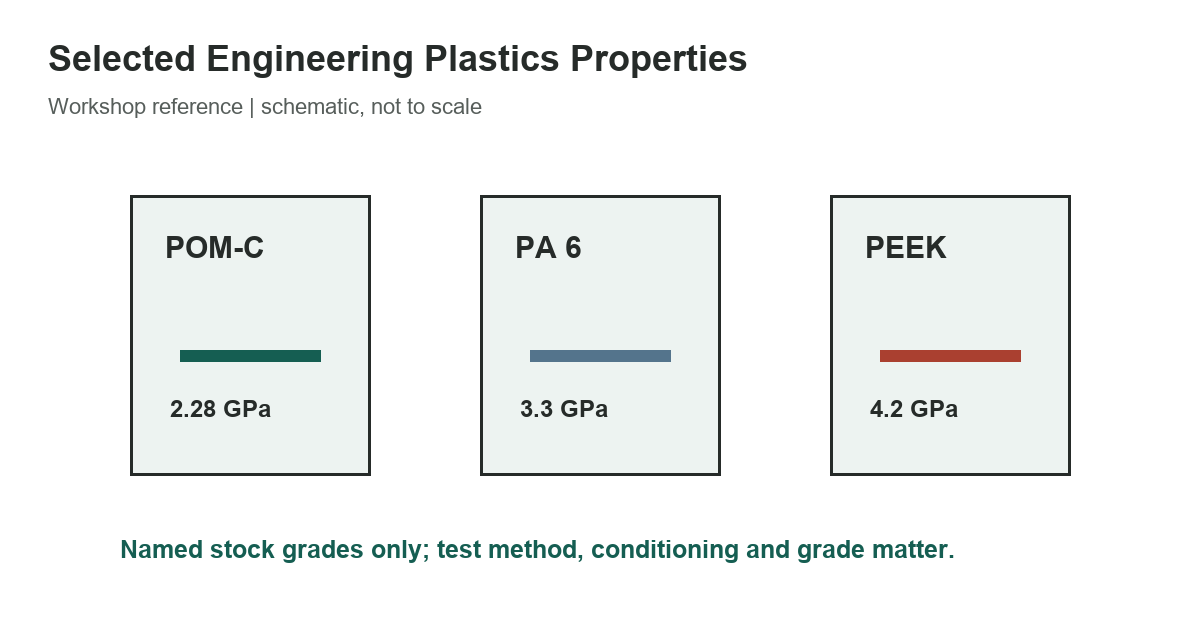
Selected supplier-reported properties
The tensile-modulus values below come from the manufacturer pages for the grades listed. The POM-C value is converted from 330,000 psi using the exact factor 1 psi = 0.006894757 MPa and rounded to 2.28 GPa. The PA 6 and PEEK values are reported in MPa and expressed in GPa by dividing by 1,000. Density is copied in the supplier’s stated units.
[gs_table id=”10971″]
Use the rows as grade-specific starting points
TECAFORM AH natural is an unfilled POM-C copolymer stock shape. Ensinger describes this grade as a balance of strength, stiffness, wear behavior, low moisture absorption and dimensional stability. These traits can make it a candidate for machined guides, gears or wear parts, but the application still has to be checked for temperature, chemical exposure, load direction, lubrication and creep. Another acetal grade, filled version or product form may have different values.
TECAMID 6 natural is a named PA 6 stock grade. The supplier reports high toughness and strength, while also noting that PA 6 absorbs more moisture and is less dimensionally stable than cast PA 6C. Moisture and temperature can change dimensions and performance. Where a fit is close, check conditioning, machining allowance, operating humidity, section size and supplier guidance instead of treating the dry datasheet number as a guaranteed service value.
TECAPEEK natural is an unfilled PEEK stock grade. Its listed modulus is higher than the two listed examples, and its supplier describes heat, chemical and creep resistance as key features. That does not establish that PEEK is automatically the best choice: cost, chemical compatibility, sterilization or regulatory needs, wear pair, load duration and actual service temperature all matter. Reinforced PEEK grades are not interchangeable with this natural grade.
Why the modulus numbers are not a ranking by themselves
The table mixes ASTM D638 tensile testing for POM-C with DIN EN ISO 527-2 values for PA 6 and PEEK. ASTM D638 defines conditions such as specimen preparation, pretreatment, temperature, humidity and testing speed; supplier-reported results are not simply independent of those choices. ASTM D638 and ISO 527 address similar subject matter but are not technically identical methods.
Modulus describes stiffness in the measured test direction and range; it is not a safe design stress, yield limit or load rating. A component can fail through creep, fatigue, impact, chemical attack, stress concentration, poor fit or heat well before a simple modulus comparison answers the design question. For bending, a tensile-modulus value is not a replacement for the supplier’s flexural data and test method.
For a real part, request the current data sheet for the exact grade, color, reinforcement and stock form. Confirm that the property is typical or specified, read its test standard and conditioning notes, and identify whether it is measured at room temperature. When the part is safety-critical or loaded for long periods, use the supplier’s design guidance and a qualified engineer rather than applying a generic chart value.
Check thermal and moisture effects before machining
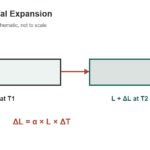
Engineering plastics expand more with temperature than most metals, and some absorb enough moisture to change dimensions. POM-C and PA 6 are not identical in this respect; the PA 6 supplier explicitly notes moisture-related dimensional limitations. Check the coefficient of thermal expansion, moisture absorption, long-term service-temperature definition and recommended conditioning for the selected grade. A short-term maximum is not the same as a continuous operating temperature.
Machining can release residual stress, and thin webs or long spans can move as material is removed. Use supplier machining guidance, appropriate tool geometry and staged cuts where needed. Verify dimensions after the part has equilibrated to the intended environment. Do not assume a stock bar’s nominal size is its finished-part size or that a catalog tolerance applies to every supplier.
Practical comparison checklist
Before selecting between grades, write down the actual load type, direction, duration, temperature range, chemical contact, moisture exposure, required tolerance, mating material and production quantity. Compare values measured with compatible methods and conditions wherever possible. If methods differ, treat the entries as screening information and ask the supplier for directly comparable values.
Verify the exact product designation on the certificate or label and keep the revision of the technical data sheet with the drawing or material record. If the material changes, recheck fit, wear, thermal movement, chemical compatibility and regulatory requirements. A polymer family name alone is not a purchasing specification.
Related references: exact inch-to-metric length relationships, rose chucking reamer dimensions, and ribbed-neck bolt dimensions. Each covers a separate shop-reference task.
Sources and scope
Supplier-reported data are from the Ensinger pages for TECAFORM AH natural, TECAMID 6 natural and TECAPEEK natural. Method context is described by ASTM’s active D638 and D790 pages. Values are product facts, not allowable design stresses.