“Reinforced plastic” describes a broad family, not a single material specification. A glass-cloth/epoxy laminate, a glass-mat/polyester laminate, and a molded glass-filled thermoplastic can differ in resin chemistry, reinforcement architecture, moisture response, electrical behavior, machining characteristics, and directional strength.
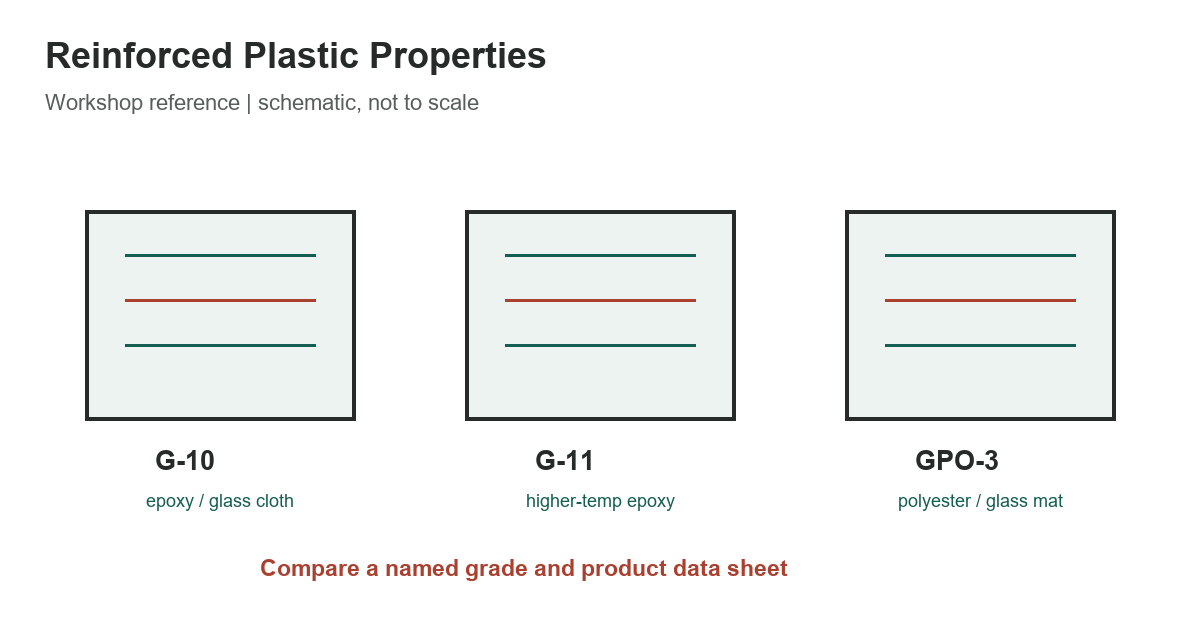
Compare named grades, not generic labels
The table shows a few current supplier-listed examples to illustrate why product names and grade details matter. G-10 FR-4 and G-11 are glass-cloth/epoxy laminates; GPO-3 is a glass-mat/polyester family, and H900 is one specific grade. The figures are typical supplier values, not guaranteed minimums or engineering design allowables. Do not apply them to a different manufacturer’s product or a vaguely described “fiberglass sheet.”
| G-10 FR-4 Natural | 45,000 psi | 75,000 psi | 284 F max continuous value listed |
|---|---|---|---|
| G-11 | 43,000 psi | 80,000 psi | 165 C max continuous value listed |
| GPO-3 H900 | 9,000 psi | 18,000 psi | Grade-specific supplier data |
3 rows
Scroll horizontally to view all columns.
The older handbook matrix includes legacy materials and asbestos-containing entries; those are deliberately excluded. No asbestos-containing material is recommended or compared here. For new work, identify a current, traceable product and review its safety data sheet and applicable regulations.
Understand what a property number represents
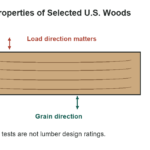
Tensile and flexural strengths come from different test configurations and should not be treated as interchangeable. A laminate’s measured performance depends on specimen direction, reinforcement orientation, thickness, conditioning, test method, and the product’s construction. A supplier’s “typical” value describes a representative result, not a guaranteed lower bound for every sheet.
Temperature notes also require care. A listed maximum continuous operating temperature is not necessarily a structural design temperature at full strength. Strength, stiffness, electrical properties, creep, and dimensional stability can change with heat and exposure time. If a component carries load near its thermal limit, request the exact grade’s property-retention information and validate the design at operating conditions.
Match construction to the job
Glass-cloth/epoxy grades such as G-10 are often selected for strength, dimensional stability, and electrical applications. G-11 is formulated for elevated-temperature service relative to G-10, but the exact grade and temperature-dependent properties still need review. GPO-3 products are used in electrical insulation and related applications, with properties dependent on the named grade and sheet construction.
Those descriptions are not blanket suitability approvals. Electrical insulation requires voltage, creepage, clearance, tracking, flame, and environmental checks. Mechanical designs need loads, stress concentrations, fatigue, fastener bearing, edge distance, moisture, and temperature. Chemical exposure can attack the resin even when the glass reinforcement remains intact.
Account for anisotropy and machining
Laminate properties may vary with the direction of the cloth or reinforcement. Ask how the supplier defines its test direction and whether a value is in-plane, through-thickness, or based on a particular specimen orientation. Drilling and machining can expose fibers, create burrs, or damage edges. Tooling, dust collection, protective equipment, and finishing methods should follow the material supplier’s safety guidance.
When comparing quotes, record the manufacturer, exact grade, resin and reinforcement, thickness, color, certification, test method, and data-sheet revision. If the part is safety critical, establish allowable values using the appropriate design basis, factors, environmental conditions, and qualification tests; do not size a component directly from this comparison table.
Also check whether the quoted product is a flat laminate, molded composite, or machined stock, and whether the supplied surface treatment changes the electrical or bonding performance. Ask for traceability when the part must meet a regulated or customer-controlled specification. A substitute grade should be reviewed against the complete drawing and service conditions, not accepted solely because its headline tensile value is similar.
- Specify a supplier and exact grade.
- Separate typical values from guaranteed data and design allowables.
- Check test method, direction, thickness, and conditioning.
- Verify electrical, chemical, moisture, and temperature suitability.
- Use current safety documentation and exclude legacy asbestos materials.
For related material references, see the PVC pipe size chart, the running-board materials overview, and the compressed-air pipe reference.
References
Review the product-specific listings for G-10 FR-4 and G-11, the glass-composites family overview, and the GPO grade property sheet.