Magnesium treatment charts require special care because process names and specifications change over time. The historical handbook page cites MIL-M-3171C, lists Type I, Type III and Type IV descriptions, and contains an incomplete thickness entry. The Department of Defense canceled MIL-M-3171C in 1998 and identified AMS-M-3171 as a suitable replacement at that time, with an explicit warning to evaluate applicability. Do not use the old chart as a current process specification.
[gs_table id=”11259″]
Read the current classification on its own terms
ASTM D1732-03(2023) is listed as active and covers chemical and anodic treatments for preparing magnesium alloy surfaces for painting. Its organization uses Class I for chemical treatments and Class II for anodic treatments, with named types under those classes. That taxonomy is not a direct renaming of every historical MIL-M-3171C process, so do not infer equivalence from similar type numbers.
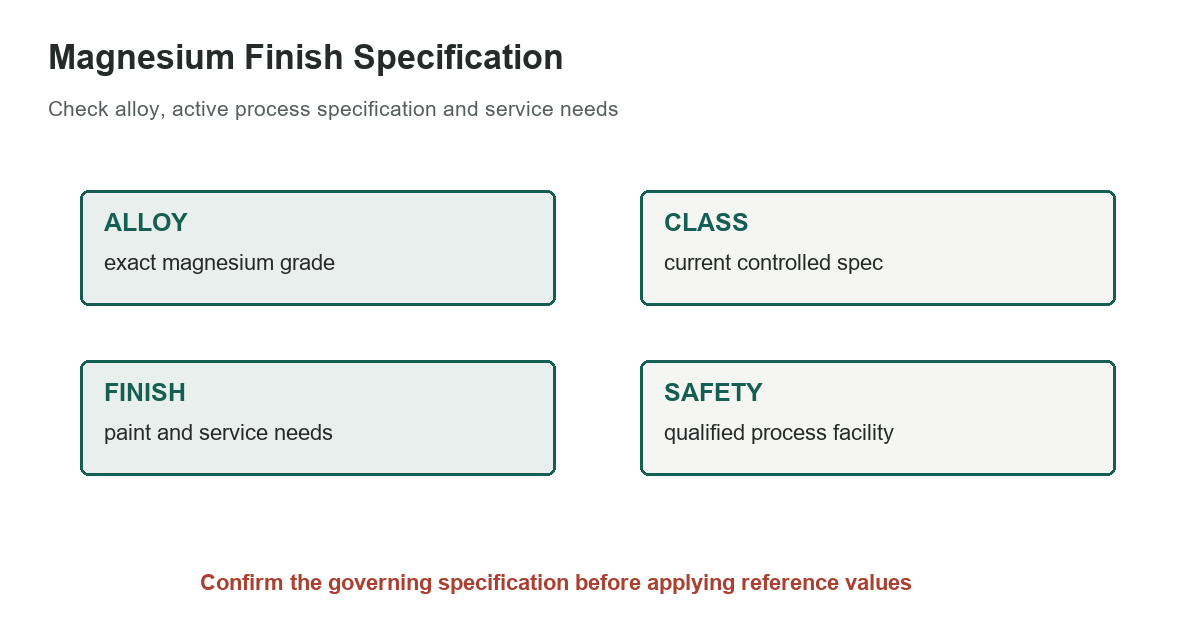
The table is a high-level map of the current class structure, not a recipe, bath specification or acceptance standard. Obtain the controlled version of the applicable specification and verify alloy limitations, pretreatment, coating type, inspection method and paint-system compatibility. The required treatment depends on the part’s alloy, geometry, exposure, service life and customer requirements.
Do not rely on an old thickness or appearance note
The handbook excerpt reports that one historical process removes metal and shows no dimensional change for another entry, while the Type III thickness cell is missing. Those statements are not interchangeable with a modern coating allowance or dimensional tolerance. Surface preparation, pickling, anodizing and conversion coating can all affect dimensions and fit. Ask the processor for the current process specification and a drawing-specific allowance.
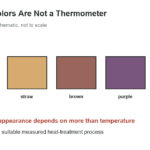
Color is not proof of coating identity, corrosion performance or conformity. A black or gray surface may result from different chemistries and process conditions. Confirm the process documentation, lot traceability, test evidence and required finish with the supplier instead of accepting by color alone.
Include safety and environmental review
ASTM warns that its practices can involve hazardous materials and operations. The active D1732 page also cautions that its hexavalent-chromium-based methods are not recommended because hexavalent chromium is a known carcinogen. This article intentionally omits chemical recipes and operating instructions. A qualified finishing facility must evaluate worker protection, ventilation, waste handling, environmental rules and the current legal requirements for the process.
Specify the desired performance and approved standard rather than naming a legacy chemistry without context. If the part is for an aerospace, automotive, defense or regulated application, use the contractually applicable process document and approved-supplier requirements. A general shop chart cannot establish compliance.
Distinguish surface treatment from alloy condition
Surface treatment does not change the base alloy designation or replace material condition requirements. Verify alloy and temper separately, then confirm coating compatibility with fasteners, inserts, sealants and paint. Dissimilar metals, trapped moisture and damaged coating edges may create corrosion concerns that are not resolved by selecting a treatment label alone.
For sheet-metal measurements, see the sheet-metal gauge chart, galvanic-corrosion guide, and steel temper-color guide. These guides cover substrate dimensions; they do not specify magnesium finishing processes or coating performance.
What to send to a finishing supplier
Provide the alloy, part drawing, service environment, paint or adhesive system, dimensional limits, masked areas, contact surfaces and required inspection records. Identify the current standard and revision by full designation. Ask whether the process is qualified for the exact alloy and geometry, and whether the proposed pretreatment can remove material beyond the drawing allowance.
Keep the historical handbook values only as a clue for locating the old terminology. Before release, confirm the current controlled specification, its cancellation or supersession notices, and the responsible customer’s acceptance criteria. This avoids treating an incomplete historical chart as an approval document.
Sources: DLA cancellation notice, ASTM D1732-03(2023), and ASTM Committee B08 guidance.