GTAW tungsten current guidance depends on more than electrode diameter. Alloy, tip shape, AC waveform or balance, shielding gas, power source and the welding procedure all affect the usable range. These two rows are selected reference examples for pure tungsten (EWP) and zirconiated tungsten (EWZr); they are not machine settings or guaranteed limits for every product.
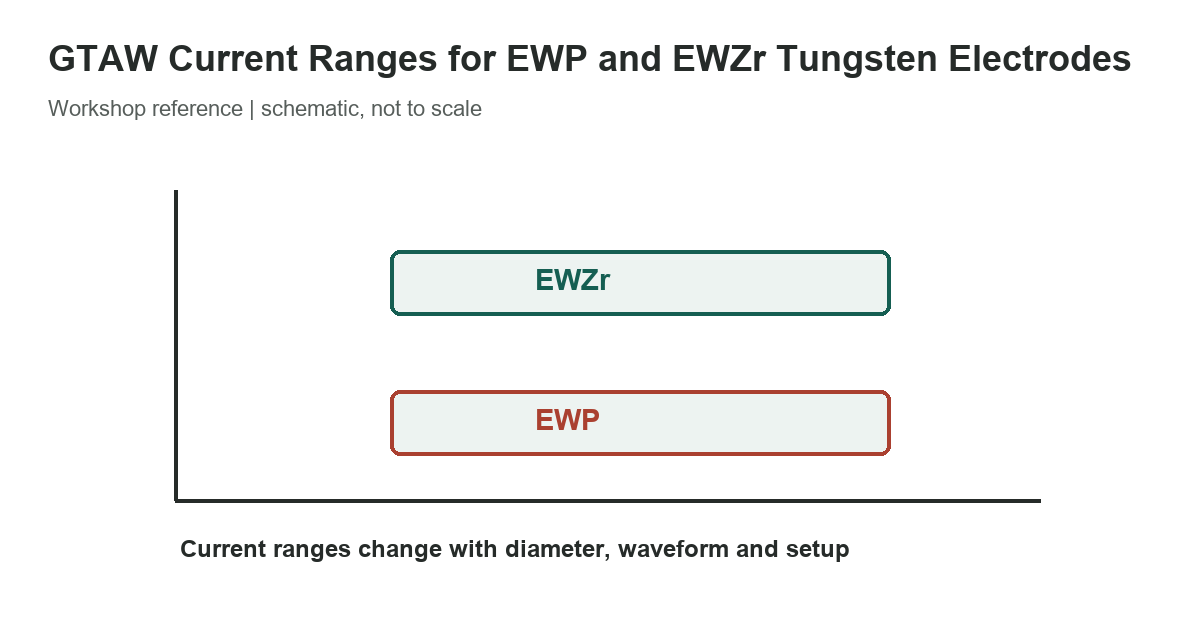
Selected AC reference ranges
Each paired value is ordered EWP first and EWZr second. The chart distinguishes balanced and unbalanced AC, so do not move a number across those conditions. The second row uses a larger electrode and shows why a diameter change affects the range, while the alloy choice still matters.
[gs_table id=”11034″]
Read the electrode classification
EWP identifies pure tungsten; EWZr identifies a zirconium-oxide tungsten classification. Supplier product pages may give an ISO designation, AWS classification, oxide percentage or color band. Confirm those markings on the exact package. Colors alone are not a reliable purchasing specification because the details can vary by supplier and product generation.
CK Worldwide describes zirconated tungsten as an AC option for aluminum and magnesium alloys, with a balled end and greater current capacity than pure tungsten in its product guidance. This is a product-family recommendation, not a universal rule for every alloy, waveform or joint. Other modern electrode families may be preferred by the power-source maker or a qualified welding procedure.
What balanced and unbalanced AC mean
AC balance describes how the machine divides the cycle between electrode-negative and electrode-positive portions. A balance adjustment can change cleaning action, penetration and heat at the tungsten. The terms and percentage direction differ among machine interfaces, so consult the welder manual rather than assuming a displayed percentage has the same meaning across brands.
Some current charts label a waveform as balanced or unbalanced; a modern inverter may expose a numerical balance setting and allow independent frequency or waveform adjustments. Those controls are not necessarily equivalent to the reference chart’s test setup. Treat the listed range as a starting comparison only and use the procedure and current electrode maker guidance for the actual equipment.
Match diameter to the process
A tungsten that is too small for the current can overheat, erode or lose its tip shape. A diameter much larger than needed can make low-current arc starts and control more difficult. Select an electrode type and diameter using the required amperage, material, AC/DC mode, waveform and tip preparation together. Confirm that the collet, collet body and gas cup fit the selected electrode.
Check the shielding gas and gas coverage as well. The CK guide states that its current chart values are based on argon and that other values may be used depending on shielding gas, equipment and application. If helium or a mixed gas is specified, do not assume the argon range transfers directly.
Do not turn a range into a WPS
A reference range does not prescribe the amperage for a particular weld. Material thickness, joint preparation, heat sinking, travel speed, filler addition, position, preheat and the qualified procedure remain controlling. Follow the WPS when one applies, and verify the final setup with a qualified welding professional.
Inspect and prepare the electrode to the manufacturer’s instructions. Contamination, an altered tip, excessive stick-out, poor gas coverage or a worn collet can change arc behavior. If the arc is unstable, investigate the setup before compensating with a current change that falls outside the procedure.
Related references: GTAW tungsten type selection, SMAW electrode current guidance, and weld-joint geometry and proportions.
Source and scope
The selected values come from Table 19 on printed page 1599 of the 31st edition of Machinery’s Handbook. Industrial Press identifies the 31st edition as the 2020 edition. CK Worldwide’s technical guide gives separate typical ranges by diameter, electrode family and AC condition, and notes that its values are based on argon; its product page identifies EWP and EWZr classifications. Use the current chart for the exact electrode and machine. CK Worldwide technical guide; CK tungsten classification notes.