Do not use a steel color chart to set, verify, or approve a heat-treatment temperature. The colors are a historical visual reference for oxide films on cleaned plain-carbon steel. The handbook itself warns that composition affects the colors and says the method is not dependable. Light, scale, surface finish, contamination, heating time, and atmosphere can also change what you see.
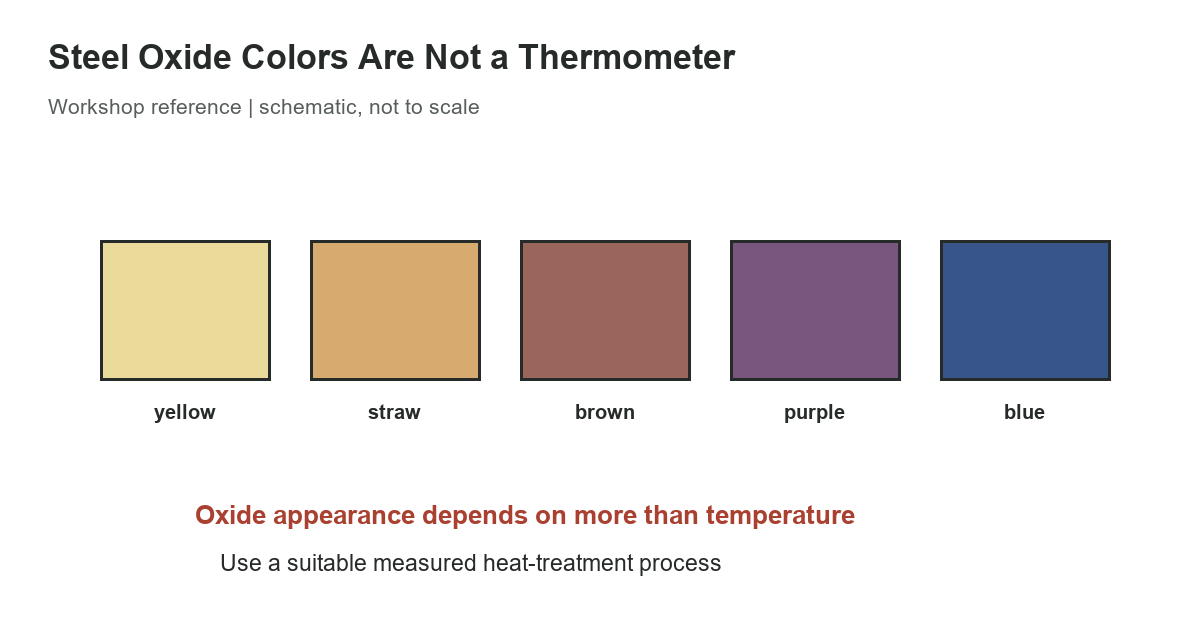
Selected historical color examples
The values below are selected entries from the handbook’s plain-carbon-steel chart. They show what the old reference associated with a particular surface appearance; they do not establish the temperature inside a part or the correct temper for a specific steel grade. The chart omits most possible colors and does not specify exposure time, surface preparation, or alloy chemistry.
[gs_table id=”11130″]
Why appearance is not a process measurement
Tempering color comes from an oxide film that forms on a heated steel surface. A clean, uniformly exposed surface may show a familiar sequence of straw, brown, purple, and blue tones, but the appearance depends on the film as well as temperature. Different grades can respond differently. Residual oil, scale, rust, polish, lighting, and the heating atmosphere make comparisons unreliable. A localized color can indicate a local heating event without describing the temperature of the full part.
That distinction matters because tempering changes hardness and toughness. A shade that resembles a handbook example cannot confirm the resulting properties, the temperature through the section, or whether a required time-at-temperature was achieved. Do not infer a steel grade, hardness, or safe service condition from color alone.
Also separate temper colors from the visible red-to-white glow of a much hotter steel surface. The terms refer to different visual phenomena and temperature ranges. This article’s selected values refer to a thin oxide film in the tempering range, not to judging forging, annealing, normalizing, or hardening temperature by the color of a hot workpiece. A dull-red surface under dim light and a straw-colored oxide under shop lighting should never be compared as if they came from one calibrated scale.
The source table itself contains gaps and uses descriptive color names, not an instrument tolerance. Lighting, eyesight, background, surface angle, and viewing time make those names subjective. Its values are included to explain the historical chart, not to recommend a target temperature. If a component has already changed color, the observation alone does not say whether it has lost strength; the alloy, prior treatment, and time-temperature history matter.
Use color only as a clue to inspect the process, not as a pass/fail test. A polished coupon may develop a more recognizable film than a scaled production part, and a local torch can heat one edge while leaving the core cooler. The same apparent shade can therefore describe different thermal histories. Record the steel identification and measured process conditions when repeatability matters.
Use a controlled heat-treatment procedure
Identify the exact steel grade and follow the supplier’s or heat treater’s procedure for austenitizing, quenching, tempering temperature, hold time, and cooling. Use a suitable calibrated temperature measurement and a controlled furnace or bath for work where properties matter. For a critical component, confirm the process and resulting properties with the required inspection or hardness test. A consumer oven dial or visual color is not a substitute for a validated process.
These examples are not instructions for torch tempering, welding, repairing a spring, or restoring a cutting edge. If you do not know the grade or prior treatment, ask a qualified heat treater before reheating the component. Our steel and sheet-metal thickness chart covers gauge dimensions, while the steel carbon-content reference and Rockwell scale guide cover separate material and measurement topics.
References
- NBS, Heat Treatment and Properties of Iron and Steel notes that observed heat colors depend on lighting and scale and calls the oxide-color estimate approximate.
- Machinery’s Handbook, 31st edition, Table 1, printed page 477 is the source of the selected color-temperature pairs and warns that composition affects the colors, making the method unreliable.
- ASM’s temper-color chapter describes oxide formation and time-temperature effects on steel.