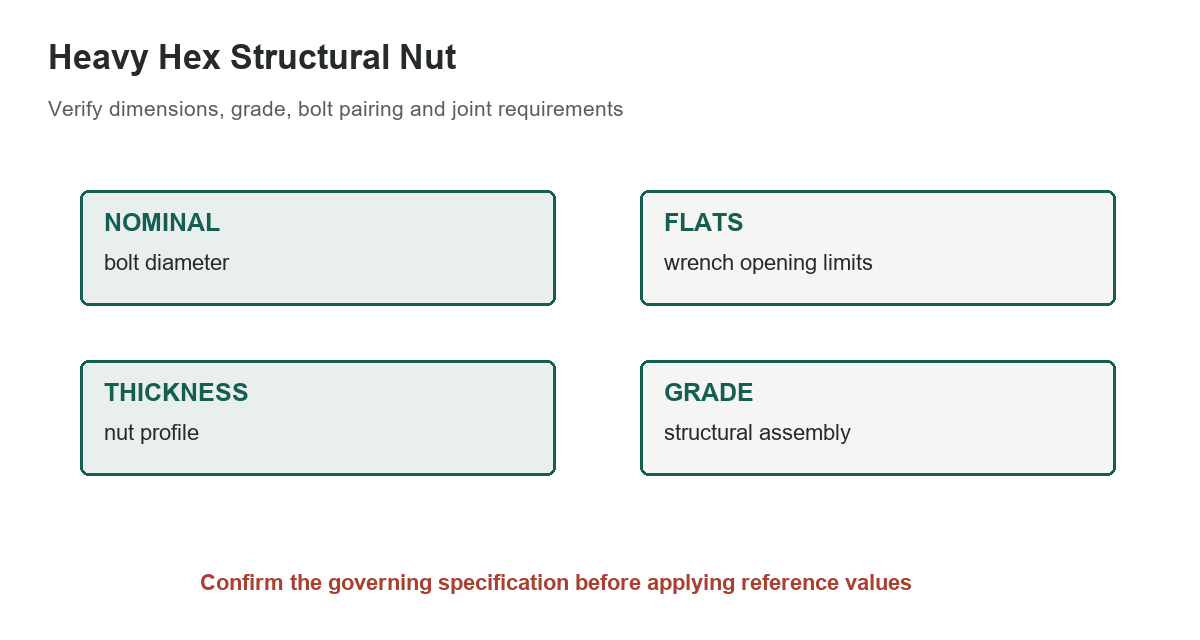
Heavy hex structural nuts are intended for structural bolting systems, not as a visual substitute for ordinary hex nuts. This compact chart shows selected dimensions from the inch-series handbook table. The source identifies ASME B18.2.6-2019 and includes notes that affect dimensions, bearing faces and proof-load interpretation; use the current governing documents for a real specification.
[gs_table id=”11251″]
Read nominal size and wrench opening carefully
Nominal size refers to the basic product diameter of the mating bolt, while width across flats describes the wrench opening. The minimum and maximum limits matter: a wrench should engage without rounding corners, and an inspection should use the applicable gages and tolerances. Do not infer the across-corners dimension by using a generic multiplier if the standard or drawing controls it directly.
The thickness column is also a defined dimension, not a guarantee that every nut sold for a bolt of that diameter is a structural heavy hex nut. Profile, material, grade marking, thread series, coating and manufacturing requirements determine whether a component is appropriate for an assembly.
Match the nut to the structural bolt assembly
ASME describes B18.2.6 as covering dimensional and general data for structural fasteners, including heavy hex nuts associated with ASTM A563. The nut grade and the bolt specification must be compatible. A dimensionally similar general-purpose nut is not automatically acceptable in a structural joint. Check project drawings, governing building or bridge requirements, procurement documents and the current fastener standard.
Proof load is a strength classification, not an installation torque. The handbook table separates proof-load categories and includes notes; this page omits those values to avoid separating them from the associated material and standard requirements. Do not calculate a tightening torque from nut dimensions or assume that one proof-load figure applies to every grade and size.
Account for bearing faces and installation
The source notes that heavy hex nuts may have different bearing-face configurations and specifies limits for runout. Surface condition and seating influence how load is transferred into connected material. Check for burrs, damaged threads, contamination, excessive coating buildup and a mismatch with the washer or bolt. Follow the qualified installation method for the joint.
Structural bolting is safety-critical. Inspection requirements may address lot traceability, grade markings, assembly condition, lubrication, pretension and the method used to verify installation. A shop chart can help identify a likely size, but it cannot replace the job specification or the responsible engineer’s requirements.
Keep wrench and socket charts in their lane
The bolt and wrench size chart, lug-nut socket chart, and SAE wrench size chart can help with related hand-tool identification. A wrench opening, socket drive and fastener nominal diameter are separate measurements. None of those references establishes structural nut grade, thread fit, bolt pretension or joint capacity.
When checking a heavy hex nut, record the nominal diameter, applicable standard and edition, grade, thread designation, coating, bearing-face style and required inspection method. Confirm that the mating bolt and washer are listed for the same application. If any item is unknown, pause procurement rather than choosing by appearance.
Use the chart as a screening reference
The table is a selected subset for quick dimensional orientation and does not include every nominal size, corner limit, runout value, thread requirement or proof-load category. Manufacturer tolerances and standard notes govern where they differ from a simplified chart. Confirm the complete dimension set before machining a wrench, designing clearance or accepting a delivered lot.
ASME identifies B18.2.6-2019 as the structural-fastener dimensional standard and notes that including dimensions does not mean every size is stocked. Check supplier availability and certification. For the exact project, use the contractually specified edition and consult the engineer of record when a substitution is proposed.
Sources: ASME B18.2.6 and ASTM A563. Related references: bolt and wrench size chart, lug-nut socket chart, and SAE wrench size chart.