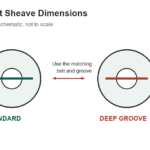
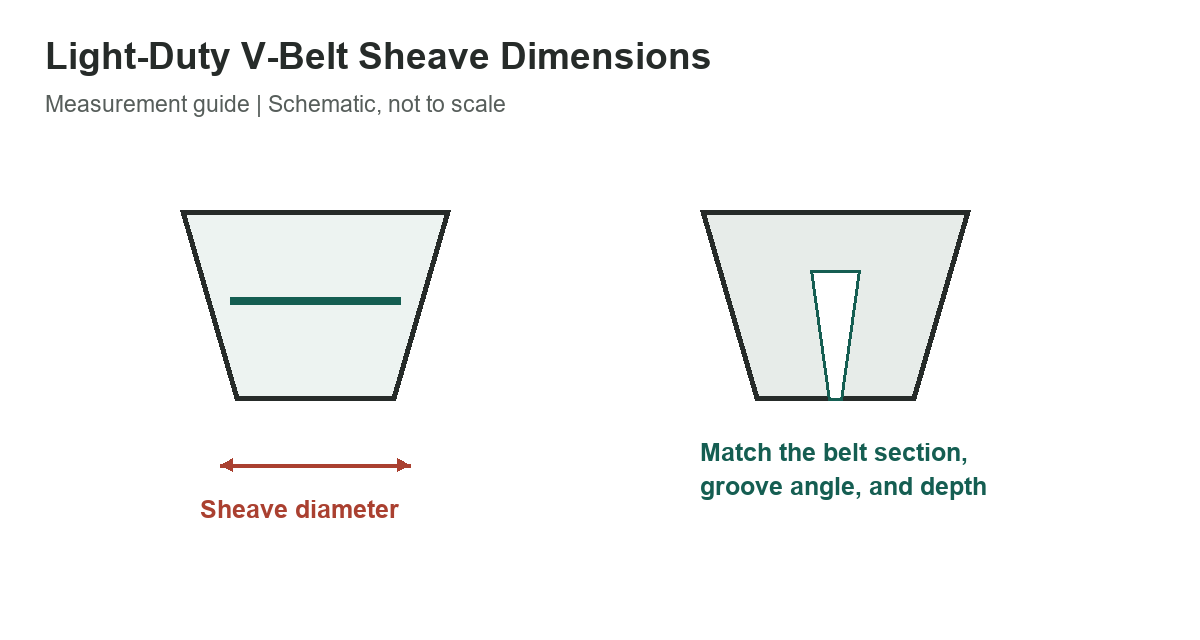
A light-duty V-belt sheave must match the belt section in groove width, angle, and depth. The minimum-diameter and groove dimensions below are selected historical reference values, not a substitute for a current component drawing. Groove angle varies with outside diameter, so the last column is only the smallest-diameter band shown for each section.
Selected groove dimensions
All dimensions are inches except the groove angle. “Ball diameter” is the source’s ball-gage dimension for checking groove geometry; it is not the belt’s width or thickness.
| 2L | 0.80 | 0.2188 | 0.250 | 32 |
|---|---|---|---|---|
| 3L | 1.50 | 0.3125 | 0.406 | 32 |
| 4L | 2.50 | 0.4375 | 0.490 | 30 |
| 5L | 3.50 | 0.5625 | 0.580 | 30 |
4 rows
Scroll horizontally to view all columns.
For a 4L section, the selected minimum recommended sheave outside diameter is 2.50 inches, with a 0.490-inch minimum groove depth and a 30-degree angle in the smallest-diameter band. The same section uses different angle bands at larger diameters. Do not extend the first-band angle to every sheave.
Groove angle changes across diameter bands
The historical table gives different angles by section and effective outside diameter. For example, its 2L series progresses from 32 degrees below 1.50 inches to 34 degrees at 1.50-1.99 inches, 36 degrees at 2.00-2.50 inches, and 38 degrees above 2.50 inches. Other sections have their own band boundaries.
These distinctions affect how the belt wedges into the groove and where it rides. An angle mismatch can cause poor contact, heat, slip, or accelerated wear. Use a sheave explicitly specified for the belt section and verify the exact angle range from current manufacturer documentation.
Understand the measurements
Outside diameter is measured across the sheave rim. Pitch diameter is a reference measurement at the belt’s working line and can be smaller; some manufacturer pages identify it as reference-only. Groove depth is measured from the top reference surface to the groove bottom as defined by the relevant drawing. Ball-gage dimensions help inspect the groove with suitable measuring equipment.
The minimum recommended diameter is not a statement that any sheave larger than that value will work. Speed, transmitted power, wrap, belt construction, number of grooves, and drive layout still matter. A compact sheave may also impose more bending on a belt and shorten its service life.
Groove dimensions are manufacturing and inspection references. They do not by themselves rate the sheave for power, speed, bore size, keyway strength, or mounting loads. A component with a matching groove can still be wrong for the shaft or operating conditions. Use the maker’s complete dimensional drawing and rating data where the drive is safety-critical or runs continuously.
A worn groove can make a correct belt appear undersized because the belt sits deeper than intended. Compare groove wear and belt seating at several points around the pulley. If the belt bottoms or contacts only a narrow region, replace or repair the component according to its manufacturer rather than compensating by overtensioning.
Match belt, sheave, and drive
Confirm whether the belt is a 2L, 3L, 4L, or 5L profile and whether the sheave maker lists compatibility with that section. Check groove count, bore, keyway, mounting method, alignment, and the equipment’s speed and load requirements. Do not combine a worn sheave with a new belt without checking the groove profile.
If the drive is part of powered equipment, isolate it before inspection and follow the manufacturer’s service instructions. Use suitable guards and never measure a rotating drive. For nonstandard or high-speed drives, obtain the component drawing or engineering support rather than relying on a compact reference table.
- Match the full belt section to the groove profile.
- Use the angle band for the actual sheave diameter.
- Distinguish outside diameter from pitch diameter.
- Inspect wear and confirm bore and mounting details.
- Verify ratings and dimensions against current product data.
Browse the reference chart library, read about air-compressor types, and see our benchtop drill-press guide.
References
See current Gates light-duty sheave information and the Gates belt identification chart. Manufacturer drawings and equipment requirements control for a specific drive.