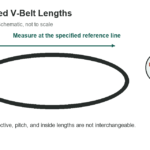
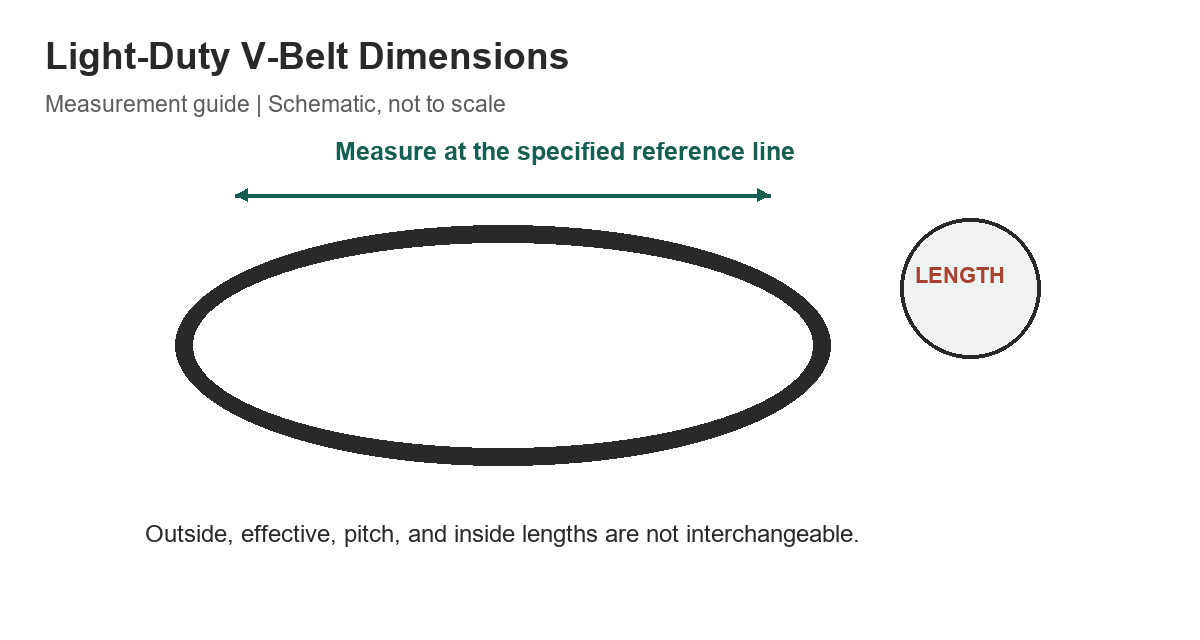
Light-duty V-belts use section codes such as 2L, 3L, 4L, and 5L. A listed length and its permissible deviation only make sense when the measurement convention is clear. Outside circumference, effective outside length, pitch length, and inside length are not interchangeable labels.
Selected 2L-5L examples
This small selection shows four examples from a historical ANSI/RMA IP-23 table. It is not the complete series. The source expresses permissible deviations asymmetrically, so both the positive and negative limits are retained.
| 2L | 20 | +0.12 / -0.38 |
|---|---|---|
| 3L | 20 | +0.12 / -0.38 |
| 4L | 30 | +0.25 / -0.62 |
| 5L | 45 | +0.25 / -0.62 |
4 rows
Scroll horizontally to view all columns.
The selected 5L example has a standard effective outside length of 45 inches with a source deviation of +0.25/-0.62 inch. A current Gates product identified as 5L450 lists 45 inches of outside circumference and 44.95 inches effective length. Those values illustrate why you should not assume a catalog’s “45” means the same length definition as every reference column.
Read the section code
The section identifies the belt’s cross-section family. Width and thickness vary across sections, so two belts with a similar circumference may still ride at different depths or fail to seat correctly. Read the full product marking and match it to the equipment maker’s parts information.
For an unmarked belt, measure with an appropriate belt-measuring tool and record how it was measured. Do not estimate length by laying a stretched belt along a ruler, and do not use the old belt as the only specification if it has stretched, worn, or been installed incorrectly.
Length is only one fit check
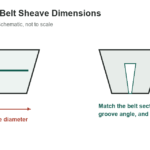
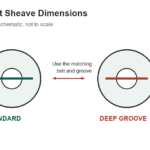
Inspect the sheave grooves for wear and confirm the new belt section is compatible. A belt that sits too low, too high, or bottoms in the groove can slip and wear prematurely. Check center distance and adjustment range, alignment, driven speed, and the maker’s tensioning instructions.
If a belt is part of a matched set, replace and tension the set according to the equipment instructions. Combining old and new belts can distribute load unevenly. Never force a belt over a sheave by prying with a tool while the machine is energized.
Temperature and use can change a belt’s condition over time. Cracks, glazing, missing material, contamination, and uneven sidewall wear are reasons to inspect the whole drive rather than simply install the next size down. Keep the belt dry and free of oil unless the product maker specifies otherwise; contamination can change friction and conceal a developing problem.
When the belt marking is gone, record several observations before ordering: section width, top thickness, the sheave groove it occupies, the equipment model, and any measurement made with a calibrated belt gauge. Send those details to the belt supplier and ask which length convention they used. That prevents a plausible-looking nominal number from masking a profile mismatch.
After installation, confirm that the belt sits correctly and that the adjustment remains within the equipment maker’s range. Recheck alignment and tension after the prescribed run-in period, if the manual calls for one. Do not apply a generic retensioning interval to machinery with different belt constructions or service conditions.
Use current product data
The 1968 source is a historical dimensional reference, not a current inventory. Manufacturers can use distinct labels for nominal size, outside circumference, effective length, or pitch length. Compare the manufacturer’s dimensions and compatibility notes rather than ordering solely from a rounded number.
- Identify the exact 2L, 3L, 4L, or 5L section.
- Keep the source length convention with every measurement.
- Retain upper and lower deviation separately.
- Check sheave profile, wear, center distance, and tension.
- Verify the current part number with the equipment maker.
For related equipment references, visit the size-chart library, read about air-compressor types, and compare the benchtop drill-press guide.
References
Consult the Gates Belt Identification Chart and current Gates 5L450 product data for current measurement fields and availability.