Metal-cutting band-saw speed normally describes the linear travel of the blade, often in feet per minute or meters per minute. It is not the rate at which the saw head moves into the work. Convert the units first, then check the speed recommended for the exact blade, material, section, and cutting conditions.
The conversion table below does not prescribe a cutting speed. A value that is mathematically correct can still be unsuitable for a particular saw or material. Use a machine approved for the intended metal-cutting task; fitting a metal blade does not automatically make a woodworking saw suitable.
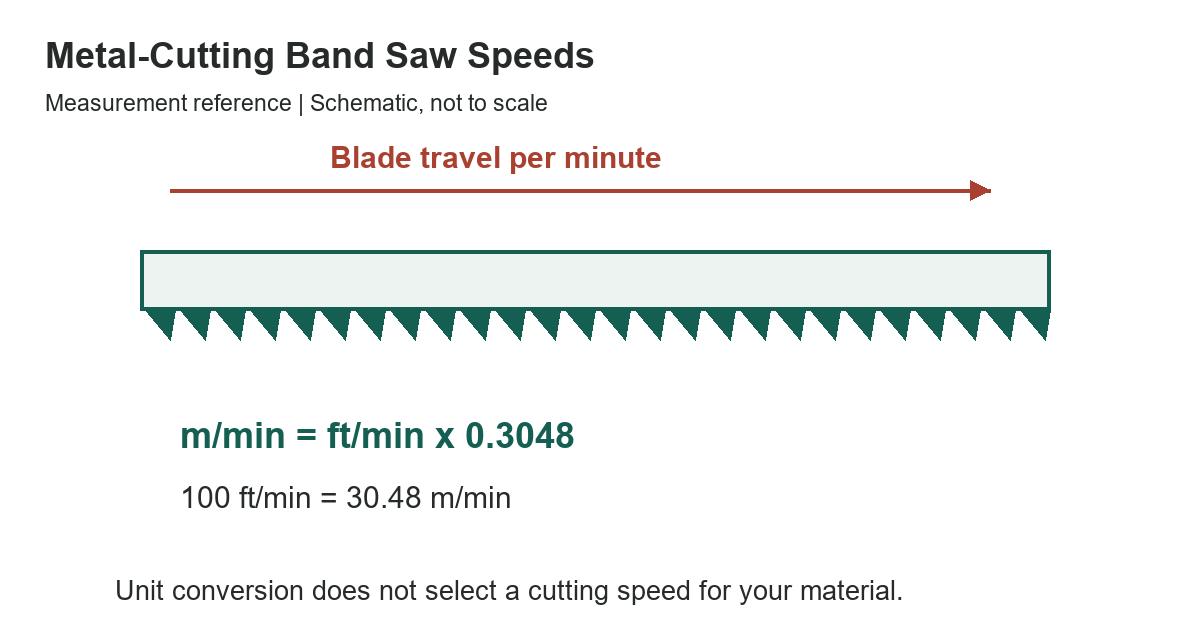
Feet per minute to metric blade speed
Multiply feet per minute by 0.3048 to obtain meters per minute. Divide that metric result by 60 to obtain meters per second. These are unit conversions of the same blade motion, not three different machine settings.
| 50 | 15.240 | 0.2540 |
|---|---|---|
| 100 | 30.480 | 0.5080 |
| 150 | 45.720 | 0.7620 |
| 200 | 60.960 | 1.0160 |
| 300 | 91.440 | 1.5240 |
| 400 | 121.920 | 2.0320 |
| 500 | 152.400 | 2.5400 |
7 rows
Scroll horizontally to view all columns.
For example, 100 feet per minute equals 30.48 meters per minute, or 0.508 meters per second. Conversely, 50 meters per minute is approximately 164.04 feet per minute. Record the units beside the selected number so a metric recommendation is not entered as an inch-unit value.
Blade travel is different from cutting feed
Blade speed tells you how fast the teeth pass through the cutting zone. Feed concerns the advance of the blade into the stock. A blade can travel quickly while the head advances slowly; those motions should not be combined into one unlabeled speed.
A manufacturer may also describe cutting productivity as an area removed per unit time. That is a different quantity again. If a chart has columns for blade speed and cut rate, retain both labels instead of copying the larger number into the saw’s speed control.
Identify the material more precisely than steel
Blade makers separate recommendations by material grade and condition because broad labels leave important information unresolved. A hardened tool-steel part and ordinary structural stock should not be assumed to share one setting simply because both contain steel.
Starrett’s reference guide organizes its cutting information around material grades, hardness, and workpiece dimensions. Use the section that matches the actual work and blade. If the material is unknown, identify it or obtain qualified guidance rather than choosing a setting from a visually similar piece.
Stock shape and tooth engagement matter
A solid bar, thin-wall tube, and irregular section expose the blade to different engagement conditions. The outside dimension alone does not describe the amount of material in the cut. Tube walls and corners can change how many teeth are engaged as the blade advances.
Confirm the blade’s recommended tooth arrangement and the machine’s holding method for the work. Secure the stock as directed and plan support for the remaining material and offcut. Do not compensate for an unsuitable blade or loose work by simply changing the speed.
Do not transfer a wet-cutting chart unchanged
A historical chart may assume coolant, a particular section size, and a specified blade construction. Those assumptions belong to the chart. They are not automatically satisfied by a small dry-cutting machine or a different bi-metal blade.
Use the current blade maker’s starting guidance and the saw manufacturer’s instructions together. The handbook research behind this page specifically concerned four-inch material with coolant; its alloy-to-speed values are not reproduced here as universal presets.
Check the machine’s available settings
A saw with stepped belt positions may not offer the exact converted value. Consult its documented settings and the blade maker’s permitted guidance rather than inventing an unapproved pulley arrangement. For variable-speed equipment, confirm which units the display uses.
Isolate the machine before adjustments or blade work as instructed. Follow the blade’s break-in and operating requirements, and stop to investigate abnormal behavior rather than repeatedly increasing pressure. A speed conversion cannot diagnose poor tracking, unsuitable tooth pitch, or inadequate workholding.
Record the complete setup
- Saw model and approved blade dimensions.
- Blade product, tooth pattern, and applicable instructions.
- Material grade, condition, and section geometry.
- Blade speed with its units and the separate feed setting.
- Coolant or dry-cutting conditions and work support.
The benchtop bandsaw guide covers a different buying decision. For work support, see garage workbenches, or browse the reference-chart library.
References
Consult Starrett’s band-saw blade reference guide and its material-based blade selector. The table on this page contains independently calculated unit conversions only.