PEX bend radius depends on the exact tubing and its installation instructions, not just the size printed on the coil. First identify the manufacturer and product, then use the actual outside diameter with the specified bend multiplier. A generic PEX chart should not override the manual supplied for your water-line system.
As one documented example, Uponor’s USA installation guide specifies a minimum radius of six times the outside diameter for its covered PEX piping. The selected calculations below apply to that guidance only. They are not a universal six-times rule for every PEX product, support, temperature, or application.
Selected water-line bend calculations
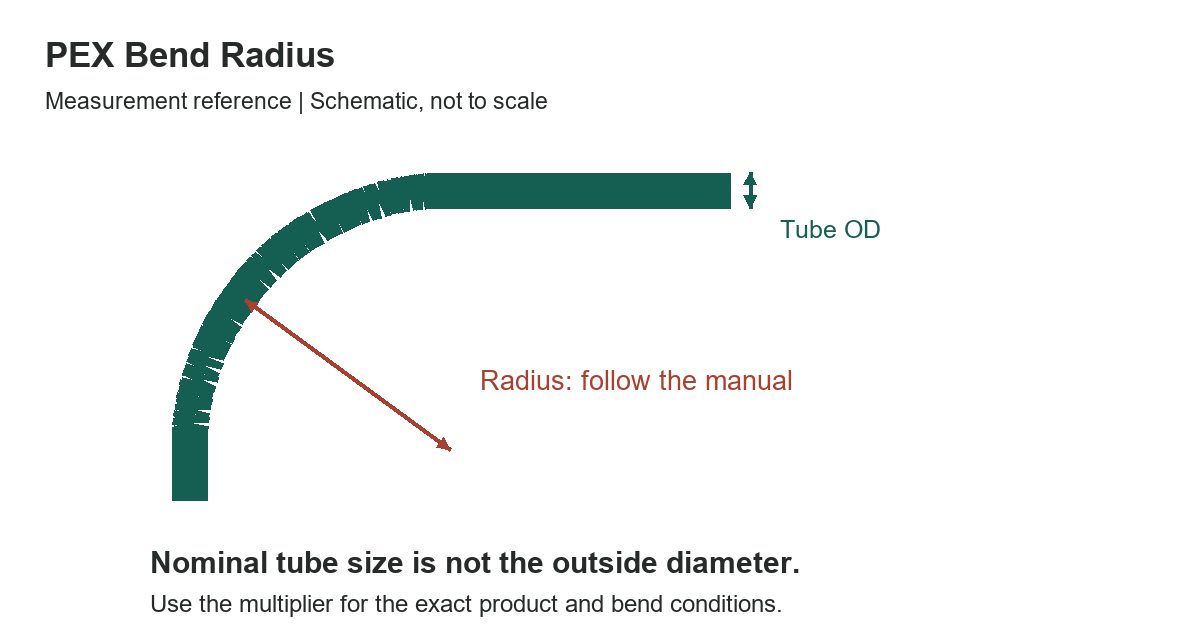
The nominal tube size and actual outside diameter are different. In these two examples, a 1/2-inch nominal tube has a 0.625-inch outside diameter, while a 3/4-inch nominal tube has a 0.875-inch outside diameter. Multiplying the nominal size instead would produce the wrong radius.
| 1/2 in | 0.625 | 3.750 | 95.25 |
|---|---|---|---|
| 3/4 in | 0.875 | 5.250 | 133.35 |
2 rows
Scroll horizontally to view all columns.
The millimeter column is calculated from the inch radius using 25.4 millimeters per inch. It is a unit conversion, not a metric tubing specification. Use the bend-radius reference shown in the manufacturer’s drawing when checking the physical route; do not silently switch between an inside-curve measurement and a centerline measurement.
Find the instructions for the tube you actually have
Before laying out a garage sink supply, record the tubing markings and confirm the product is approved for the proposed water service. Keep the relevant manual with the project notes. PEX construction, connection systems, and installation conditions vary, so a radius learned from another brand or an older chart may not apply.
A handbook value and a current product instruction can differ without making either number a universal rule. The useful question is which document controls the specific tubing and installation. If the product cannot be identified, do not choose the smallest radius found online and assume the unknown tube can tolerate it.
Radius is only one part of the available space
A smooth curve needs room for the tube itself, its supports, nearby fittings, and access for making the connections. Check that the route can be assembled without forcing the tube sideways at a fitting. A line that looks acceptable before fastening may become sharply distorted when a clamp pulls it against framing.
Uponor’s guide also calls for spacing before changing direction near a ProPEX connection. Review that separate detail in the manual rather than starting the curve immediately at the fitting shoulder. A minimum bend radius does not remove the need for connection clearance or suitable support.
When a bend support or elbow may be needed
A compatible bend support can help maintain a planned change in direction, but the support must suit the tubing and instructions. Do not assume any curved bracket sold for a similar nominal size is interchangeable. Check its intended tube size, use, and installation method before enclosing the line.
If the required route cannot accommodate a permitted bend, revise the layout or use a fitting approved for that system. Do not flatten the tube to squeeze it through an opening or rely on a nearby panel to hold a tighter curve. Include space for inspecting and servicing the installation where required.
Kinks and garage exposure need separate checks
A crease or crushed section is not an acceptable shortcut around a tight corner. Stop and follow the exact manufacturer’s damaged-tube procedure. Do not generalize a heat-reforming procedure from another product, and never use an open flame to reshape the tube.
Also consider the actual garage environment. Protect the line from vehicle contact, stored chemicals, and unsuitable sunlight exposure. A routing sketch should identify where impact protection or different placement is needed. This water-line reference does not approve ordinary plumbing PEX for distributing compressed air.
Before closing the wall
- Confirm the tubing identity and current installation manual.
- Use actual outside diameter in the manufacturer’s calculation.
- Check the radius reference, connection spacing, and approved supports.
- Inspect for damage and arrange the required system inspection and testing.
The pipe-size reference explains other size labels. Keep PVC dimensions separate from PEX dimensions, and browse the chart library for related measurements.
References
See printed pages 25-26 of the Uponor USA PEX installation guide and the Plastics Pipe Institute’s PEX installation guidance. The product instructions control the covered system.