Grinding-wheel RPM counts revolutions per minute. Surface speed describes how far the wheel’s rim travels in a given time, commonly in surface feet per minute or meters per second. The two quantities are related through wheel diameter, but neither should be confused with permission to operate a particular wheel at a particular speed.
Before using a wheel, follow the machine and wheel instructions and check their markings. A calculated rim speed does not replace the actual wheel’s maximum operating speed, approved dimensions, mounting requirements, or application limits.
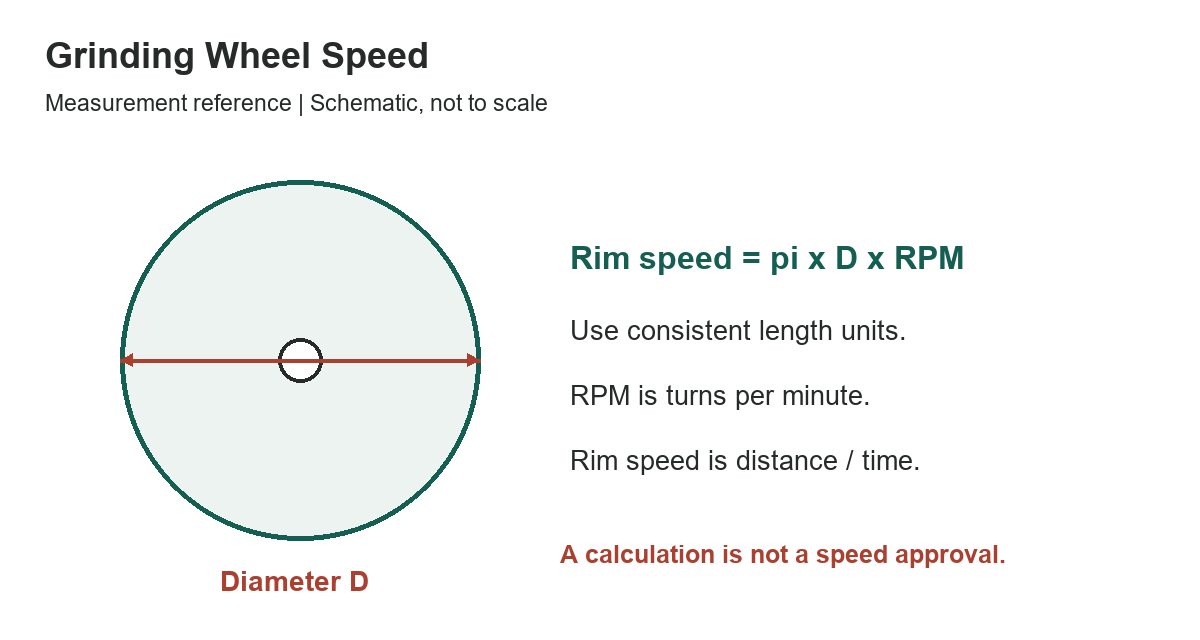
Calculate rim speed from diameter and RPM
One revolution moves a point on the rim through the wheel’s circumference. Multiply that circumference by RPM to obtain distance per minute. With diameter in inches, divide by 12 to express the result in feet per minute.
| 4 | 1800 | 1885.0 | 9.58 |
|---|---|---|---|
| 4 | 3600 | 3769.9 | 19.15 |
| 6 | 1800 | 2827.4 | 14.36 |
| 6 | 3600 | 5654.9 | 28.73 |
| 8 | 1800 | 3769.9 | 19.15 |
| 8 | 3600 | 7539.8 | 38.30 |
6 rows
Scroll horizontally to view all columns.
These rows are mathematical examples only. They do not recommend a four-, six-, or eight-inch wheel for any machine, and they do not establish an acceptable operating speed. Match the complete wheel specification and machine requirements independently.
The formulas and their units
Surface feet per minute equals pi multiplied by wheel diameter in inches and RPM, divided by 12. The abbreviated form is approximately 0.2618 times diameter in inches times RPM. Norton uses that rounded relationship in its discussion of wheel speed.
For meters per second, first convert the diameter to meters, multiply by pi and RPM, then divide by 60. When starting with inches, the full expression is pi times diameter times 0.0254 times RPM, divided by 60.
A six-inch diameter at 1,800 RPM therefore corresponds to approximately 2,827.4 surface feet per minute, or 14.36 meters per second. This worked example describes motion. It does not approve that combination for an unidentified wheel or grinder.
Why wheel diameter changes the answer
At the same RPM, a larger diameter travels through a larger circumference each turn. Doubling diameter doubles rim speed. Conversely, when diameter decreases while RPM stays unchanged, the calculated rim speed decreases.
That relationship is not permission to increase a grinder’s speed as a wheel wears. Machine limits, the wheel’s marked rating, minimum usable dimensions, guarding, balance, and the complete installation remain relevant. Do not modify a drive or bypass speed controls to recover a number from a chart.
Maximum operating speed is a separate requirement
A broad reference chart can describe historical wheel classes or typical processes, but it cannot identify the exact wheel in front of you. Use the rating and instructions for that specific product. Do not choose the highest speed listed for a material or bond and apply it to every wheel with a similar appearance.
Norton emphasizes that the wheel’s marked safe operating speed must not be exceeded. CCOHS likewise instructs portable-grinder users to check attachment speed ratings against the grinder’s maximum speed. A wheel’s application and mounting compatibility still need checking even when the speed rating appears sufficient.
RPM and surface-speed labels should travel together
If a supplier gives a surface-speed figure, record its units and the wheel diameter it refers to. Meters per minute and meters per second differ by a factor of 60. Surface feet per minute is different again. An unlabeled number is not a safe basis for selecting equipment.
Where both RPM and surface-speed markings are provided, check the manufacturer’s documentation rather than resolving an apparent conflict by choosing the more convenient figure. If the marking is unreadable or the product identity is unknown, obtain clarification before use.
Dimensions and condition remain essential
The calculation uses diameter only, but a usable wheel also has a specified bore, thickness, shape, bond, and intended operation. It must fit the machine and its guards using the approved mounting components. Similar diameter alone does not establish interchangeability.
Inspect the wheel and machine as instructed. Damage, abnormal vibration, loose mounting parts, or uncertain ratings call for stopping and investigation, not another calculation. Do not alter a wheel or mounting arrangement to make a mismatched product fit.
Record before operating
- Exact wheel identification, dimensions, and intended application.
- Marked maximum operating speed and its units.
- Machine model, maximum speed, guards, and approved mounting.
- Any required inspection and installation checks.
- The diameter and units used in a calculation, kept separate from approval.
For stationary workshop layout, compare garage workbenches and workbench sizing considerations. Other measurement topics are in the chart library.
References
See Norton’s wheel-speed explanation, its machine-maintenance guidance, and CCOHS portable-grinder precautions. Product markings and instructions govern actual use.