A taper-shank core drill is selected by more than the hole diameter. The flute count, Morse taper number, flute length, and overall length all affect whether the tool fits the machine and reaches the work. This chart summarizes five fractional sizes from a historical ANSI/ASME reference; it is a quick comparison, not a complete catalog or a substitute for the current tool drawing.
[gs_table id=”11363″]
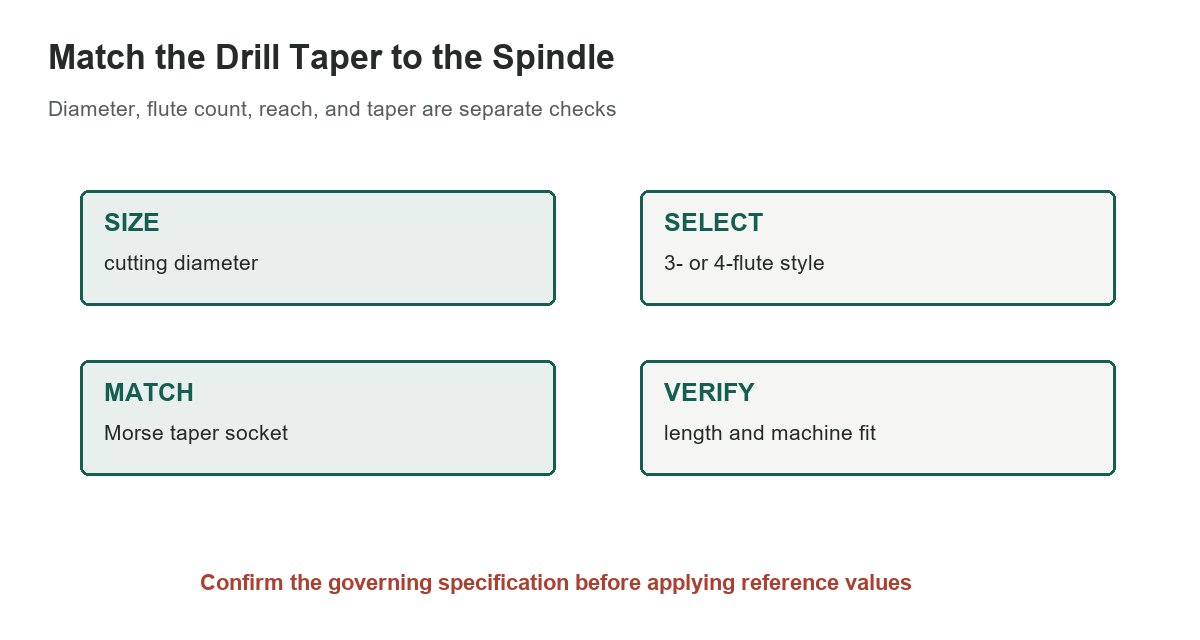
Read diameter, taper, and length separately
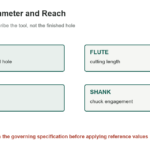
Drill diameter is the nominal cutting size. The Morse taper number identifies the tapered shank/socket series; it does not tell you the drill diameter. Flute length is the cutting-channel length, while overall length includes the full tool from point to the back of the shank. Check all of them against the job and spindle before ordering.
The source distinguishes three-flute and four-flute drills and marks unavailable combinations rather than implying every diameter is made in both styles. The selected chart preserves that distinction: the two smaller examples show both flute-count entries; the larger examples shown are four-flute rows.
Do not infer holder compatibility from the taper number alone
Morse taper sockets vary by number and machine interface. Confirm the spindle, adapter, tang, drawbar, and retention arrangement required by the machine manufacturer. A nominal taper number does not establish that the tool’s tang or gauge-line dimensions fit a particular spindle assembly.
ASME B5.10 covers detailed dimensions for self-holding and steep machine tapers and corresponding sockets. ASME B94.11M covers drill nomenclature, sizes, and tolerances. Those are separate standard scopes; this selected lookup is not the full text of either standard and does not certify a tool.
Check reach, chip space, and drill style
A tool’s overall length affects clearance, but it is not the same as usable drilling depth. The point geometry, work thickness, fixture, spindle nose, and chip evacuation all matter. Allow room for the point and approach, and follow the manufacturer’s limits for material, speed, feed, and coolant.
Do not substitute a straight-shank core drill, taper-shank reamer, jobber drill, or reduced-shank tool solely because the diameter looks similar. Their shanks, flute geometry, and intended use differ. Inspect a used drill for a damaged taper, chipped cutting lips, corrosion, or runout before putting it into service.
Prepare the machine and workpiece
Before installation, isolate the machine and clean the spindle socket and tool taper according to the machine maker’s instructions. Dirt, oil, burrs, or damage can prevent proper seating. Support and clamp the work securely; a large drill can grab material and rotate it if the work is held by hand or an inadequate fixture.
Use the specified speed and feed for the tool material and workpiece, and manage chips with the recommended method. Keep guards in place and stop the machine before measuring, clearing chips, or adjusting the setup. These are general precautions; the machine and tool manuals govern the actual procedure.
Check the exact catalog entry
The current manufacturer drawing controls for the product you buy. Tool makers may offer similar sizes with different overall lengths, flute lengths, materials, point forms, or dimensional tolerances. Compare the actual part number and drawing, especially when the machine has limited clearance or the hole must meet a close tolerance.
Guhring’s current Morse-taper drill catalog illustrates that commercial tools are listed by specific diameter and shank series, with product-specific dimensions. The historical chart is useful for comparison, not proof of current stock or interchangeability.
Keep nearby drill references distinct
A taper-shank core drill is not a taper-shank jobber drill or a Morse taper reamer. The benchtop drill-press guide covers machine selection, the drill-point length chart covers point geometry, and the tap-drill chart covers hole preparation for threads. Use the reference that matches the dimension being checked.
Sources: Machinery’s Handbook, 31st edition, selected original page, ASME B94.11M-1993 Twist Drills, ASME B5.10-1994 Machine Tapers, Guhring Morse-taper shank drill catalog