A raised tank can create useful water pressure without a pump, but the height alone does not tell you how much water will reach a hose, sink, washer, or pump. The first estimate comes from the vertical distance between the tank’s free surface and the outlet. Pipe friction, fittings, elevation changes, and the equipment’s minimum inlet pressure then determine whether the system works in practice.
[gs_table id=”11359″]
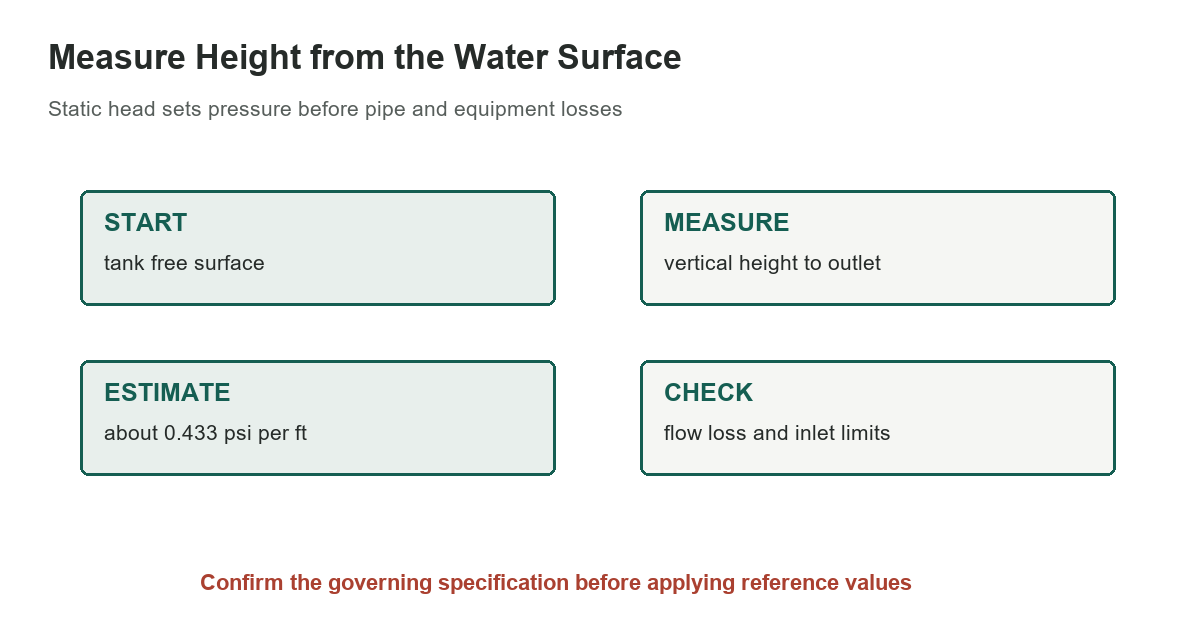
Measure the useful height
Measure vertically from the water surface in the tank to the outlet or equipment connection. Do not measure along the pipe. For water near 70 F, the reference table gives approximately 0.433 psi per foot of head: a 10 ft difference is about 4.33 psi before losses, and 20 ft is about 8.66 psi.
If the water level drops as the tank empties, the available static pressure drops too. Use the lowest expected operating water level for a conservative check. A horizontal run does not add static head; its length matters because it adds friction while water is flowing.
Static pressure is not flow performance
The values in the table describe static head-to-pressure equivalents. When water flows, pipe diameter and length, valves, elbows, filters, and hose restrictions consume pressure. A system can show a reasonable static reading and still have low flow at a fixture. Measure pressure and flow under the expected demand or calculate losses with an appropriate method.
The reference conversion is for water under the stated source conditions; temperature, fluid density, elevation, and installation details can change the result. Do not assume the listed static pressure is available at a pump inlet or appliance while running.
Check the equipment before connecting it
Read the exact equipment manual for its minimum inlet pressure, maximum inlet pressure, flow range, and any required backflow or supply arrangement. For a pump, check its inlet-pressure and NPSH requirements at the intended flow. A manufacturer may prohibit suction lift for a particular pump even when a simple height conversion appears favorable.
Grundfos describes inlet pressure as pressure available where the suction pipe meets the pump and relates it to net positive suction head. Its guidance makes clear that pump suitability depends on the pump curve and conditions, not a generic feet-to-psi chart. Use the product-specific limits and qualified installation instructions.
Account for plumbing and safety
A gravity tank still needs a sound support structure, secure connections, an overflow path, and materials rated for the water and installation. Protect stored water from contamination and freezing where relevant. Any potable-water, pressure-vessel, plumbing-code, electrical-pump, or backflow requirements depend on the installation and local rules.
This table is not a pipe-size chart, pressure-vessel rating, or approval to use a household tank in a pressurized system. Avoid sealing or pressurizing a container that is not designed and rated for that service. If the required operating pressure exceeds the available head, choose a manufacturer-approved system rather than improvising a pump or pressure vessel.
Plan the garage supply
List each outlet and its required pressure and flow, then compare those needs with the lowest tank level and expected simultaneous use. Check the route for elevation changes and restrictions. If you cannot verify the equipment inlet limits, ask the manufacturer or a licensed plumbing professional before installation.
Related pipe references include the pipe size chart, PVC pipe dimensions, and PEX water-line bend-radius examples. They describe dimensions or routing, not pressure loss or approval for a particular installation; use the actual pipe and equipment documentation.
Sources: Machinery’s Handbook, 31st edition, selected original page, Grundfos pump hydraulics: pressure head conversion, Grundfos inlet pressure and pump suction, Grundfos: what an NPSH curve means