A regular-section helical spring-lock washer is a split ring with a raised end. Its dimensions help identify a compatible part, but the word “lock” is not a promise that a joint cannot loosen. This selected chart gives five inch-series sizes from the regular-section column of ASME B18.21.1; it is not a chart for heavy, extra-duty, or high-collar washers.
Read the dimensions
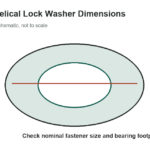
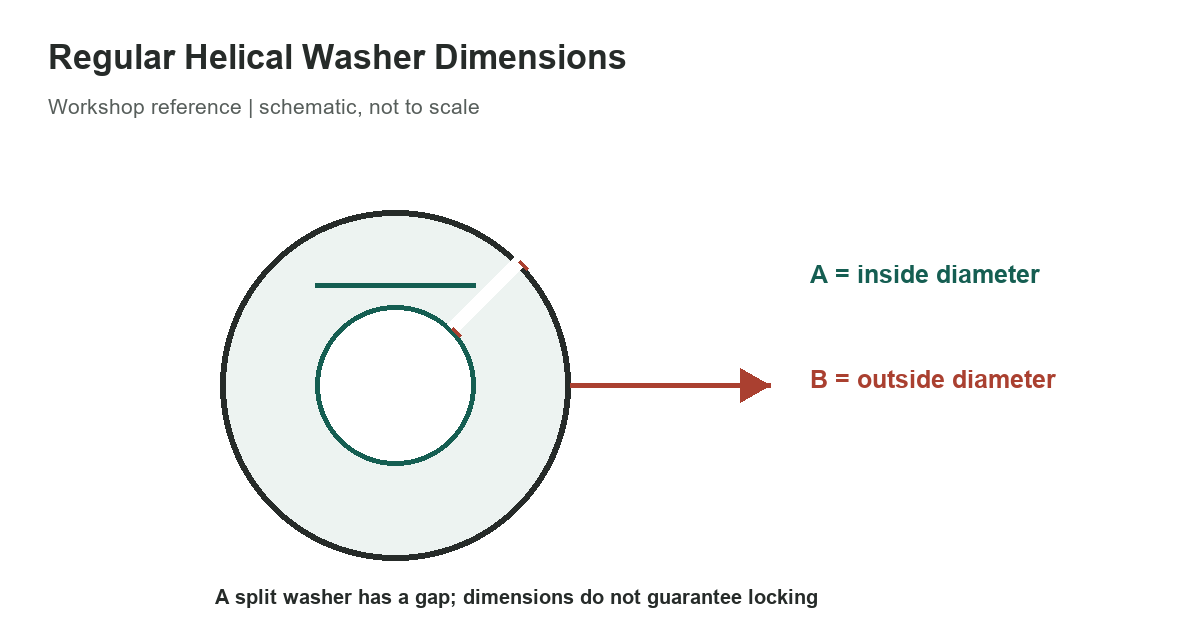
Nominal size identifies the fastener size family. Inside diameter A is given as a minimum-to-maximum range. Outside diameter B is a maximum, W is the minimum section width, and T_a is the minimum mean section thickness. T_a is the average of the two washer-end thicknesses shown in the original figure; the listed value is its minimum limit. The table values are in inches, including the fractional nominal size labels.
A dimension is not an installation instruction. Compare the washer to the fastener and the joint drawing, and check the supplier’s current catalog before ordering. The standard itself cautions that not every listed dimensional item is necessarily a stock product. A washer that measures within these dimensions may still differ in material, hardness, coating, or test requirements.
[gs_table id=”11072″]
For example, a 1/2-inch nominal regular washer has A from 0.502 to 0.512 in, B no greater than 0.869 in, section width 0.171 in, and mean thickness 0.125 in. Those measurements describe the selected standard size; they do not establish the washer’s load capacity or prove a locking performance for a particular assembly.
Do not confuse washer styles
Regular, heavy, extra-duty, and high-collar are separate helical washer sections. Their outside diameters and cross-sections differ, so do not select a replacement by nominal fastener size alone. The companion high-collar washer dimensions guide covers that distinct style. For square lag-screw heads, use the separate head measurement and corner-clearance chart rather than assuming the washer dimensions apply to the head.
Spring washers have a long history, but test results and joint behavior depend on the fastener, substrate, preload, vibration, and design. ASME notes that “lock” is a generic historical name and does not imply indefinite permanence of fixity. Do not use this chart to justify replacing a specified locking method, calculating bolt preload, or approving a safety-critical connection. Follow the assembly drawing, engineering specification, and fastener supplier instructions.
When replacing a washer, inspect the mating surfaces and the fastener shoulder as well as the nominal thread size. A washer that bottoms on a radius, covers too little bearing area, or conflicts with a nearby feature may not seat as intended. Do not flatten, grind, stack, or reuse a damaged washer to make it fit. If the original design calls for a different washer style, match that style rather than choosing the closest diameter in this chart.
Also separate dimensions from performance claims. The chart has no torque values, load ratings, fatigue data, or vibration test results. If a joint repeatedly loosens, investigate the assembly design and installation method rather than assuming a spring washer alone will solve it.
When the dimensions are not enough
Use a current manufacturer drawing when the washer must fit inside a recess, clear a shoulder, cover a slot, or maintain a specified bearing area. Check the material and coating separately: corrosion exposure and temperature can change which product is appropriate. If the standard designation on a package is unclear, ask the supplier to confirm the exact section and edition rather than relying on an online nominal-size label.
This reference intentionally shows selected regular-section dimensions only. It does not reproduce every size in the standard, specify material properties, or recommend spring washers for a particular joint. Related workshop measurement references can help with layout dimensions, while this page is limited to washer fit.
References
ASME B18.21.1 covers dimensional requirements, physical properties, and related test methods for inch-series helical spring-lock washers. ASME notes that a listed size is not necessarily a stock item and that “lock” does not mean an attachment is permanently fixed. Check the current supplier drawing and assembly specification before choosing a washer.