A correction factor is useful only when its meaning and calculation method stay attached. Table 20 in the handbook gives length-flex factors, Kf, for a double V-belt drive procedure. It is not the same as the belt-length factor used to adjust a standard horsepower rating. The selected values below show how Kf changes with effective belt length per sheave and belt cross section; they are historical method inputs, not a complete drive recommendation.
[gs_table id=”11422″]
What the factor changes
The surrounding procedure first determines the tight-side tension at each loaded sheave, then uses allowable tight-side tension per belt and the length-flex factor to estimate the number of belts required. In that context Kf corrects the allowable tension rating for belt length flexing. It is not a speed-ratio factor, arc-of-contact factor, service factor, or stand-alone multiplier for horsepower.
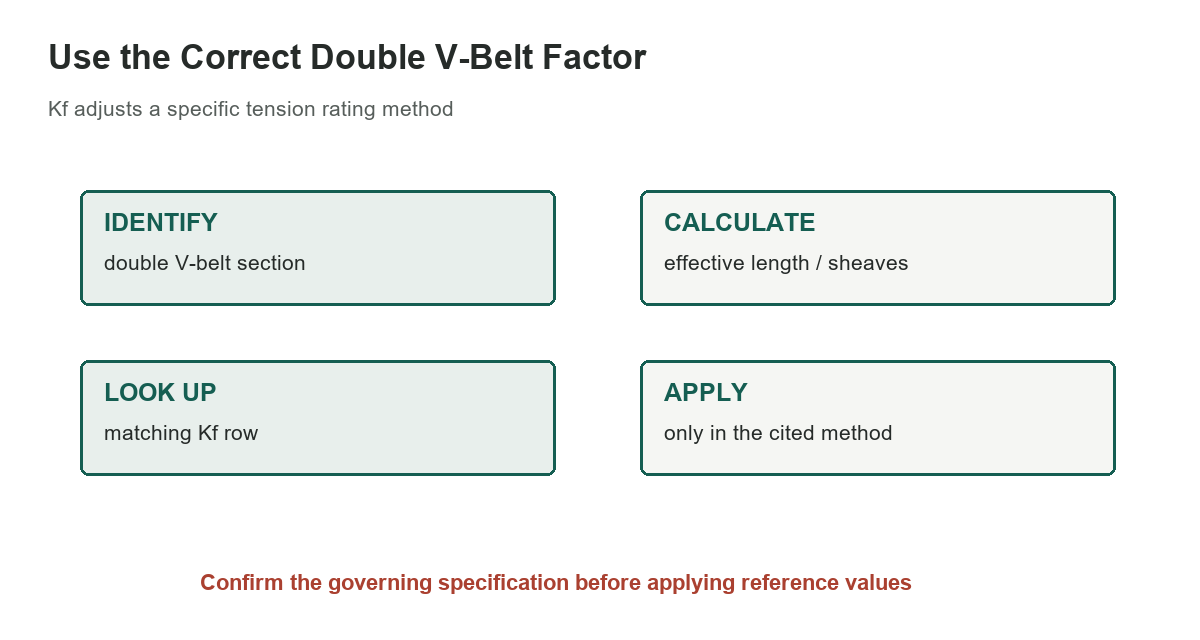
The source’s notation uses Le for effective belt length and n for the number of sheaves, so the table lookup is based on Le/n. Use the same definition of effective length and sheave count that the complete method specifies. Do not replace n with the number of belts or the number of loaded driven units.
Read the selected rows
Choose the AA, BB, CC, or DD section from the belt marking or controlled drawing, then find the matching Le/n row. At 25 inches per sheave, the selected Kf entries range from 0.70 for DD to 0.87 for AA. At 50 inches per sheave, the values range from 0.84 to 1.05. A factor above 1.0 is still only the value printed in this historical method; it does not certify a higher safe working load for a modern belt.
This compact lookup includes only three complete rows. It omits other source values and does not supply the allowable tension tables, effective sheave diameters, speed, arc of contact, service conditions, or the remaining drive calculations. A missing value in the source selection is not zero and should not be interpolated without authority from the method.
The units matter: the ratio uses inches divided by a count, while Kf is dimensionless. If a workflow uses millimetres, convert effective length consistently before calculating the lookup ratio. Keep unrounded values for calculations and retain enough precision to select a valid source entry.
Keep other V-belt factors separate
The site’s narrow V-belt length correction guide covers a different table and a different rating adjustment. Its cross-section correction reference describes still other constants, while the narrow V-belt sheave chart concerns pulley dimensions. Similar labels do not make the factors interchangeable.
Use current product data for a real drive
A belt manufacturer’s design procedure is tied to its belt construction, sheave geometry, ratings, installation tension, and service assumptions. The Gates design manual is one example of a manufacturer-specific method; its formulas and product data should be used together rather than blended with this historical handbook table. Check the exact belt family, drive layout, load, speed, temperature, and guarding requirements with the manufacturer or a qualified designer before selecting components.
For a drive with several sheaves, idlers, shock loads, reversals, or unusual belt routing, the actual load distribution and slip limits can require a complete engineering analysis. Do not size or repair machinery by multiplying a nameplate horsepower by one row from this chart.
Quick check before using a factor
Write down the source method, belt section, effective length, number of sheaves, and the units before looking up Kf. Confirm that the method asks for length-flex adjustment to tight-side tension. If the calculation instead asks for a belt-length horsepower correction or an arc-of-contact adjustment, stop and use the matching data for that method. Record the edition and the source table beside any retained calculation.
Sources: Machinery’s Handbook, 31st edition, double V-belt Table 20, printed page 2588, Gates Heavy Duty V-Belt Drive Design Manual