Roller-chain pitch is the center-to-center distance between adjacent pins. To identify an unknown transmission chain, measure that spacing, then check the roller dimensions, inside width, series, and application against the manufacturer’s drawing. Pitch is an important starting point, not a complete replacement specification.
Only inspect a drive after it has been safely isolated and prevented from starting or moving. Do not reach through a guard or measure a chain while the machine is running. Where the drive supports a load or can move under stored energy, have a qualified person establish a safe inspection method.
Selected nominal roller-chain pitches
The table lists selected ANSI-series labels and their nominal unworn pitch. The metric values and ten-pitch spans are calculated conversions. They are not manufacturing tolerance limits, service loads, or replacement-wear thresholds.
| No. 40 | 0.500 | 12.700 | 5.000 |
|---|---|---|---|
| No. 41 | 0.500 | 12.700 | 5.000 |
| No. 50 | 0.625 | 15.875 | 6.250 |
| No. 60 | 0.750 | 19.050 | 7.500 |
| No. 80 | 1.000 | 25.400 | 10.000 |
5 rows
Scroll horizontally to view all columns.
Notice that No. 40 and No. 41 both have a half-inch pitch. Measuring that pitch alone cannot distinguish the two chains. A replacement must also match the relevant width, roller and pin dimensions, construction, connecting link, sprocket, and equipment requirements.
Count intervals, not just visible pins
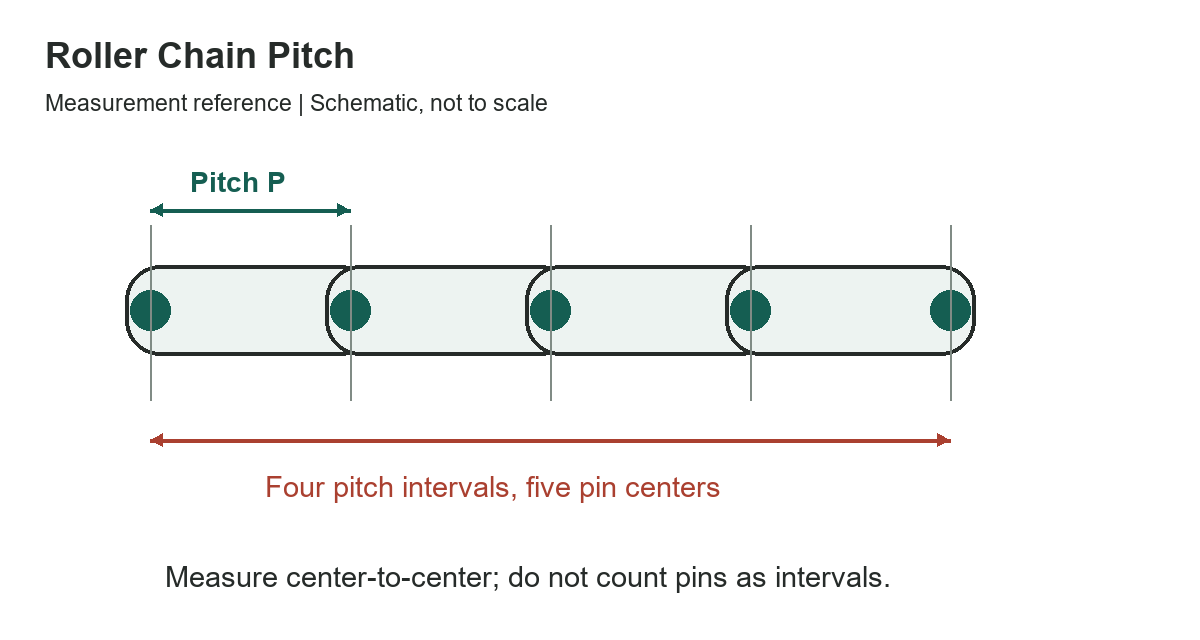
Measuring several intervals can make the spacing easier to read than measuring a single small gap. Choose identifiable pin centers and count the spaces between them. A measurement from the first pin center to the eleventh pin center covers ten pitch intervals, not eleven.
For example, ten nominal half-inch intervals span 5 inches. Dividing that center-to-center span by ten gives a half-inch pitch. In the diagram, five pin centers cover four intervals. Write the number of intervals beside the recorded length so the calculation can be checked later.
This is an identification calculation, not a wear test procedure. The chain must be positioned and measured under the conditions specified for that task. A loose, curved, dirty, damaged, or worn sample may not give a reliable nominal-size reading.
Keep pitch separate from roller diameter and width
Pitch runs along the chain between pin centers. Roller diameter is measured across an individual roller. Inside width describes the space between the relevant inner plates. Overall pin length and attachment features are additional dimensions, not substitutes for any of those three.
Make a simple sketch and label each measurement rather than sending a supplier an unlabeled collection of numbers. Include clear photographs of the side plates, rollers, connecting link, any markings, and the associated sprocket. A ruler beside the chain helps show scale but should not replace careful measurements.
Similar-looking chain may belong to another series
A chain with the expected pitch may still be a different standard series, heavy series, multiple-strand chain, attachment chain, or application-specific product. Do not assume a familiar number guarantees every dimension or connecting component is interchangeable.
Likewise, industrial transmission-chain labels do not identify a garage-door opener’s approved replacement assembly. Use the opener model and its parts documentation for that job. Tire traction chains are a different product category entirely and are not sized from this transmission-chain chart.
Wear can complicate identification
A used chain can measure longer across several pitches than its nominal new length. Renold supplies chain-wear guides specifically for assessing elongation. Use the correct manufacturer procedure and acceptance criteria rather than treating the nearest rounded ruler measurement as proof of condition.
Do not correct a long measurement by arbitrarily changing the number of counted intervals or selecting the next larger chain. Identify the original series, inspect the drive as required, and resolve wear or damage before ordering. A new chain on an unsuitable or damaged sprocket is not established as compatible by pitch alone.
Information to send with a replacement inquiry
- Machine make, model, drive location, and any original part number.
- Chain markings, series, strand count, and attachment details.
- Measured span and the exact number of pin intervals.
- Roller diameter, inside width, and other requested drawing dimensions.
- Connecting-link details and clear photographs of the mating sprocket.
For related workshop measurements, use the fastener and wrench chart and SAE wrench reference. The size-chart library keeps other identification topics separate.
References
U.S. Tsubaki’s roller-chain basics explains pitch and selected chain labels. Renold’s chain-wear guides address elongation assessment; use the instructions applicable to the actual drive.