
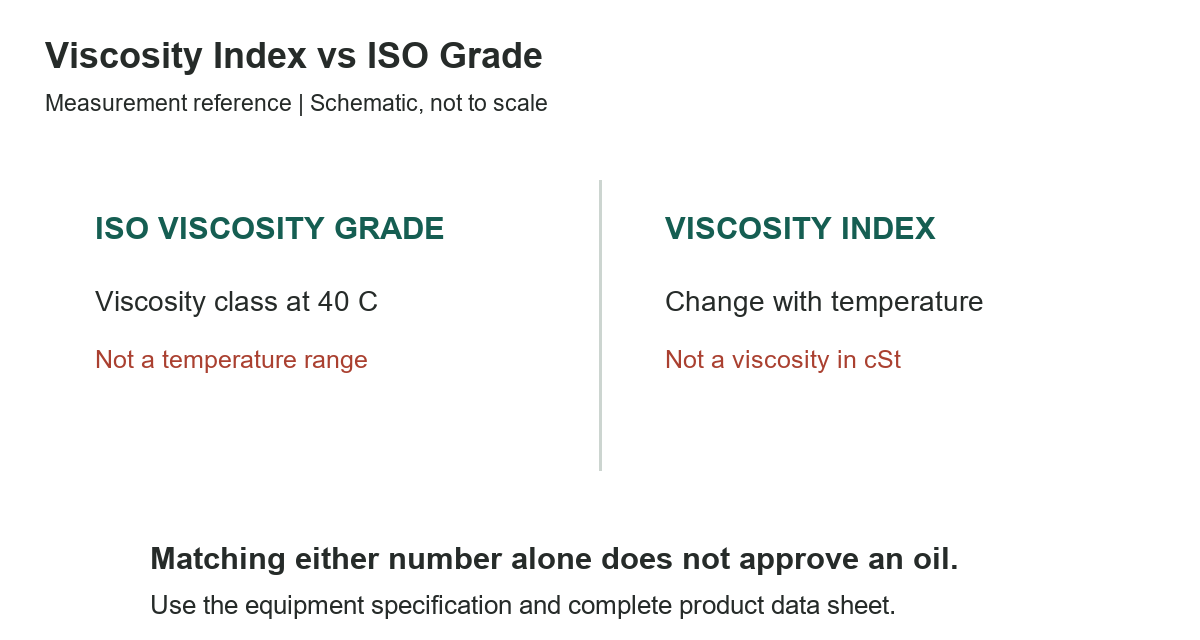
Viscosity index and ISO viscosity grade describe different properties of an oil. ISO viscosity grade identifies an industrial viscosity class referenced at 40 degrees Celsius. Viscosity index, usually abbreviated VI, describes how viscosity changes with temperature. Matching either number alone does not prove that an oil is suitable for a machine.
When reading a compressor, hydraulic-equipment, or machine-tool oil data sheet, keep the field name, test temperature, units, and equipment requirements together. A number copied without its label can turn a useful specification into a misleading comparison.
What the main data-sheet fields mean
The table separates common labels and the conclusions they do not support. It is a reading guide, not an oil-substitution chart. The complete product specification and the equipment manufacturer’s lubricant requirements still control the decision.
| ISO viscosity grade | Industrial viscosity class referenced at 40 C | Not the viscosity index |
|---|---|---|
| Kinematic viscosity, 40 C | Measured viscosity with temperature and units | Not every operating temperature |
| Kinematic viscosity, 100 C | A second stated-temperature measurement | Not a cold-start test |
| Viscosity index (VI) | Temperature dependence expressed as a unitless index | Not a cSt value or approval |
| Pour point | A separately tested low-temperature property | Not a complete start-up limit |
| Equipment approval | The named specification or approval where documented | Not established by matching viscosity alone |
6 rows
Scroll horizontally to view all columns.
ISO grade is not the viscosity index
An ISO viscosity grade and a VI value may both appear as plain numbers, but they cannot be exchanged. If a machine specifies an industrial viscosity grade, finding another oil with that same number in its VI column does not satisfy the requirement.
Mobil’s explanation of industrial oil selection identifies ISO grade as a 40-degree-Celsius reference and VI as a measure of temperature dependence. That distinction helps explain why two oils in the same viscosity class need not behave identically as conditions change.
Keep the measurement temperature attached
Kinematic viscosity is commonly reported in square millimeters per second, also called centistokes or cSt. The temperature matters: a reading at 40 degrees Celsius is not interchangeable with one at 100 degrees Celsius. Compare like fields before drawing a conclusion from the relative numbers.
A simple comparison worksheet should give each temperature its own column. Include the units in the heading and mark missing data as missing rather than moving another value into the gap. If one product sheet lists a field that another omits, ask for the relevant documentation instead of guessing.
A higher VI is not a complete quality ranking
A higher viscosity index indicates less change in viscosity with temperature within the index’s framework. It is not itself a viscosity measurement, a pressure rating, an equipment approval, or a permitted service interval. It cannot establish compatibility with the oil already inside a machine.
Do not select the largest VI number on the shelf as a universal upgrade. A lubricant must meet the application requirements as a whole. Where a supplier proposes a replacement, ask which complete equipment specification it meets and what changeover requirements apply.
Read a real data sheet without turning it into a recommendation
Shell’s EcoSafe S3 DU property table illustrates the distinction by listing ISO grade, kinematic viscosity at two temperatures, and viscosity index on separate lines. Those separate fields show why the labels must travel with the values when comparing documents.
That example is an industrial fluid for a specified application, not a recommendation to pour it into garage equipment. The fact that a public data sheet is detailed does not make the product an alternative to the lubricant required by your compressor, jack, gearbox, or other machine.
Low-temperature figures and approvals need their own checks
Pour point is another separately reported property. Do not treat it as the complete minimum starting temperature for an assembled machine. Starting behavior and equipment limits need the relevant product and machine instructions, not a conclusion drawn from a single laboratory property.
Similarly, distinguish a documented equipment approval from broad wording about intended use. Record the exact designation requested by the manual and check the current product documentation. If a manual names an obsolete oil, seek a supported replacement from the equipment maker or a qualified lubricant supplier.
A useful comparison note
- Record the machine model and exact lubricant requirement.
- Identify the product, market, and current data-sheet revision.
- Separate grade, temperature-specific viscosity, and VI.
- Check approvals and compatibility rather than only numbers.
- Resolve missing information before topping up or changing products.
The air-compressor guide covers equipment context. Garage-door lubrication is a separate maintenance task, while the reference library covers other measurement labels.
References
See Mobil’s explanation of viscosity index and Shell’s separately labeled product-property example. Neither replaces your equipment’s lubricant specification.