Poisson’s ratio describes how a material’s lateral strain relates to its axial strain under loading. The selected values below come from a historical table for resins and compounds at 23°C. They help identify the scale and terminology of the property, but a polymer family name is not a substitute for a current datasheet or measured value for the exact grade.
[gs_table id=”11305″]
Understand the definition
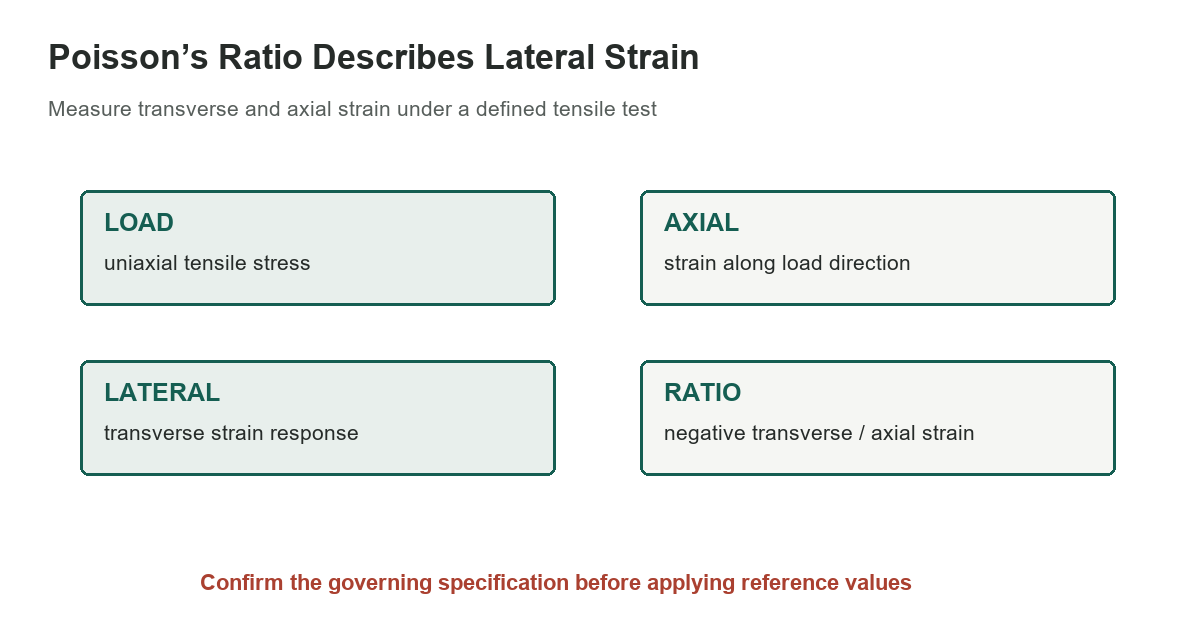
For a uniaxial tensile test in the elastic response region, Poisson’s ratio is commonly written as the negative of transverse strain divided by axial strain. The negative sign reflects that many specimens narrow laterally while extending in the loading direction. The ratio is dimensionless because both strains are length change divided by original length.
The value depends on how the material is tested and interpreted. Plastics can be sensitive to strain rate, temperature, moisture, specimen preparation, and prior conditioning. Fiber-reinforced compounds can also behave differently along and across the reinforcement direction.
Use the 23°C values as historical context
The source table is explicitly labeled at 23°C and includes unfilled resins, mineral-filled materials, and glass-fiber-reinforced compounds. The selected rows preserve those distinctions rather than presenting every entry as a generic resin value. Ranges in the source, such as the acrylic entry, are retained as ranges.
The labels do not identify a supplier grade, fiber orientation, molding process, test speed, or specimen conditioning. Treat each number as a representative historical reference, not as a guarantee for every ABS, PTFE, or polycarbonate product currently sold.
Recognize the effect of reinforcement
A reinforced plastic can be direction-dependent. Fiber content, orientation, laminate layup, flow direction, and specimen location can affect axial and transverse response. A single scalar Poisson ratio may be inadequate for an anisotropic material model; use the constitutive data and material axes appropriate to the part.
Do not infer a reinforcement effect from the family label alone. Compare the exact manufacturer grade and datasheet, and verify whether the reported value is measured or estimated. If directional behavior matters, use a test plan or approved supplier data that covers the relevant orientations.
Choose the right test evidence
ASTM D638-22 covers tensile properties of plastics and includes an option for determining Poisson’s ratio from strains under uniaxial stress. ASTM notes that tensile properties can depend on specimen preparation, test speed, and environment. The method and material specification should be reviewed together before comparing values from different sources.
A single room-temperature number may not describe creep, long-term loading, impact, elevated temperature, moisture uptake, or cyclic conditions. For design, use validated grade-specific properties and the material model accepted by the governing code or engineering organization.
Connect the property to the application
Poisson’s ratio may matter in stress analysis, finite-element models, contact behavior, or dimensional response under load. It is not a strength value and cannot determine whether a part will carry a given load. Modulus, yield or failure criteria, creep, temperature, geometry, and boundary conditions remain separate inputs.
For related material context, the site’s running-board materials guide describes common substrates, and its plastic running-board restoration guide addresses surface care rather than structural properties. The sheet-metal gauge reference concerns metal thickness and does not provide polymer constants.
Set a defensible material model
Record the full resin designation, reinforcement, orientation, conditioning, temperature, test method, source revision, and whether the value is measured or nominal. Keep the selected value consistent with the rest of the material model and validate sensitivity when it affects safety margins or dimensional control.
This compact selection omits most rows in the source and is not a design database. Obtain current supplier data or conduct a controlled test when the result governs a critical decision. Have a qualified materials or structural engineer review consequential analysis.
Sources: ASTM D638-22 tensile properties of plastics, MatWeb material property example, Original handbook extraction