Work and power are related but different quantities. Work measures energy transferred by a force through a distance; power measures how quickly work is done. The selected equations below use English engineering units and assume the stated force and motion relationships apply to the situation being modeled.
[gs_table id=”11309″]
Start with work
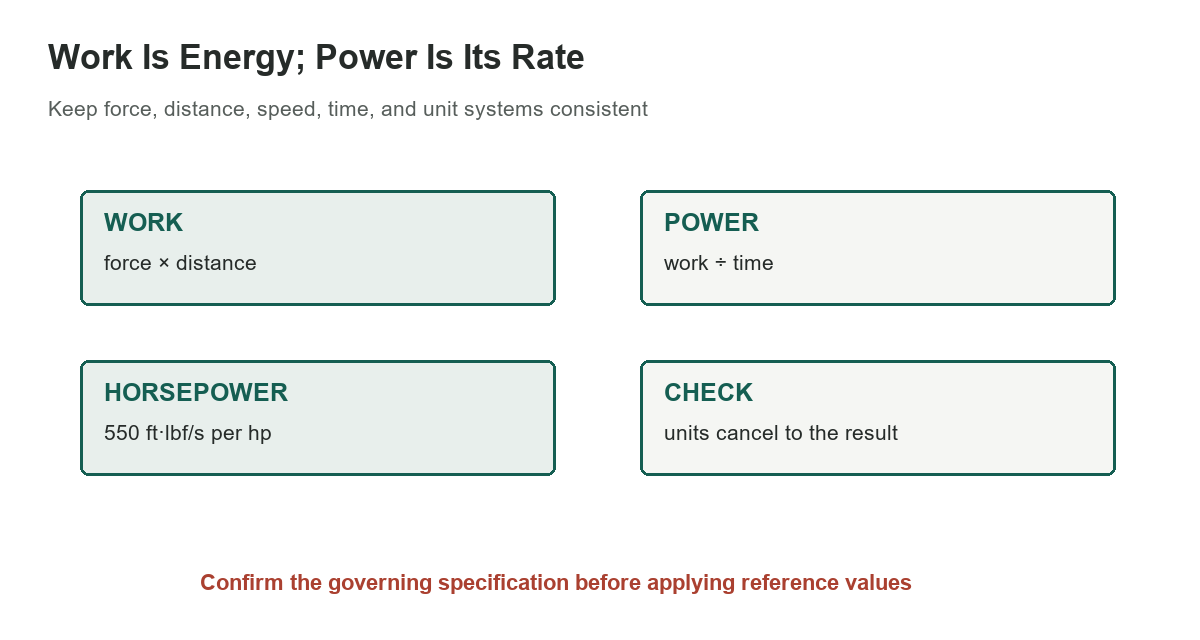
For a constant force acting along the direction of motion, work K equals force F multiplied by distance S. With F in pounds-force and S in feet, the result is foot-pounds-force, written ft·lbf. If force changes with position or acts at an angle, the simple product may not represent total work; use the appropriate integral or component of force.
Work is an energy quantity, not a rate. A larger work value can result from greater force, greater distance, or both. Keep the definition of force clear: pounds-force are not pounds-mass, and substituting a mass value without converting it is a dimensional error.
Calculate power from work or motion
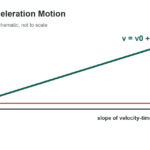
Average power P is work divided by elapsed time. If a constant force acts at a constant speed in the same direction, power can also be calculated as force times velocity. With F in lbf and V in ft/s, P is in ft·lbf/s. The two forms agree when their assumptions and measurement interval match.
For variable force or velocity, instantaneous power and average power can differ. State which quantity is being reported and define the interval. A motor rating, electrical input, shaft output, and useful load power are not necessarily identical because losses and operating conditions intervene.
Convert mechanical horsepower correctly
In this source’s English-unit convention, one mechanical horsepower corresponds to 550 ft·lbf/s. Divide power in ft·lbf/s by 550 to express it in horsepower. NIST lists this horsepower definition and distinguishes it from other horsepower variants; verify which unit a specification or instrument uses before comparing values.
Do not mix mechanical horsepower with metric horsepower, boiler horsepower, or electrical horsepower. When working in SI, use watts and joules per second instead. Convert once at a clearly defined boundary and retain enough precision for the calculation.
Check equations with dimensions
Dimensional checks catch many mistakes. Force times distance gives work; work divided by time gives power; force times speed gives power; and work divided by power gives time. If units fail to reduce to the requested result, check the inputs and conversion factors before trusting the number.
A useful check is a 1 hp output: in this convention it corresponds to 550 ft·lbf/s, or approximately 746 W. NIST gives the conversion from horsepower and foot-pound-force per second to watts. The site’s air-tool CFM chart deals with flow demand, which is separate from work and power.
Apply the formulas to real equipment carefully
The constant-force equation is an ideal relationship, not a complete motor or machine-sizing procedure. Starting torque, acceleration, friction, efficiency, duty cycle, transmission losses, thermal limits, and service factors can control the selection. Do not use a calculated average power to infer that a component can withstand a peak load.
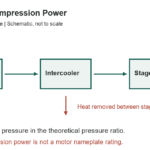
For compressor context, see the site’s air-compressor overview and two-stage compressor guide. Those pages discuss equipment rather than replacing a measured load calculation. The impact-wrench guide is a product comparison, not a torque-to-power rating method.
Record the assumptions
A clear calculation states the force direction, distance, time basis, speed condition, unit convention, and whether values are average or peak. Include efficiency only when its definition and boundary are known. For a moving mechanism, identify the point where velocity is measured and whether the force is applied at that same point.
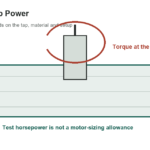
These selected formulas do not cover rotational torque-power conversion or electrical input power. Use the specific relationship and unit convention for the system being analyzed. For a critical design or lifting application, verify the model and assumptions with a qualified engineer and the equipment manufacturer’s data.
Sources: NIST Guide to SI, Appendix B.9 conversion factors, NIST SP 811 PDF power conversions, Original handbook extraction