A band brake wraps a flexible band around a drum. In the ideal sliding-friction model, the tight-side and slack-side tensions are related by the capstan equation. The factors below show how that mathematical ratio changes with wrap angle and assumed friction coefficient. They are not brake-capacity ratings. For related workshop references, see our workshop guide, bench-vise guide, and bolt measurement chart.
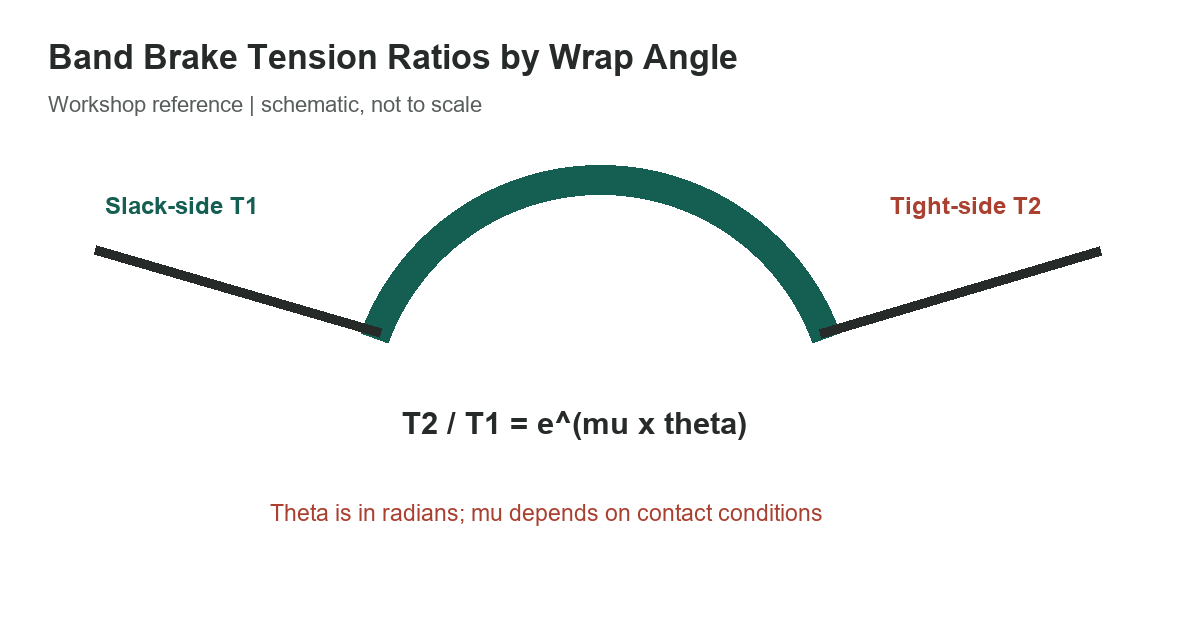
Ideal tension-ratio examples
The table calculates T₂/T₁ = e^(μθ), where T₁ is the slack-side tension, T₂ is the tight-side tension, μ is a coefficient of friction, and θ is the contact angle in radians. The decimal ratios are rounded to three places.
[gs_table id=”10933″]
Convert the wrap angle first
The exponential equation requires radians. Convert degrees using θ = degrees x π/180. A 180-degree wrap is π radians, and a full 360-degree wrap is 2π radians. Entering degrees directly produces an invalid result.
For example, at an assumed μ of 0.30 and a 180-degree wrap, the ideal ratio is e^(0.30π), approximately 2.566. At a 90-degree wrap the same assumed coefficient gives about 1.602. These values describe the model’s tension ratio at impending slip, not an absolute force; multiply by a properly determined slack-side tension only when the model’s assumptions and the brake geometry are applicable.
Friction is a system property
The coefficient is not a fixed property of one lining material in isolation. It depends on the contacting pair and can change with temperature, wear, speed, moisture, contamination, pressure and surface condition. The values 0.2, 0.3 and 0.4 in this chart are selected calculation inputs. They are not recommendations for a particular lining or a substitute for supplier test data.
A real band brake also depends on band width and strength, drum radius, lining pressure limits, anchor and lever geometry, direction of rotation, thermal capacity, wear, adjustment and structural details. Jönköping University’s mechanics treatment shows that torque follows the tension difference multiplied by drum radius, while brake layout changes how the two end tensions act through the lever.
For a simple ideal comparison, the model also implies braking torque proportional to the difference between tight-side and slack-side tension times drum radius. That relationship is useful for understanding the mechanism, but it still needs the actual end forces, rotation direction and brake geometry. The ratio by itself has no units and cannot tell you the force, torque or stopping performance of a particular assembly.
The MIT design notes derive the capstan relation from a small band or cable element and show its use in a band-brake example. That derivation helps explain why the exponential term appears; it does not remove the need to check band stress, drum loading, contact pressure and lever moments for the actual brake.
Do not size a brake from this ratio
The ideal capstan relation assumes a flexible member, a defined wrap angle and a uniform friction coefficient at impending sliding. It does not determine allowable band stress, maximum lining pressure, stopping distance, heat dissipation, fatigue life, fail-safe behavior or regulatory compliance. Some differential band-brake arrangements can become self-locking as geometry and friction change.
Use the brake manufacturer’s rating and design documentation for equipment selection or repair. Do not alter a vehicle, hoist, lift, machine guard, emergency brake or other safety-critical system based on this chart. Brakes must be evaluated for the required load, speed, duty cycle, direction, environment and applicable safety standards by a qualified designer.
This chart is most useful for understanding sensitivity: increasing μ or wrap angle raises the ideal ratio exponentially. A larger calculated factor can also make a system more sensitive to uncertain friction and geometry. Confirm the contact conditions and use a complete brake analysis before making any engineering decision.
Sources
Jönköping University’s Applied Mechanics chapter on brakes and clutches and MIT’s capstan and band-brake notes derive and apply the tension relationship. The tabulated factors are independent calculations from the ideal equation, not measured brake performance.