Circle calculations depend on a correctly measured radius or diameter. Sector calculations also depend on the angle unit: the compact formulas s = rθ and A = r²θ/2 require θ in radians. The reference below keeps that requirement visible so a degree value is not accidentally inserted into a radian formula.
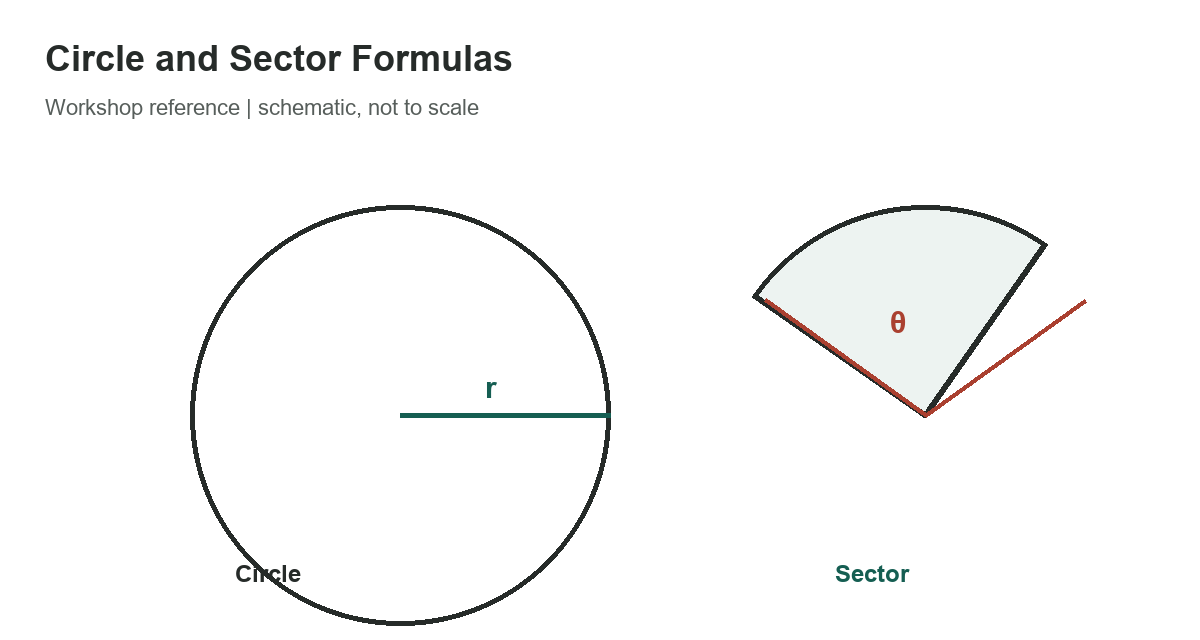
Circle and sector formulas
Use consistent length units throughout. If a radius is in millimetres, circumference and arc length are in millimetres, while area is in square millimetres. The constant π is dimensionless. Keep more digits during calculation and round the final result to match the measurement precision.
[gs_table id=”10837″]
Area and circumference
For radius r, circle area is A = πr² and circumference is C = 2πr. If the measured dimension is diameter d, use r = d/2, giving A = πd²/4 and C = πd. For a 50 mm diameter, area is π × 25², about 1,963.5 mm²; circumference is π × 50, about 157.1 mm. Those are geometric results, not estimates of material weight or cutting allowance.
Check whether the drawing gives a radius, diameter, bore size or outside diameter. Measuring a curved edge at an angle can produce a chord instead of a diameter. For a physical circle, measure across the center in more than one direction and note any ovality. For a drawing, identify the dimension datum and any stated tolerance.
Arc length and sector area
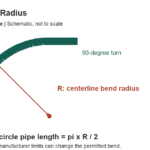
A sector is the portion of a circle enclosed by two radii and the intervening arc. With central angle θ in radians, arc length is s = rθ and sector area is A = r²θ/2. A full turn is 2π radians, so a full circle returns circumference 2πr and area πr². A half-turn is π radians and a quarter-turn is π/2 radians.
If an angle is given in degrees, convert it first: θ radians = θ degrees × π/180. For a 60-degree sector with radius 35 mm, θ = π/3 radians. Arc length is 35π/3, about 36.65 mm. Sector area is 35²π/6, about 641.4 mm². The same angle can be entered as 60π/180; using 60 directly in the radian formula would make the answer 180/π times too large.
Check the geometry before calculating
Use the sector’s central angle, not an angle measured at a point on the circumference. Confirm whether the requested arc is the minor arc or the longer major arc. For a major sector, the angle is greater than π radians and less than 2π radians. If a drawing gives a chord and angle but not radius, derive or measure the missing value carefully before applying the formula.
These identities assume a planar circle and a true circular arc. They do not include kerf, stock allowance, material thickness, a beveled edge or a noncircular approximation. For irregular outlines, split the geometry into appropriate pieces or use measured coordinates. For polygon area, keep the shape regular before applying an apothem formula, and see the bolt measurement chart for an example of dimensions defined from specific datums.
A quick dimensional check can catch common mistakes. Circumference must be a little more than three times diameter because π is about 3.14159. Circle area scales with the square of the radius: doubling the radius multiplies the area by four, not two. Arc length scales linearly with radius and with the central angle when that angle is in radians. These checks are useful for spotting a misplaced decimal or a degree/radian mix-up.
When angles come from a drawing, confirm whether the dimension is the included central angle or an exterior/reference angle. For repeated sectors, check whether the angle is one sector or the full pattern. Convert fractions and mixed dimensions before calculating, but preserve the original drawing value in your notes. In fabrication, compare calculated results with a physical template or a second independent calculation when the geometry controls a safety-critical fit.
For more practical references, browse the size-chart library and the pipe-size and unit reference.
Sources
OpenStax presents circle-sector area and arc-length relationships and distinguishes angle units. The formulas in this reference are standard geometric identities; worked values are recalculated from the stated dimensions.