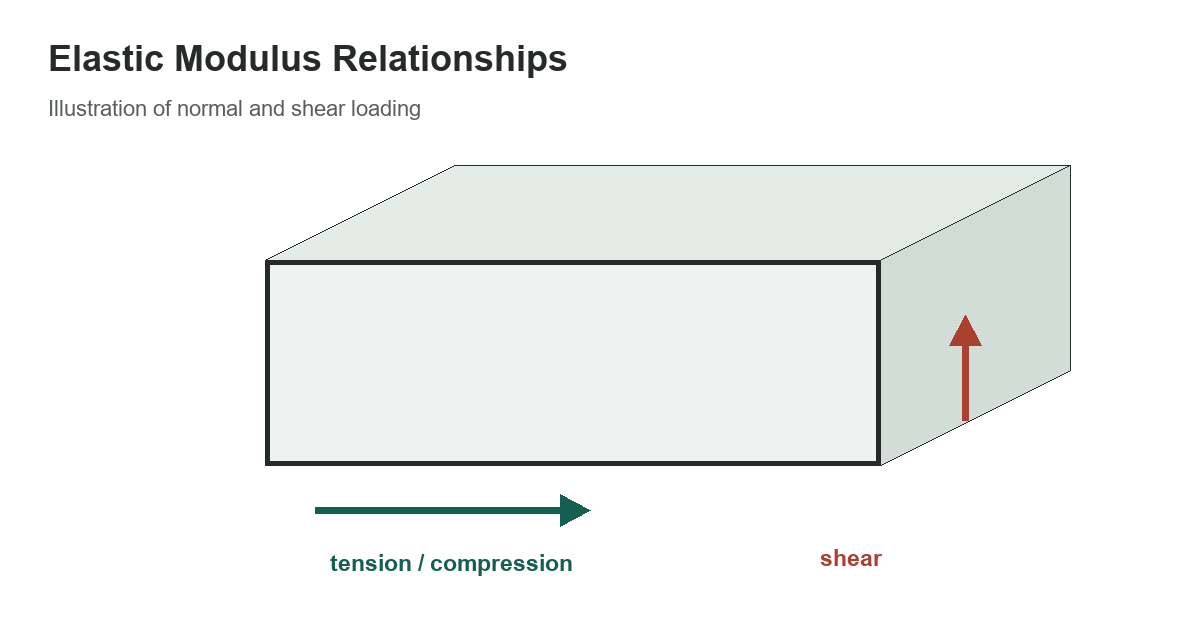
Elastic-property charts can be confusing because several moduli describe different kinds of deformation. Young’s modulus concerns axial tension or compression, the shear modulus describes shape change, the bulk modulus describes volume change under pressure, and Poisson’s ratio relates lateral strain to axial strain. This compact equation guide clarifies how the terms fit together.
Definitions and isotropic relationships
Stress has units of pressure, while strain is a ratio and has no units. Each elastic modulus therefore has the same units as stress, usually pascals or gigapascals. Poisson’s ratio is dimensionless. The table gives the basic definitions and common relationships for a linear-elastic isotropic material.
[gs_table id=”11038″]
Use two independent constants
For an isotropic linear-elastic material, only two of the common constants E, G, K and nu are independent. If Young’s modulus and Poisson’s ratio are known, calculate G = E / [2(1 + nu)] and K = E / [3(1 – 2nu)]. Conversely, with G and K, E = 9KG / (3K + G). Keep all moduli in consistent units before substituting.
As a simple check, let E = 200 GPa and nu = 0.30 for an illustrative isotropic material. Then G = 200 / [2(1.30)] = 76.9 GPa and K = 200 / [3(0.40)] = 166.7 GPa. These are calculated values from assumptions, not measured properties of a named grade. Do not use the example as a design allowable.
Choose the modulus that matches the loading
For a slender bar in uniaxial loading, Young’s modulus connects axial stress and axial strain while deformation remains in the linear range. For a component twisted or sheared, use shear modulus with the matching shear-stress and shear-strain definition. A pressure vessel or compressible volume problem may call for bulk modulus under hydrostatic pressure.
Poisson’s ratio is the negative ratio of transverse strain to axial strain in uniaxial loading. The negative sign accounts for a typical material becoming narrower when stretched. Do not confuse this with a percentage volume change or with a direct measure of stiffness on its own.
Know when the formulas do not apply
The simple relationships assume an isotropic, homogeneous, linear-elastic continuum. Many engineering materials are direction-dependent, layered, porous, reinforced or nonlinear. Wood, composites, rolled products, printed materials and single crystals can have different properties along different directions. For those materials, a single E or nu may not describe every loading direction.
Even isotropic metals can have property values that vary with grade, heat treatment, temperature, strain rate, processing and test method. Elastic modulus is not yield strength, ultimate tensile strength, fatigue strength or a safe stress limit. Once a material leaves its linear-elastic region, these simple proportional relationships cannot predict permanent deformation or failure.
Check units and source conditions
One pascal equals one newton per square meter, and one gigapascal equals one billion pascals. A modulus reported in million psi must be converted before combining it with a value in GPa. Poisson’s ratio has no units, so it should not be multiplied by a unit conversion factor.
When an engineering datasheet provides multiple moduli, check whether values are measured directly or calculated from other constants. Rounded published values may not satisfy the identities exactly. Use the source’s method, temperature and orientation, and do not combine constants from different grades or test conditions as if they described one specimen.
For a safety-critical part, obtain material-specific test data and have the design checked by a qualified engineer. The equations here explain elastic relationships; they do not establish allowable loads, buckling capacity, joint strength or fatigue life.
Related references: named engineering-plastic properties, constant-acceleration equations, and stainless tube pressure limits.
Sources and assumptions
OpenStax defines the stress-strain moduli and their units; MIT OpenCourseWare gives the generalized Hooke’s law and isotropic relationships. Cross-property equations here assume a homogeneous, isotropic, linear-elastic material. OpenStax: stress, strain and elastic modulus; MIT OpenCourseWare: isotropic elastic constants.