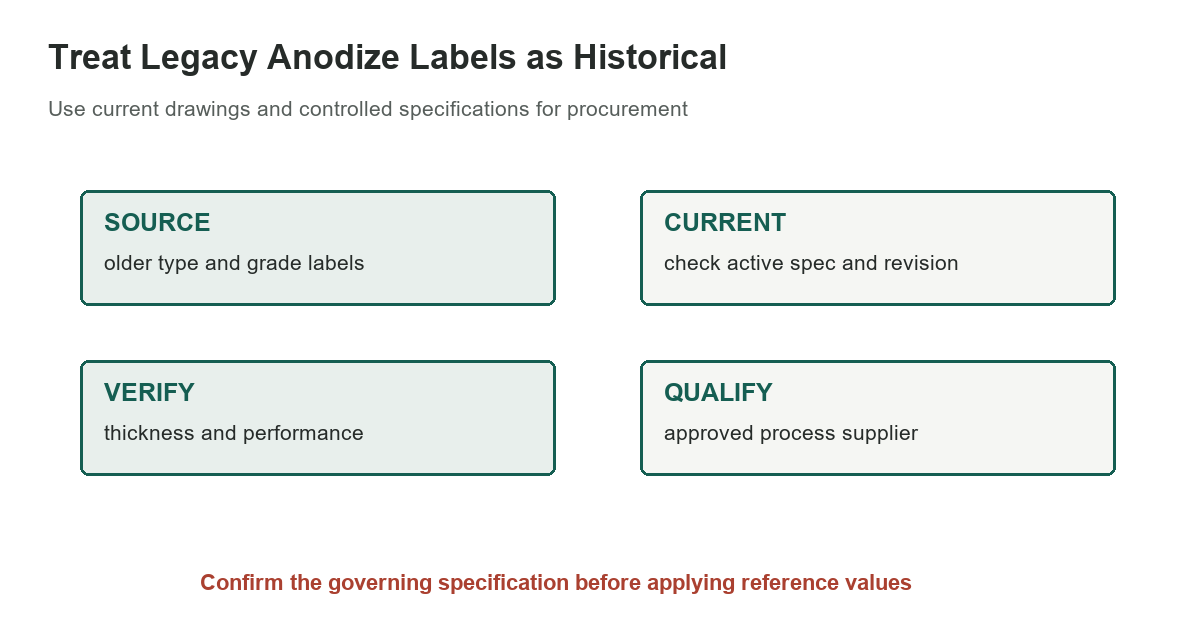
An older anodizing chart can help decode terminology found on a legacy drawing, repair record, or supplier document. It should not be used by itself to order a coating. The source uses Type I and Type II labels alongside Classes A, C, and D and several grade descriptions; current specifications organize requirements differently.
[gs_table id=”11301″]
Read the historical entries literally
The selected chart identifies light Type I and heavy Type II coatings. It assigns typical thicknesses to some classes and describes colors and historical process notes. Grade rows list post-treatment descriptions but do not provide a separate typical thickness. A blank thickness cell should not be filled by inference from the class above or below it.
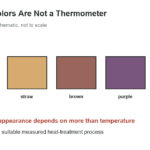
HAE and Dow #17 are source-era descriptors, not generic quality ratings. Color can vary with alloy, surface preparation, process, and viewing conditions. Do not use appearance alone to accept a coating or infer corrosion resistance, wear performance, or electrical properties.
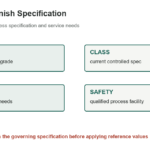
Do not treat this as a modern crosswalk
The active DLA record for MIL-PRF-8625 describes anodic coatings for aluminum and aluminum alloy and includes six types and two classes. That structure is not equivalent to the legacy A/C/D class and 1-5 grade labels shown here. A matching Roman numeral does not prove that an old chart row meets a current type, class, thickness, seal, or performance requirement.
When a drawing cites a historic specification, confirm the exact revision, amendment, and contract requirements with the design authority or qualified coating supplier. Ask for an approved cross-reference only when the responsible engineering organization accepts it; do not silently substitute a newer label based on a chart.
Specify performance, not color alone
A coating callout may control thickness, sealing, corrosion resistance, wear, electrical behavior, fatigue sensitivity, masking, and dimensional limits. The correct process depends on alloy, part geometry, service environment, and downstream paint, adhesive, or assembly needs. A generic statement such as heavy anodize is not enough to establish all acceptance requirements.
Keep the part drawing, material designation, required finish, inspection method, and coating specification together. Verify that critical dimensions remain within tolerance after finishing and that mating surfaces or threads are handled as the drawing directs. Request supplier certifications or inspection records when required by the contract.
Recognize process-safety implications
The historical source mentions a dichromate post-treatment. Certain chromium compounds can involve hexavalent-chromium hazards, and OSHA maintains a specific workplace standard and exposure guidance. This article intentionally gives no bath recipe, concentration, voltage, time, or process sequence. Anodizing and sealing belong with a qualified facility operating under applicable safety and environmental controls.
Do not attempt to recreate a legacy process from a handbook description. A coating vendor must identify the proposed chemistry, worker-protection controls, waste handling, and applicable regulations. If a specification or drawing calls for a restricted substance, resolve the requirement through the responsible engineer and compliance team.
Separate anodizing from other finishes
Anodizing is an electrochemically formed oxide layer on aluminum, whereas paints and polymer coatings add a different material system. Their thickness, adhesion, repair, masking, and inspection requirements are not interchangeable. The correct choice depends on the component’s function and the coating specification, not only on the finish color.
For related surface-finish context, the site’s aluminum polishing guide covers cleaning and appearance, while its running-board material guide discusses component substrates. The sheet-metal gauge chart covers substrate thickness, not anodic-film requirements.
Resolve old callouts before production
If a legacy part must be reproduced, first establish whether the original standard remains contractually applicable, has been superseded, or requires customer approval. Compare the complete specification rather than matching one thickness number. Document the approved finish, required test methods, acceptance limits, and supplier qualification before releasing work.
A class/grade lookup can point to the right question, but it cannot certify a coating. Keep the governing drawing and controlled standard as the authority, and obtain review from a qualified materials or corrosion engineer when performance or compliance is uncertain.
Sources: DLA ASSIST current MIL-PRF-8625 record, OSHA hexavalent chromium overview, Original handbook extraction