Power-finishing brushes differ in wire form, trim length, fill material and contact width. Those features affect how the brush conforms to a surface, removes burrs or prepares a part for a later finish. The selected examples below summarize several constructions described in a historical reference; they are not a buying list or a current speed chart.
[gs_table id=”11213″]
Match construction to the work
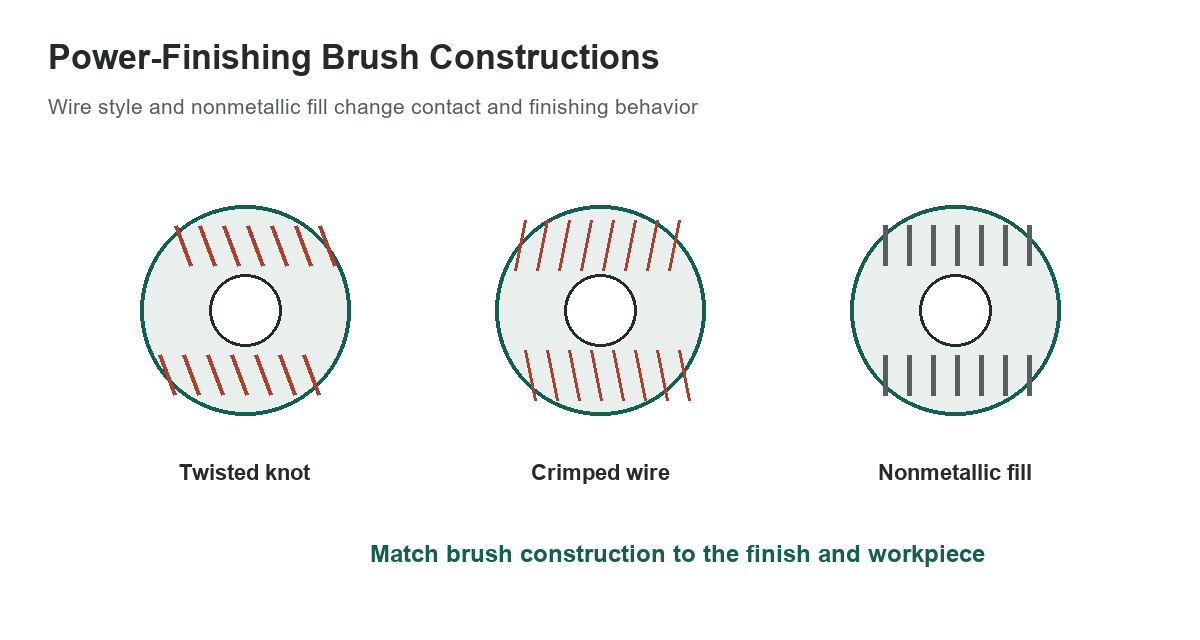
Short-trim dense-wire brushes concentrate the wire tips and can provide an aggressive action on localized features such as gear teeth and sprockets. Twisted-knot wire bundles are stiffer and are used for demanding cleaning tasks such as weld cleaning. Crimped wire is more flexible and can follow irregular surfaces for general deburring or cleaning. Nonmetallic fills support finishing applications where a softer contact or abrasive-filled material is appropriate.
These descriptions are starting points only. Wire material, diameter, knot configuration, brush diameter, trim length, backing and workpiece material can change performance. Choose a brush that is compatible with the base material and the contamination-control requirements. Keep dedicated brushes for materials such as stainless steel or aluminum when the process requires avoiding cross-contamination.
Brush face width and access also matter. A narrow brush can concentrate contact on a weld or edge, while a wide-face brush covers more area but may bridge contours or create uneven pressure. Choose a shape that contacts the intended surface without striking adjacent features. Check that the work can be held securely and that the brush can be controlled throughout the path; difficult access is not a reason to remove a guard or exceed the product rating.
Interpret historical speed examples correctly
The source-speed column records selected values from the old handbook pages. Surface feet per minute is a brush peripheral-speed measure, not spindle RPM. It also is not a maximum safe speed label. A historical operating example must never override the speed marked on the exact brush or the limits of the machine, guard, arbor and application.
To relate surface speed and revolutions per minute, the nominal relationship for a circular brush is sfpm = pi × diameter in feet × rpm. In practice, do not calculate a target speed from that equation and assume it is safe. The brush manufacturer’s marked maximum speed is the hard ceiling, and the machine must also be appropriate for the attachment. Optimum working speed may be lower and depends on the task and material.
Use the manufacturer’s current instructions
Before use, inspect the brush and mounting for damage, secure the work, install the required guard and wear the protective equipment specified by the tool and brush manufacturers. Never exceed the marked maximum speed. Do not run a brush with a damaged hub, missing wires, loose attachment or abnormal vibration. Apply only the contact pressure and approach recommended for that brush style.
Brush performance depends on how it is used as well as its construction. If a brush cuts too slowly, behaves too aggressively or produces an inconsistent finish, diagnose that specific symptom instead of raising speed indiscriminately. The separate power-brush troubleshooting guide addresses symptom-to-adjustment checks. The grit-size conversion chart can help compare abrasive grades, and the abrasive belt selection guide covers a different contact process.
Plan for the finish and workpiece
Decide whether the job is weld cleaning, burr removal, coating removal, surface preparation or final finishing. Consider the shape and accessibility of the part, the amount of material to remove, the finish requirement and whether loose wire or abrasive contamination is acceptable. Make a controlled test on representative material when the finish is important, then inspect the result and adjust the brush choice or process within the maker’s instructions.
For nonmetallic brushes, check compatibility with the workpiece, compound and any slurry. Avoid excessive pressure, which can create heat and shorten brush life. For metallic brushes, keep the work path controlled and do not use force to compensate for the wrong wire style or an unsuitable tool.
Takeaway
Construction narrows the brush options, but it does not determine a universal speed or guarantee a finish. Use these historical examples to understand the differences between brush families. Select the exact current product using its manufacturer data, confirm the machine and guard limits, and follow the marked speed and operating instructions every time.
Historical construction, application and speed examples: Machinery’s Handbook, 31st edition, “Characteristics and Applications of Brushes Used in Power Finishing”. For current product and safety decisions, consult the exact brush maker’s rating and Norton Abrasives’ power wire-brush guidance or the Osborn 2025 product catalog.