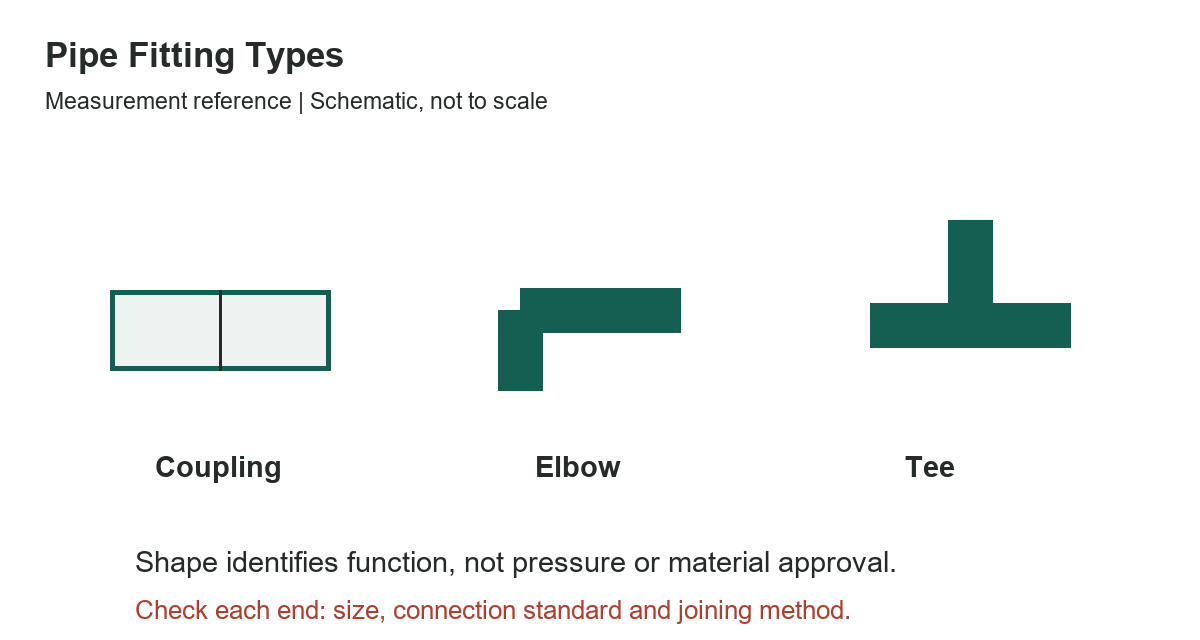
A pipe fitting’s shape tells you its basic job, but not whether it belongs in your system. A coupling joins ends, an elbow changes direction, and a tee adds a branch. Before selecting any of them, identify the material, service, size system, connection details, and pressure and temperature requirements.
Use the chart as an identification aid when preparing a parts list or discussing a replacement with a supplier. It is not a universal compatibility chart. Two fittings can look nearly identical and still differ in dimensions, joining method, permitted application, or thread standard.
Common fitting families and what to check
The categories below describe function rather than a particular brand or material. Some products combine functions: a reducing tee creates a branch and changes size, while an adapter elbow changes direction and connection type. Check the specification of each end instead of identifying the part from its overall silhouette alone.
| Coupling | Join aligned pipe ends | Size, end preparation, joining system |
|---|---|---|
| Union | Provide a separable joint | Seat, seal, orientation, access |
| Elbow | Change direction | Angle, sweep, material, service |
| Tee or wye | Create a branch | Branch geometry and permitted flow direction |
| Cap | Close a pipe or fitting end | Connection and pressure/service approval |
| Plug | Close a compatible opening | Thread or other specified seat |
| Reducer or adapter | Change size or connection type | Both end specifications, not just one label |
| Flange | Make a bolted connection | Pattern, facing, gasket, hardware, rating |
8 rows
Scroll horizontally to view all columns.
Coupling versus union
A coupling joins aligned pipe ends. Its installation might use threads, solvent-weld sockets, a mechanical connection, or another system-specific method. The word coupling does not mean the joint can later be opened without cutting or moving the piping.
A union provides a separable joint through its designed assembly. That can be useful around equipment that needs removal, but the sealing arrangement and permitted use remain product-specific. Do not mix halves, nuts, or seals from superficially similar unions unless the manufacturer expressly approves the combination.
Elbows, tees, and wyes
An elbow changes direction. Its angle, sweep, end connections, and installation space all matter. A compact elbow that fits on a sketch may not provide the geometry or access required by the actual piping system. Account for assembly space as well as the finished shape.
Tees and wyes create branches with different geometries. Drainage fittings and pressure fittings are not interchangeable merely because their nominal sizes match. Where flow direction and branch orientation matter, use the appropriate system design and installation requirements. Do not select a drainage junction as though it were simply a cheaper pressure tee.
Caps, plugs, reducers, and adapters
A cap closes a compatible pipe or fitting end; a plug closes an appropriate opening. Identify the exact mating arrangement rather than assuming cap means unthreaded or plug means a particular thread. Temporary test closures also need their own instructions and limits.
A reducer changes size, while an adapter changes connection type or system. A fitting may do both. Write down both ends in a consistent order on the parts list. For example, a threaded end and a socket end need separate descriptions; one nominal size on a shopping note may leave the supplier guessing.
Flanges require a complete matching assembly
A flange is more than a ring of bolt holes. Check its connection standard, pattern, facing, gasket requirements, hardware, and rated service. A matching hole pattern by itself does not establish a suitable sealing surface or pressure capability.
Leave enough room for the specified assembly and maintenance access. Do not pull misaligned piping into position by tightening flange bolts unless the controlling instructions expressly address that condition. Resolve the layout rather than using the joint as a substitute for correct support and alignment.
Read size labels and connection standards carefully
Nominal pipe size is not always the measured bore or outside diameter. Record the size system and product dimensions. Threaded fittings also need the exact thread designation; similar-looking threads should not be forced together to find out whether they seal.
For plastic systems, identify the approved joining materials and procedures. For mixed materials, check the specified transition fitting and compatibility requirements. Neither color nor a familiar shape proves that a product is suitable for drinking water, hot water, chemicals, or another intended service.
A water rating is not compressed-air approval
Do not build a compressed-air line from ordinary PVC, CPVC, or ABS plumbing parts because their water-pressure labels appear high enough. Charlotte Pipe explicitly warns against compressed-air or gas service and testing in those products. Spears also warns against compressed-air applications for its thermoplastic products.
Compressed gas stores energy differently from a water-filled system. Use a piping system expressly approved for the intended compressed-air application and follow its complete instructions. This fitting-identification guide does not authorize a pneumatic pressure test.
For dimensions, compare the pipe-size chart and PVC-size reference. For air-system context, see the garage air-compressor guide.
References
The Spears product and engineering sourcebook separates fitting families and system types. Consult Charlotte Pipe’s safety information and Spears’ material limitations before specifying plastic piping.