A classical V-belt’s printed length designation and its datum length are related but not identical. This selected historical table shows the inch values listed for standard designations and belt sections A/AX, B/BX, C/CX, and D. The source is ANSI/RMA IP-20 from 1988; ISO 4184:2025 is now the published international edition for classical and narrow V-belt lengths in the datum system.
[gs_table id=”11388″]
Read the section and designation together
The handbook footnote says to specify a belt by prefacing the standard length designation with the letter for its cross section, such as B90. A blank cell means that the selected historical table shows no entry for that section and designation; it is not a zero length or a recommendation to interpolate.
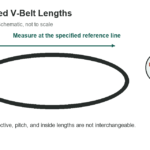
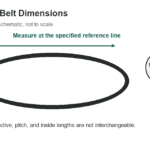
The datum-length column is a different quantity from the designation. For example, designation 60 appears with 61.3 in for A/AX and 61.8 in for B/BX in this legacy table. Do not convert a row number into millimetres, outside length, or inside length without confirming the measurement system and product family.
Treat the table as historical
ISO’s current listing identifies ISO 4184:2025 as the published edition and ISO 4184:1992 as withdrawn. The 2025 scope covers classical sections Y, Z, A, B, C, D, and E as well as narrow sections SPZ, SPA, SPB, and SPC. The handbook’s ANSI/RMA IP-20 values are therefore a historical reference, not the current international tolerance schedule.
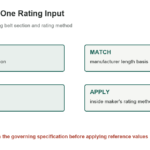
Gates’ belt-length guide distinguishes datum, effective, and inside length definitions and shows that conversions vary by section and standard. Check the belt’s exact section, manufacturer’s code, and current length basis before comparing it with a sheave or ordering a replacement.
Check compatibility beyond length
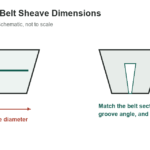
A matching length alone does not establish that two belts are interchangeable. Verify cross-section, construction, length basis, pulley groove, drive geometry, speed, power, and application. Confirm whether a belt is classical or narrow; similar-looking profiles can use different grooves and should not be mixed unless the manufacturer explicitly permits it.
The per-section deviations and set-matching limits shown here are historical context only; use the current standard and belt maker’s method to inspect or match a modern set. For a 360/CX belt, confirm the datum length in the current manufacturer’s catalog because this historical table does not provide a usable value for that combination.
Use related belt references
The site’s scooter drive-belt size chart covers a different belt family. The belt-drive garage-door opener guide discusses a separate product application, and the planned variable-speed V-belt length reference covers different profiles. Check each manufacturer’s current data before treating any of these lengths as equivalent.
A practical replacement check
Before ordering, photograph the belt markings and the full drive arrangement, then record the belt section, complete designation, length basis, and manufacturer or product family. Inspect the sheaves for wear, damage, contamination, and a groove profile that matches the belt. Confirm centre distance, adjustment range, alignment, and whether the drive uses a matched set. A replacement that shares a nominal number but differs in section or measurement basis may sit incorrectly in the groove and alter tension or power transmission.
Use the current belt maker’s catalog or selection tool to confirm the exact replacement and operating conditions. Follow its tensioning procedure and the equipment maker’s instructions; do not set tension from the historical deviation column in this chart. Isolate the machine before removing guards or checking a belt, and reinstall guards before operation. If the belt code is unreadable or the drive has been modified, have a qualified service technician identify the correct belt and inspect the sheaves. Record the selected part number and date for future maintenance.
Sources: Machinery’s Handbook, 31st edition, selected original page, ISO 4184:2025: Classical and narrow V-belt lengths in the datum system, Gates Preventive Maintenance Manual: belt length definitions