A converging nozzle can reach sonic speed at its throat when the downstream pressure is low enough relative to the upstream source pressure. The critical pressure ratio marks that threshold in a simplified, steady, adiabatic ideal-gas model. It is a dimensionless comparison, not a pressure limit for a compressor, tank, hose, or receiver. The selected values below are examples from a handbook table; use the equation and a property value that matches the gas and operating state.
[gs_table id=”11397″]
Use the ratio in the correct direction
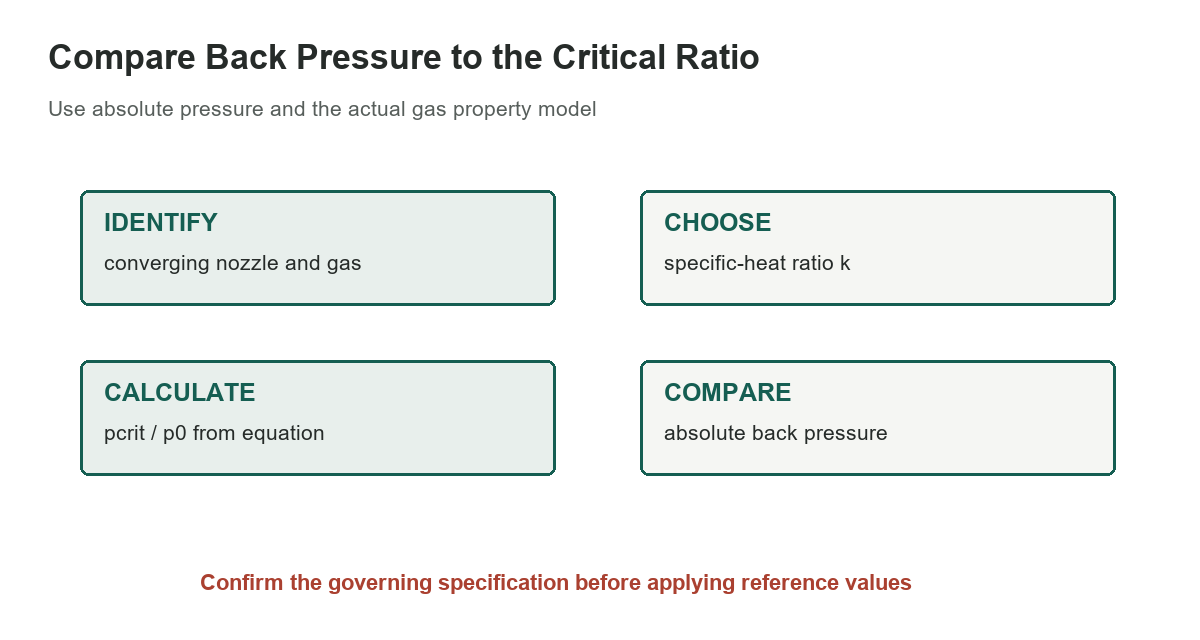
The handbook defines the critical ratio as critical nozzle or back pressure divided by source pressure: pcrit/p0. The printed relationship is pcrit/p0 = (2/(k+1))^(k/(k-1)), where k is the adiabatic exponent, commonly written gamma. Both pressures must be absolute. Do not divide source pressure by back pressure or compare a gauge-pressure reading directly with the table.
For air with k=1.4, the listed ratio is about 0.528. In an idealized example with a source at 100 psia, the critical back pressure is about 52.8 psia. A lower back-pressure ratio reaches the choked-flow condition; raising or lowering downstream pressure further does not increase ideal throat velocity above Mach 1. This ratio alone does not provide mass flow, which also depends on temperature, gas properties, area, and discharge behavior.
Why the gas entries differ
The six entries pair a selected k with a rounded ratio. The exponent changes the result: a lower k produces a larger critical back-pressure fraction in these examples. Real-gas properties vary with temperature, pressure, and composition, so a handbook gas name is not a substitute for checking the state-specific value. Mixtures and vapors may need a property package or a validated real-gas method rather than a single constant k.
The handbook’s adjacent flow equations make further assumptions about nozzle geometry and thermodynamic behavior. Losses, heat transfer, friction, a nonuniform inlet, changing composition, condensation, or two-phase flow can move the actual result away from the ideal calculation. A converging-diverging nozzle also has a different downstream expansion problem after the throat reaches sonic conditions.
Separate the threshold from equipment ratings
The critical ratio answers a flow-regime question for a modeled nozzle; it does not state what pressure a compressor, pipe, fitting, valve, or storage vessel may safely contain. Do not use it to set a regulator, relief valve, or operating limit. Those components require their own manufacturer ratings, adopted code requirements, and operating conditions.
For a garage air system, the site’s compressed-air pipe sizing chart concerns line capacity and pressure drop, while the air-compressor types guide and two-stage compressor overview discuss separate equipment choices. None is a nozzle flow calculation or pressure-vessel approval.
A short calculation check
First identify the upstream stagnation or source state and the downstream static pressure used by the model. Convert both to absolute pressure in the same units. Next choose k at the relevant state, calculate the dimensionless threshold, and compare pback/p0 with it. Keep extra precision during calculation, then round the displayed result consistently with the input data. State whether a value is calculated or copied from a reference table.
If the ratio is near the threshold, do not make a binary operating decision from a rounded three-decimal table entry. Recalculate with the full property value and evaluate the nozzle, fluid, instrumentation, and uncertainty with an engineer. For actual equipment, follow the manufacturer’s data and governing safety requirements.
When a simple model is not enough
Use a qualified compressible-flow method when the gas is near its critical region, highly non-ideal, reacting, wet, or partly condensed; when there are significant pressure losses before the nozzle; or when the nozzle has complex geometry. A suitable analysis may require state-dependent properties, a discharge coefficient, and a validated treatment of heat transfer and flow regime. The critical ratio is one useful checkpoint in that analysis, not a complete design method.
Sources: Machinery’s Handbook, 31st edition, selected original page, NASA Technical Memorandum 2019-220164: critical pressure and temperature ratios